Ace Alliance Riga
Ace Alliance Riga
Don’t miss the Early Bird Offer! | August 6-7, 2026
Get Your Pass!
Table Of Content :

Blask x Ace Alliance Report: World Cup 2026 and European iGaming Demand

trust
Ace Alliance: Delivering Trust Through Expertise
From exclusive events and interviews to real-time market trends, Ace Alliance brings you unbiased, well-informed, and data-driven content. Our editorial team adheres to strict editorial standards, ensuring that the information you receive is not only relevant but also trustworthy.

Built by market experts hosting events since 2023, with our first event in Riga, Latvia gathering over 300 top level iGaming industry executives, Ace Alliance is able to provide you with reliable information from direct interaction with experts and leaders in the sector.
Darko Ilievski
Lead Editor
Updated:
Reading Time: 5 minutes
Blask x Ace Alliance World Cup 2026 iGaming demand report banner.

World Cup 2026 is the largest edition of the tournament to date: 48 teams, 104 matches and 39 days of fixtures. For European operators, affiliates and suppliers, this creates one of the clearest test cases for World Cup 2026 iGaming demand across regulated markets.

Five of Europe’s major iGaming markets will have national-team representation at the tournament, with the UK market represented through England and Scotland, alongside Germany, France, Spain and the Netherlands. Italy has missed out for the third consecutive World Cup. For an industry that treats the tournament as one of the biggest acquisition events on the calendar, that is a meaningful gap in the European demand pool.

Report

Key Takeaway: What Blask Data Shows About World Cup 2026 iGaming Demand

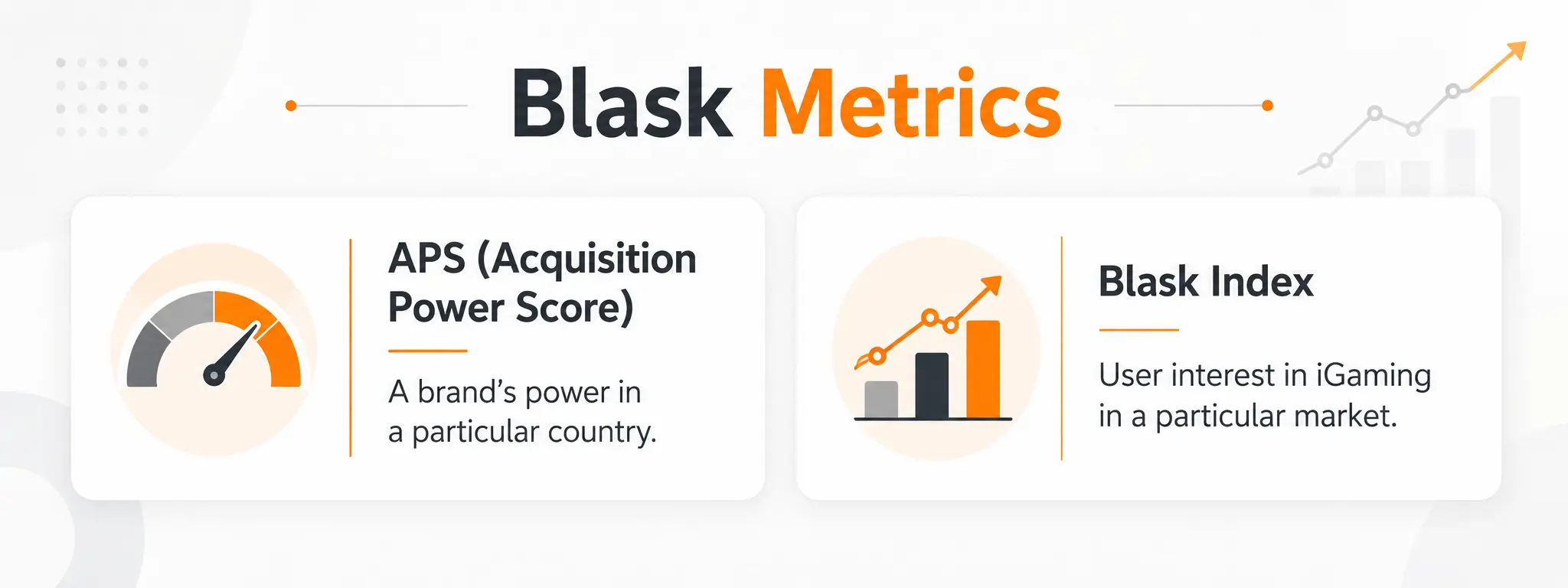
Blask compared APS (Acquisition Power Score), CEB (Competitive Earning Baseline), and Blask Index data across the 2018 and 2022 World Cup cycles, then used the same framework to assess the market conditions around WC 2026. Euro 2024 is also used as a direct comparison point because it ran in the same June–July window.

The report builds on the previous Blask x Ace Alliance World Cup iGaming Index, which showed that football performance and iGaming demand do not always move in the same direction. It also sits within a wider discussion around data transparency in iGaming, where shared market signals can help operators, affiliates and suppliers understand demand beyond headline results.

The data points to four main patterns:

  • Football culture can outweigh results: iGaming demand can rise even when national teams underperform or fail to qualify.

  • Tournament demand can outlast the final: some markets keep a higher post-World Cup demand floor when new players remain active.

  • Market scale changes the opportunity: smaller markets may show sharper percentage uplift, while larger markets deliver bigger player cohorts.

  • Regulation decides conversion: licensed operators only capture tournament demand when product access, advertising rules and enforcement allow it.

Football Culture Shapes European iGaming Demand More Than World Cup Results

European iGaming demand does not move only with how far a national team goes. In several markets, APS trends suggest that football culture, betting habits and tournament visibility can matter more than the final result. 

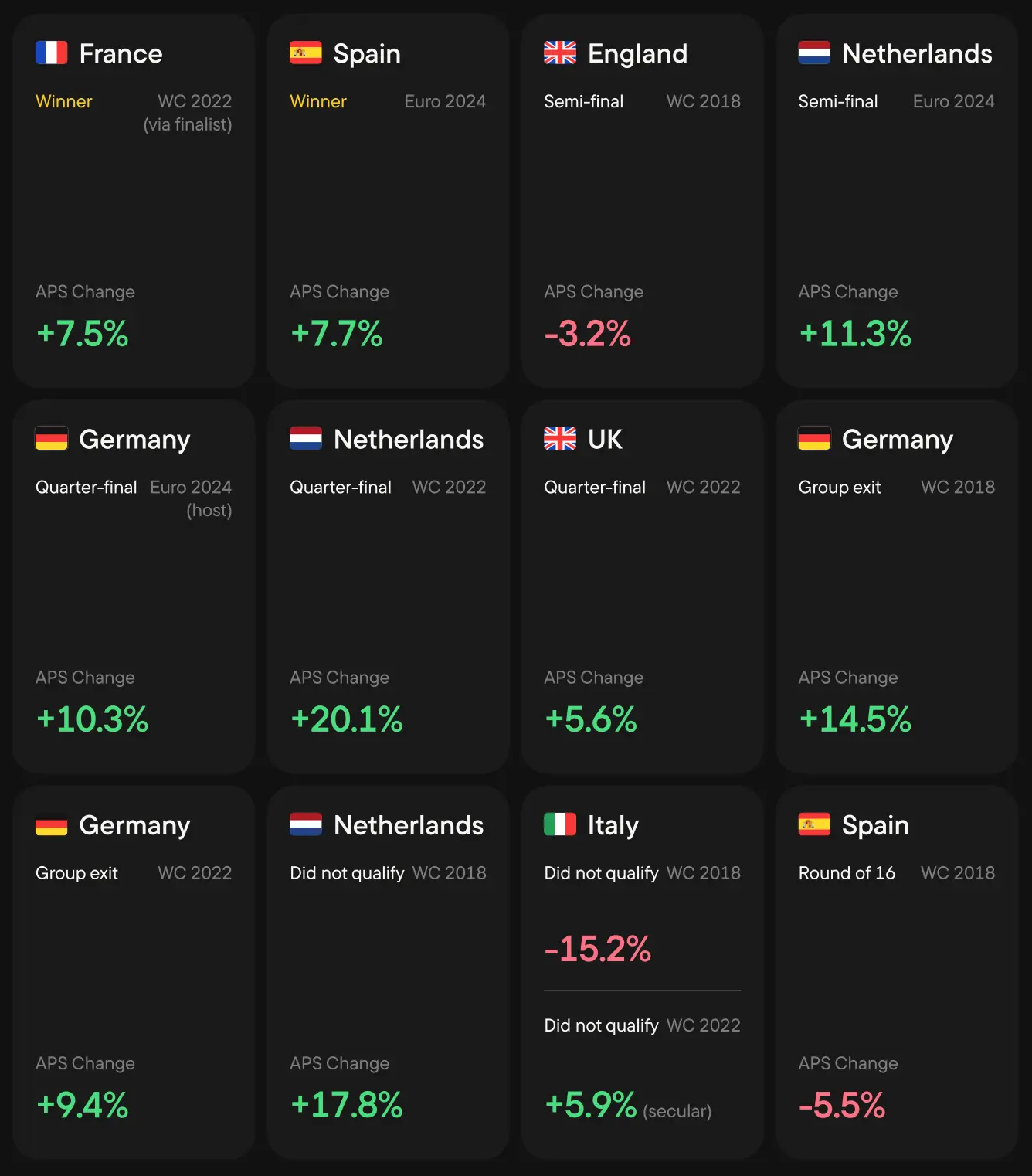
Germany posted positive APS at every major tournament in the dataset, despite mixed sporting outcomes:

APS change cards for European teams across World Cup and Euro tournaments.

That pattern suggests that tournament demand in Germany is not purely dependent on national-team performance. The event itself creates enough football attention to lift acquisition conditions.

The Netherlands shows the same point from another angle. It gained +17.8% APS at WC 2018 without even qualifying, then delivered the strongest result in the dataset at WC 2022, with +20.1% APS during its first World Cup as a licensed market.

Italy is the opposite case. Without a team on the pitch, Italian player engagement dropped below seasonal norms at WC 2018, with -15.2% APS. Even when Italy did participate but exited early at Euro 2024, the Blask Index still went negative, at -2.7%.

In other words, missing the tournament is not fatal for every market. In countries with strong football culture and active betting habits, the World Cup can still lift demand. But when a participating team exits early, the drop-off can be sharper because national attention has already been activated and then cut short.

World Cup Demand Can Raise the Post-Tournament Market Floor

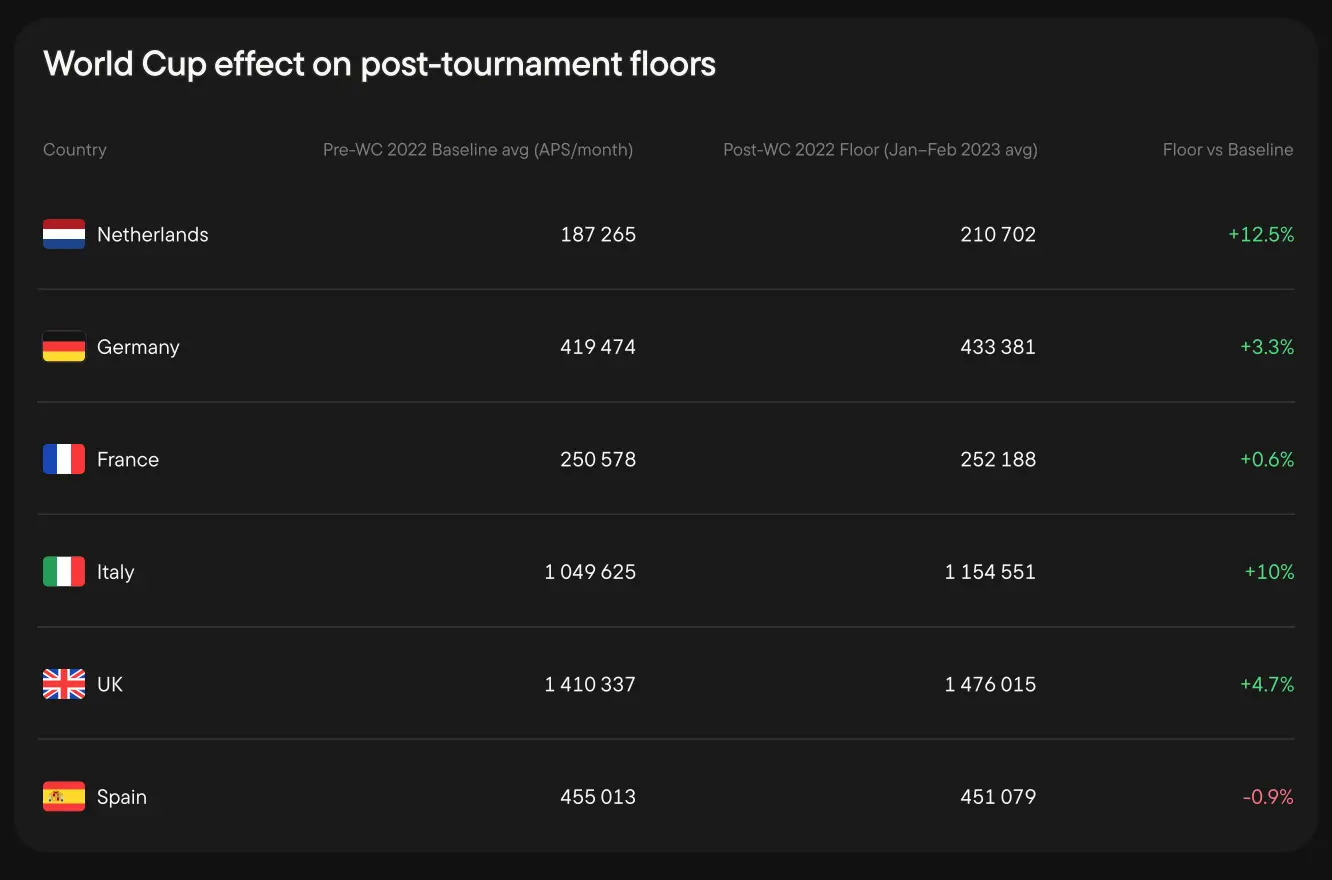
The tournament effect does not always disappear once the final whistle blows. Blask compared average APS before WC 2022 with the level recorded one to two months after the tournament. In most markets, the post-tournament demand floor remained above its previous baseline.

The clearest example is the Netherlands, where APS stayed +12.5% above baseline after WC 2022. The logic is simple: the tournament gives players a culturally relevant reason to place a first bet, a share of those users remain active through retention mechanics, and the market enters the next period with a higher demand base.

Post-World Cup 2022 APS floor table for major European iGaming markets.

France was the exception. Its post-tournament floor barely moved, at +0.6%. That reflects the structure of the French market, where licensed online gambling is limited to sports betting and does not include online casino. Without casino, slots or crash-game cross-sell, tournament demand has fewer paths into a broader long-term revenue base.

World Cup iGaming Demand Depends on Market Scale, Not Just Uplift

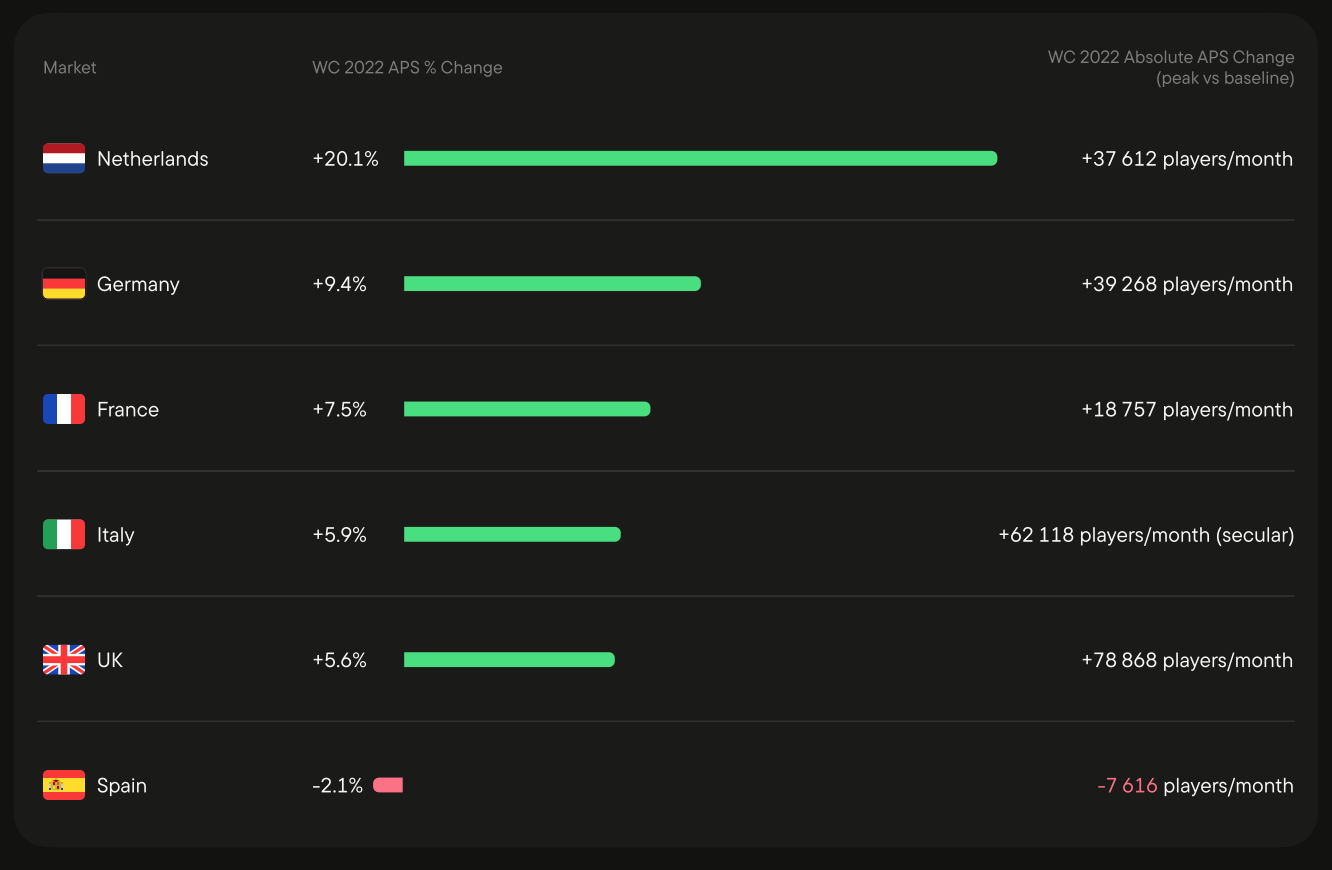
The biggest relative gain does not always produce the largest player cohort. At WC 2022, the Netherlands posted +20.1% APS, but that translated into 37,600 new players a month because the underlying market is smaller. The UK gained a more modest +5.6%, but that still produced 78,900 new players a month, the largest absolute figure in the dataset.

WC 2022 APS uplift chart comparing percentage and player growth by market.

That difference matters when assessing World Cup iGaming demand across Europe. Smaller or mid-sized markets can show sharper percentage movements, while larger markets can deliver greater absolute player growth even when the uplift rate is lower. This also mirrors wider differences in iGaming campaign strategies ahead of the World Cup window, where market structure, funnel behaviour and conversion economics can vary sharply between regions. 

This splits markets into two strategic groups:

Regulation Shapes How World Cup iGaming Demand Converts

Demand may rise during major football tournaments, but how much of that activity licensed operators can capture depends heavily on regulation.

France Shows the Limits of Sports-Only Regulation

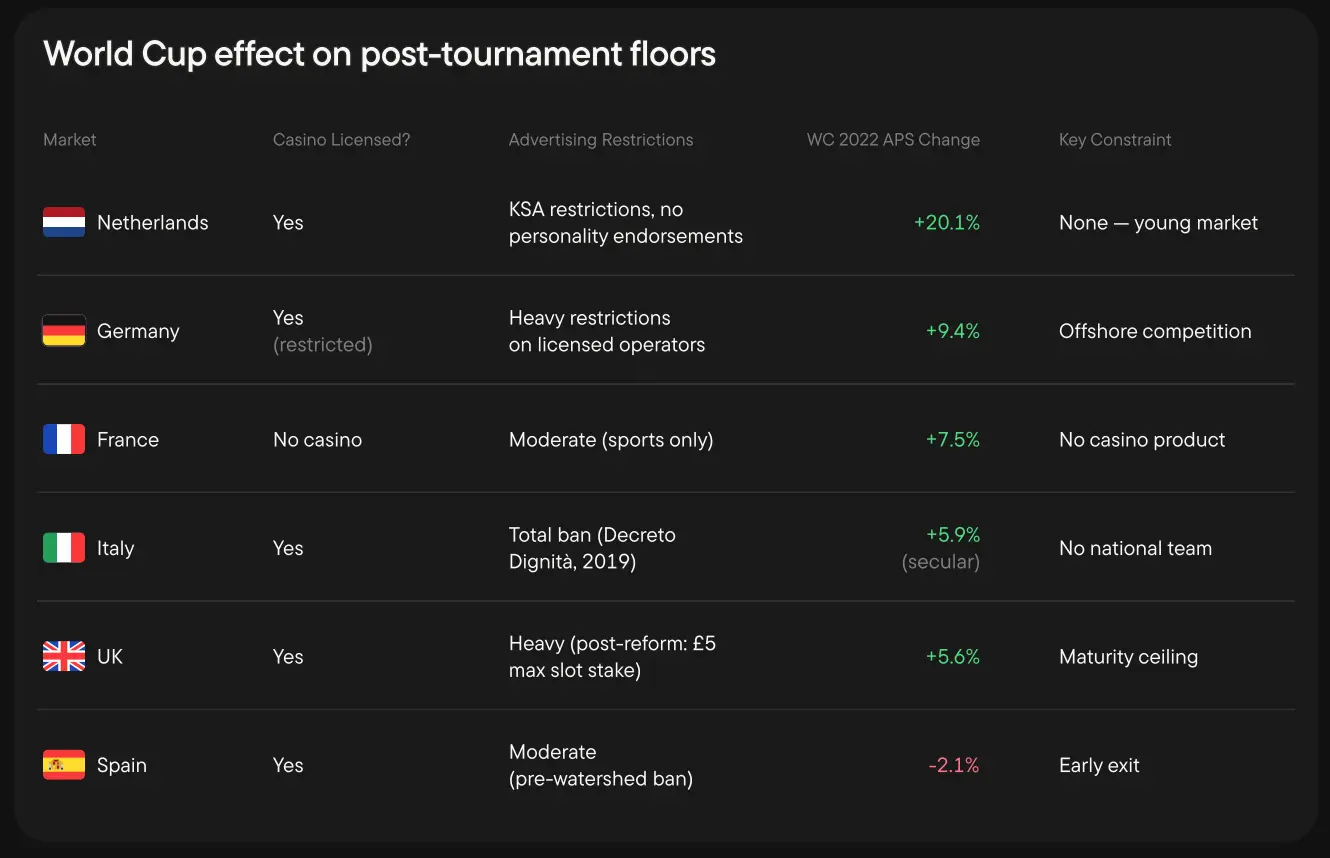
France is the clearest example of a structural ceiling. The market does not have a licensed online casino product, with legal online gambling limited to sports betting, poker and horse racing. That means operators cannot convert World Cup betting demand into casino, slots, or crash-game cross-sell. The issue is especially relevant heading into 2026, as France’s regulator has already urged restraint around World Cup betting advertising. According to Blask data, France’s APS has barely moved since WC 2018, showing how limited product availability can restrict long-term demand conversion.

Italy Shows How Advertising Restrictions Limit Activation

Italy faces a different problem. Under the Dignity Decree, gambling advertising is heavily restricted, limiting operators’ ability to activate demand even during matches involving the world’s biggest national teams. Italy remains one of Europe’s largest iGaming markets, but recent World Cup cycles show how limited visibility can weaken tournament-led acquisition.

Germany Shows the Risk of Offshore Leakage

Germany shows another form of leakage. Demand rises, but a meaningful share can flow to unlicensed operators outside the limits of the GlüStV, Germany’s 2021 interstate gambling treaty. The framework introduced tighter rules around stakes, advertising and product availability for licensed operators. This remains a central topic for Germany’s regulated iGaming market, where black-market growth, compliance and the review of the 2021 State Gambling Treaty continue to shape industry discussion. Blask data shows that branded offshore demand reached 61.9% in April 2025, before tighter enforcement brought it down to 29.4% by December.

Regulation table showing how European iGaming markets convert WC demand.

Taken together, these markets show that tournament attention alone is not enough. World Cup demand only becomes licensed-market value when regulation allows operators to activate, retain and cross-sell that demand effectively.

The Real World Cup Test Is Market Readiness

WC 2026 runs in the same June–July window as Euro 2024, giving Blask a direct comparison point for European iGaming demand. Spain also creates a useful test case, entering the tournament as defending European champion and one of the leading title favourites.

If the pattern from previous cycles holds, the biggest variable will not be any single team’s result. It will be how prepared each market is to convert tournament attention into licensed player acquisition, retention and long-term value—the same commercial view operators track through core operator KPIs for acquisition and retention.