Ace Alliance Riga
Ace Alliance Riga
Don’t miss the Early Bird Offer! | August 6-7, 2026
Get Your Pass!
Table Of Content :

How House Edge Works in iGaming

trust
Ace Alliance: Delivering Trust Through Expertise
From exclusive events and interviews to real-time market trends, Ace Alliance brings you unbiased, well-informed, and data-driven content. Our editorial team adheres to strict editorial standards, ensuring that the information you receive is not only relevant but also trustworthy.

Built by market experts hosting events since 2023, with our first event in Riga, Latvia gathering over 300 top level iGaming industry executives, Ace Alliance is able to provide you with reliable information from direct interaction with experts and leaders in the sector.
Darko Ilievski
Lead Editor
Updated:
Reading Time: 6 minutes
Image for house edge in iGaming with casino wheel, charts, and operator-focused visuals.

House edge in iGaming is one of the most important mechanics that can shape the player’s expectations, gambling profitability, and game format. You can find it in every casino game as well as in sports betting slips. Understanding house edge is crucial for operators as it can help them establish and maintain a profitable brand.

Article

What Is House Edge in iGaming?

The house edge represents the percentage of total bets an operator should expect to claim over a certain time. It’s a mathematical advantage that casino games have over the gamblers. For example, a casino house edge of 5% shows that the gambling platform will retain €5 of every €100 wagered over a longer period. But this parameter doesn’t predict individual player outcomes as they are entirely random.

Operators can use the house advantage to predetermine their potential casino and sportsbook profits in the long run. They can theoretically expect a bigger income percentage on online gambling products with a higher house edge. But experienced players would always go for lower house edge games due to better odds.

House Edge vs RTP: The Key Difference

We at Ace Alliance noticed that some operators and players mix RTP and house edge information due to their similarities. But you should know that they have totally opposite meanings from one another. The Return to Player (RTP) parameter indicates the player’s expected gambling returns over a longer period.

Earlier, we explained that the house edge calculations determine the expected long-term margin by the operator. Know that the sum of the RTP and house edge percentages is 100% on most games. For instance, a certain game might have a 4% house edge and a 96% RTP. Remember that the RTP rate is a theoretical parameter based on longer gaming sessions. This means that you shouldn’t follow it blindly when evaluating shorter single gambling timeframes.

House Edge RTP
Shows the operator’s expected long-term margin. Shows the player’s expected long-term return.
Used to understand how much the operator may retain over time. Used to understand how much players may get back over time.
Example: 4% house edge means the operator expects to retain €4 from every €100 wagered over time. Example: 96% RTP means players are expected to receive €96 back from every €100 wagered over time.
Applies over a long period, not to individual sessions. Applies over a long period, not to short-term results.

How House Edge Works Across iGaming Products

The house edge affects all gambling games and sports betting services, but it does so in a different way. You need to understand these differences before you decide which house edge games and betting services to offer.

Online Casino Games

A top operator tends to include different house edge games in its casino lobby. Among the most popular ones are online slot machines, blackjack, roulette, and baccarat. But you should know that the game rules, volatility level, bonus rounds, and additional features may affect the long-term casino edge.

Sports Betting

Every profitable sportsbook adjusts its betting odds to retain a margin regardless of the outcome distribution. An operator would use a fee or commission known as vig or juice to profit regardless of the match result. They also include an overround to measure the probability exceeding 100% and to add a built-in statistical advantage.

Poker

Online and land-based casinos use rake in poker the same way they use house edge in other games. Operators don’t need to beat the players or wait for a game outcome to secure an income. All they have to do is input a rake, and they’ll start earning from the gamblers’ hands, pots, and tournament fees.

Why House Edge Matters for Operators

The house edge matters greatly from the operator’s perspective as it influences the following aspects:

Revenue forecasting

use the built-in advantage to predetermine your future gambling income.

Game portfolio balance

establishing a diverse game library that features various low and high-edge products.

Bonus profitability

excluding games with a significantly lower house edge from certain bonuses to ensure a profit.

Player segmentation

divide your customers based on their house edge preferences for a better, optimal strategy.

Retention strategy

setting up a systematic plan that will keep your existing customers happy and loyal.

Risk management

identifying and assessing potential threats in the early stages to avoid harm.

Operators need to find the perfect mix of products with high and low house edges. Simply focusing on high-edge games can damage engagement, while offering titles with a very low casino advantage can harm margins.

House Edge, Volatility, and Player Experience

Casinos should calculate the house edge when they try to measure their long-term profitability. But they must also consider the volatility level, as it measures how the game distributes wins and losses. The volatility can provide a different player experience even on products with the same RTP rate.

High volatility games can offer bigger payouts to players, but not very often. Gamblers can expect more frequent wins on low volatility games. But their payouts won’t be as big as high volatility titles. That’s why we categorise high volatility products for experienced players and high rollers, and low volatility games for beginners and low rollers. Mixing both types of products is a preferred approach among top operators. 

Check out our Ace Alliance blog for more expert opinions.

How Operators Can Use House Edge Strategically

Operators can use house edge to establish a profitable strategic approach, just like experienced players use various game strategies to gain an advantage. Here are a couple of tips that can show you how to strategically use the iGaming edge.

Build a Balanced Game Portfolio

Set up a casino lobby that features a perfect mix of low-edge high RTP games and high volatility titles. You should also consider inputting titles that come with jackpots and various other bonus features. Consider supplying products from reputable game providers that may allow you to adjust the game edge.

Align Bonuses With Margins

Offer promotions that won’t lower your predetermined margins by avoiding high RTP products as eligible games. Don’t forget to include wagering requirements that don’t scare off players from the featured bonuses. You must also consider the bonus abuse risk and set clear rules to deal with it.

Use Analytics to Monitor Performance

Some of the best analytics that can help you monitor performance are GGR, bonus cost, and RTP deviation. You can even track games that bring in the most revenue, and see which products cause gamblers to stop playing. Using the contribution margin can help you determine your revenue after direct variable costs.

Responsible Gaming and Transparency

Every operator must be clear and transparent with its customers on how the house edge applies on the platform. The most trusted brands on the market are those that show RTP details, explain game mechanics, and provide responsible gambling tools like deposit limits and self-exclusion. These operators tend to urge customers to play responsibly at all times.

We should note that plain transparency doesn’t remove or lower the house edge on the gambling site. But knowing the house edge helps players make a strategic decision on which games to play. It also allows them to set up realistic expectations for longer gambling sessions.

Common Misconceptions About House Edge

People who don’t have a house edge understanding usually have the wrong idea about this gambling parameter. Let’s look at the most common misconceptions regarding the casino edge.
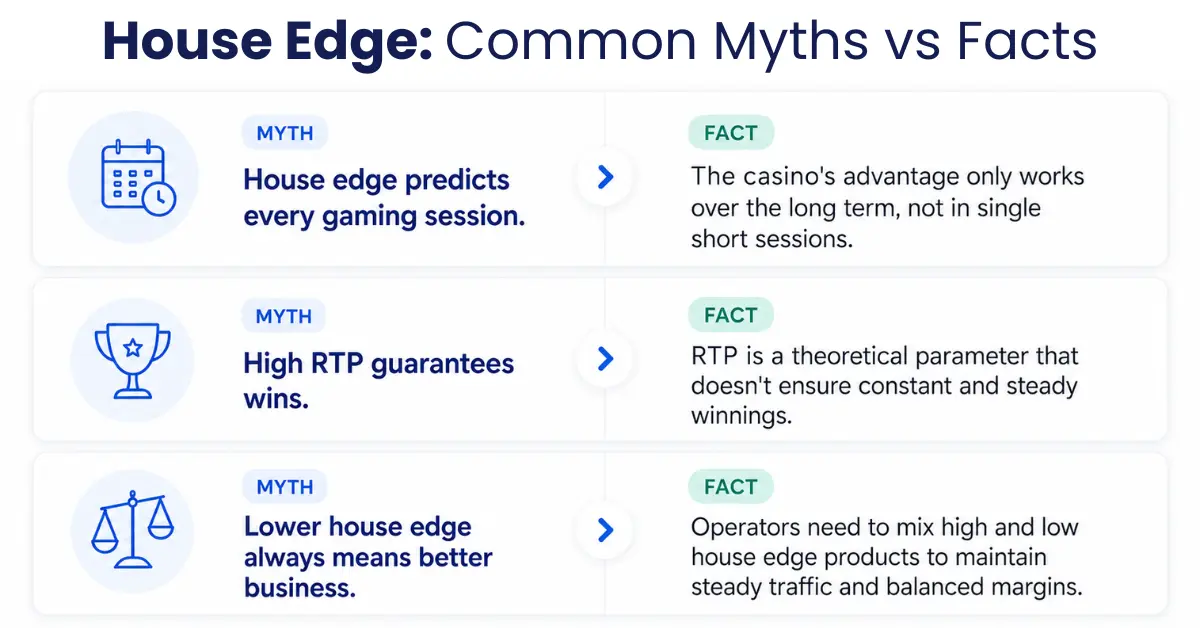
Three house edge myths compared with facts about RTP, gaming sessions, and operator margin balances.

Closing Thoughts on House Edge

House edge is one of the main iGaming mechanics that determines operators’ profitability and player experience. Casinos and sportsbooks should use this parameter only as a strategic tool, not as a meaningless mathematical percentage. They shouldn’t go all in on the statistical edge, as it could greatly damage their long-term profit. The best approach is balanced game offerings and margin, transparency, responsible gambling, and maintained trust.

House Edge in iGaming FAQ

What is the house edge in iGaming?

House edge in iGaming shows the mathematical edge built into casino games and sports betting. It represents the percentage an operator gets from the total bets over a certain time. For example, if a slots house edge is 96%, the casino should expect to get €5 for €100 wagered over a longer period.

What is the difference between house edge and RTP?

Know that the house edge indicates the operator’s expected long-term margin. The RTP shows how much money a player should expect to get back after a longer gambling session. Knowledgeable players know that choosing games with higher RTP rates may offer better chances of winning in short sessions.

Why does house edge matter for iGaming operators?

Understanding house edge is crucial for iGaming operators as it can help them forecast revenue and balance their game library. This parameter is also important for ensuring bonus profitability and customer categorisation. Casinos and sportsbooks use house edge to build a stable retention strategy and solid risk management.