Ace Alliance Riga
Ace Alliance Riga
Event Agenda | August 6-7, 2026
Sold Out
Table Of Content :

Why Affiliate Networks Should Avoid Pooled Account Dependency

trust
Ace Alliance: Delivering Trust Through Expertise
From exclusive events and interviews to real-time market trends, Ace Alliance brings you unbiased, well-informed, and data-driven content. Our editorial team adheres to strict editorial standards, ensuring that the information you receive is not only relevant but also trustworthy.

Built by market experts hosting events since 2023, with our first event in Riga, Latvia gathering over 300 top level iGaming industry executives, Ace Alliance is able to provide you with reliable information from direct interaction with experts and leaders in the sector.
Darko Ilievski
Lead Editor
Updated:
Reading Time: 7 minutes
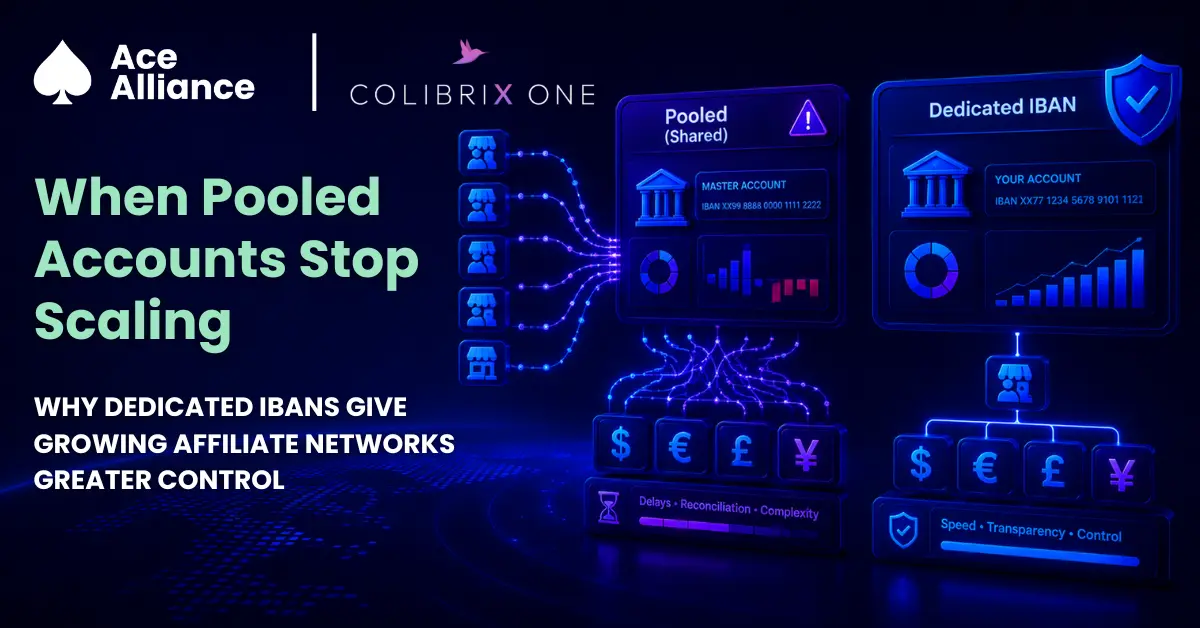
Ace Alliance and COLIBRIX ONE graphic explaining why growing affiliate networks outgrow pooled accounts and shared payment infrastructure.

A pooled IBAN can expose an affiliate network to risks it does not control. Because several businesses may sit behind the same underlying account, an AML issue involving one participant can trigger wider restrictions, while reference-based allocation can delay payment identification and reconciliation.

Businesses often enter these arrangements because dedicated infrastructure was unavailable or the underlying account model was not examined closely enough. The safer approach is to understand how funds are held, attributed, and reviewed before opening the account, then choose payment infrastructure designed to support future transaction volumes, currencies, and expanding partner payouts without requiring an early rebuild.

Blog
Payments

Key Takeaways: Why Dedicated IBAN Infrastructure Matters

  • Pooled accounts commonly use a master account, with individual client balances tracked through sub-accounts, virtual identifiers, or payment references.

  • The main structural risk is dependency: payment access, reconciliation and transaction visibility rely heavily on the provider and its banking partners.

  • Shared infrastructure can create wider disruption when a review takes place at provider, master-account or banking-partner level.

  • Dedicated IBANs improve payment identification and create a clearer connection between transactions and the company receiving them.

  • A dedicated IBAN does not automatically prove that funds are held in a separate bank deposit or individually segregated safeguarding account.

  • Payment architecture becomes increasingly difficult to replace as transaction volumes, supported currencies and partner lists expand.

  • Migration should be planned before an account restriction or settlement problem makes the change urgent.

The Pooled Account Trap

Pooled accounts create two practical risks for growing networks: payment delays caused by reference-based reconciliation and exposure to account restrictions triggered elsewhere in the shared infrastructure. Businesses should understand the account structure before opening it, rather than planning to replace it later.

How Pooled Accounts Create Shared Exposure

In a pooled arrangement, several businesses receive funds through one underlying master account. The provider separates balances using an internal ledger, customer identifier, payment reference or virtual IBAN.

Businesses often enter these structures because dedicated infrastructure is unavailable, onboarding elsewhere is difficult or the underlying account model was not examined closely enough. Although each customer may see a separate balance, access still depends on the provider, master account and upstream banking partners.

Reconciliation Delays and AML Freeze Risk

Pooled accounts rely on accurate payment references. When a reference is missing, incorrect, or removed during processing, the provider may need to allocate the payment manually. This can delay attribution, reconciliation, and partner settlement, with the workload increasing as transaction volumes and currencies expand.

Shared infrastructure also creates compliance risk. If another business using the same underlying IBAN triggers an AML review, the provider or banking partner may restrict the master account or related payment flows while checks are completed. This can affect businesses that were not responsible for the original issue.

Key takeaway: Confirm whether the IBAN is dedicated, virtual or connected to a shared master account before opening it. Payment infrastructure should be selected for future growth from the outset, rather than treated as something that can be replaced easily later.

Why Businesses Shift to Dedicated IBAN Infrastructure

A pooled IBAN routes payments into a shared master account, with references or internal ledger entries used to identify each business. A dedicated IBAN is assigned exclusively to one legal entity, allowing incoming payments to be attributed through the account number itself.

The benefit is therefore not simply a different account number. Payment identification becomes part of the infrastructure rather than a manual accounting process, reducing missing-reference issues and making reconciliation easier as transaction volumes increase.

As COLIBRIX ONE’s Margarita Matjanova explains:

The hidden cost usually emerges later in the form of manual reconciliation, delayed payment allocation and increased operational workload.

Payment Attribution
Multi-Currency Control
European IBAN
Check the Structure

Automatic Payment Attribution

A dedicated IBAN gives the business consistent account details across invoices, contracts and commercial relationships. Counterparties no longer need to send funds to a shared account with a separate identifying reference.

This supports:

  • More reliable payment identification
  • Faster reconciliation with accounting systems
  • A clearer transaction history
  • More consistent counterparty records
  • Simpler internal reporting
  • Better visibility across currencies and entities

Because transactions are connected more directly to the relevant legal entity, finance teams can trace payments more easily and maintain clearer records for audits, regulatory reviews and counterparty checks.

Multi-Currency and FX Control

COLIBRIX ONE states that one dedicated account can receive and route EUR, GBP, USD, CHF, PLN and other supported currencies into the appropriate wallet automatically. Businesses can hold several currencies within one account structure rather than opening a new account or forcing a conversion each time they enter another market.

According to the company, currency conversions take place in near real time at competitive rates. This allows businesses to choose when to convert funds, reduce unnecessary conversion steps and manage balances across markets from one dashboard.

European IBAN Credibility

COLIBRIX ONE issues European dedicated IBANs supported by SEPA, SEPA Instant, and SWIFT infrastructure. Using an IBAN assigned exclusively to the company can provide counterparties with clearer beneficiary details and strengthen confidence in who owns and operates the account.

European payment infrastructure can also simplify collections and reporting across supported markets, although businesses should still confirm which regulated entity issues the account and which payment corridors are available.

Check What Sits Behind the IBAN

A dedicated IBAN, virtual IBAN, named account, and safeguarding account describe different parts of the payment structure and should not be treated as interchangeable.

Before choosing an account, businesses should ask:

  • Which regulated entity provides the account?
  • Is the IBAN standalone or virtual?
  • Who is the contractual account holder?
  • How are customer funds safeguarded?
  • How often are balances reconciled?
  • Could reviews affect other payment flows?
  • Which currencies and payment corridors are supported?

A dedicated IBAN can improve attribution, multi-currency management, and operational control, but its value still depends on the contractual, regulatory, and safeguarding structure behind it.

How COLIBRIX ONE Approaches Dedicated Payment Infrastructure

COLIBRIX ONE offers business accounts within a wider payment platform for companies managing international collections, settlements and expenditure. According to the company, each account includes a dedicated IBAN that routes incoming payments to the appropriate currency wallet without requiring separate reference codes. The platform supports SEPA, SEPA Instant and SWIFT transfers, with multi-currency coverage including EUR, USD, GBP, CHF and more, alongside acquiring, payouts, recurring billing and virtual cards.

Multi-Currency Accounts and Cross-Border Transfers

COLIBRIX ONE states that its dedicated IBAN routes supported incoming currencies into the appropriate wallet, allowing finance teams to manage several balances within one environment. SEPA and SEPA Instant support European transfers, while SWIFT provides wider international coverage. Settlement times may still depend on the currency, receiving institution, intermediary banks and any checks applied to the transaction.

Acquiring Across More Than 130 Countries

COLIBRIX ONE says its acquiring infrastructure covers more than 130 countries. Supported local and digital methods include Apple Pay, Google Pay, Multibanco, BLIK, Bancontact, MB Way and EPS. The company states that requested alternative payment methods can be added within one to two business days, although actual timelines may depend on business reviews, market requirements and technical integration.

High-Volume Partner and Recipient Payments

COLIBRIX ONE’s platform includes mass-payout infrastructure for payments to partners, suppliers, agencies, creators and other commercial recipients. Available services include Visa Direct and Mastercard MoneySend. Businesses should still keep treasury and partner-settlement records separate: the treasury tracks company balances, while the partner ledger records what each recipient has earned, what has been approved and what has already been paid.

Recurring Payments

COLIBRIX ONE enables subscription and membership businesses to retain control over their pricing and billing logic. Companies calculate fixed, usage-based or hybrid charges within their own systems, then use the COLIBRIX ONE API to execute payments on demand. Businesses can connect directly or through an orchestrator while combining recurring payments with acquiring and wider account services.

Human Support When Payments Are Delayed

COLIBRIX ONE describes its support model as providing named human contacts and access to teams operating around the clock. This can be important when payments are delayed, transactions require review or additional documentation is requested. Businesses should confirm the support terms included in their agreement, including response times, escalation procedures and whether assistance is available outside standard business hours.

Regulatory Entities

COLIBRIX ONE operates through regulated entities in Malta and the United Kingdom. Its website identifies Mellifera Kartiera Limited as an electronic money institution authorised by the Malta Financial Services Authority, while Colibrix Limited is authorised by the UK Financial Conduct Authority. Businesses should confirm which legal entity will provide each service, as this may depend on their location, transaction model and payment requirements.

What High-Growth Networks Should Do Differently

Choosing payment infrastructure built for future growth from the outset can help businesses avoid a complex migration later. Moving away from pooled infrastructure is not simply a pricing-plan change; it affects accounting systems, counterparties, contracts, partner records, permissions and payment instructions. Where migration is necessary, it should be treated as a wider infrastructure project rather than a straightforward account switch.

Understand the Existing Structure
Separate Treasury From Partner Settlement
Reduce Provider Concentration
Plan Migration Early

Map How Funds Move Through the Existing Payment Structure

Businesses should first map how funds move through their payment infrastructure. This includes identifying the account provider, regulated entity, safeguarding institution, intermediary banks, supported currencies, collection methods, payout services and reconciliation systems. They should also confirm whether the account is genuinely dedicated, a virtual identifier or part of a wider pooled structure.

Keep Company Treasury and Partner Settlements Separate

Treasury and partner-settlement records should remain separate. Treasury shows the funds available to the business, while the settlement ledger records what each partner has earned and whether payments are pending, approved or completed. Keeping these functions distinct creates a clearer audit trail and supports the wider use of structured affiliate tracking and performance data, helping teams identify whether discrepancies originate in the account, commercial calculation or payout process.

Consolidate With a Capable Provider

Working with one provider that can support accounts, acquiring, payouts, currency conversion and operational spending can simplify payment management and reduce fragmentation. Consolidating transaction volume may also support more flexible commercial terms and lower overall costs than maintaining several separate providers. The priority is to choose infrastructure with enough geographic, currency, and product coverage to support the business as it grows.

Plan the Payment Migration Before Disruption Occurs

Changing payment infrastructure can affect invoices, contracts, beneficiary instructions, partner dashboards, APIs, accounting systems, permissions, and settlement schedules. A controlled migration may require old and new accounts to operate in parallel while balances and counterparties are transferred. Businesses should also retain enough liquidity to manage delayed payments during the transition rather than waiting until an existing account is restricted.

Payment Infrastructure Should Scale From Day One

Businesses should choose reliable payment infrastructure from the outset, with enough currency, geographic and operational coverage to support future growth. A dedicated IBAN can improve payment attribution, reconciliation and financial visibility before shared-account dependencies become embedded in the business.

For companies already using pooled infrastructure, the next step is to assess how the account operates, how funds are safeguarded and where payment delays or shared compliance exposure may arise. Any migration should be planned early, before rising volumes or an account review makes the transition more difficult.

References