Ace Alliance Riga
Ace Alliance Riga
Don’t miss the Early Bird Offer! | August 6-7, 2026
Get Your Pass!
Table Of Content :

Ace Alliance x SlotCatalog Report: Slots of the Gods

trust
Ace Alliance: Delivering Trust Through Expertise
From exclusive events and interviews to real-time market trends, Ace Alliance brings you unbiased, well-informed, and data-driven content. Our editorial team adheres to strict editorial standards, ensuring that the information you receive is not only relevant but also trustworthy.

Built by market experts hosting events since 2023, with our first event in Riga, Latvia gathering over 300 top level iGaming industry executives, Ace Alliance is able to provide you with reliable information from direct interaction with experts and leaders in the sector.
Darko Ilievski
Lead Editor
Updated:
Reading Time: 13 minutes
Cover banner for SlotCatalog Report: Slots of the Gods with three mythologies represented.

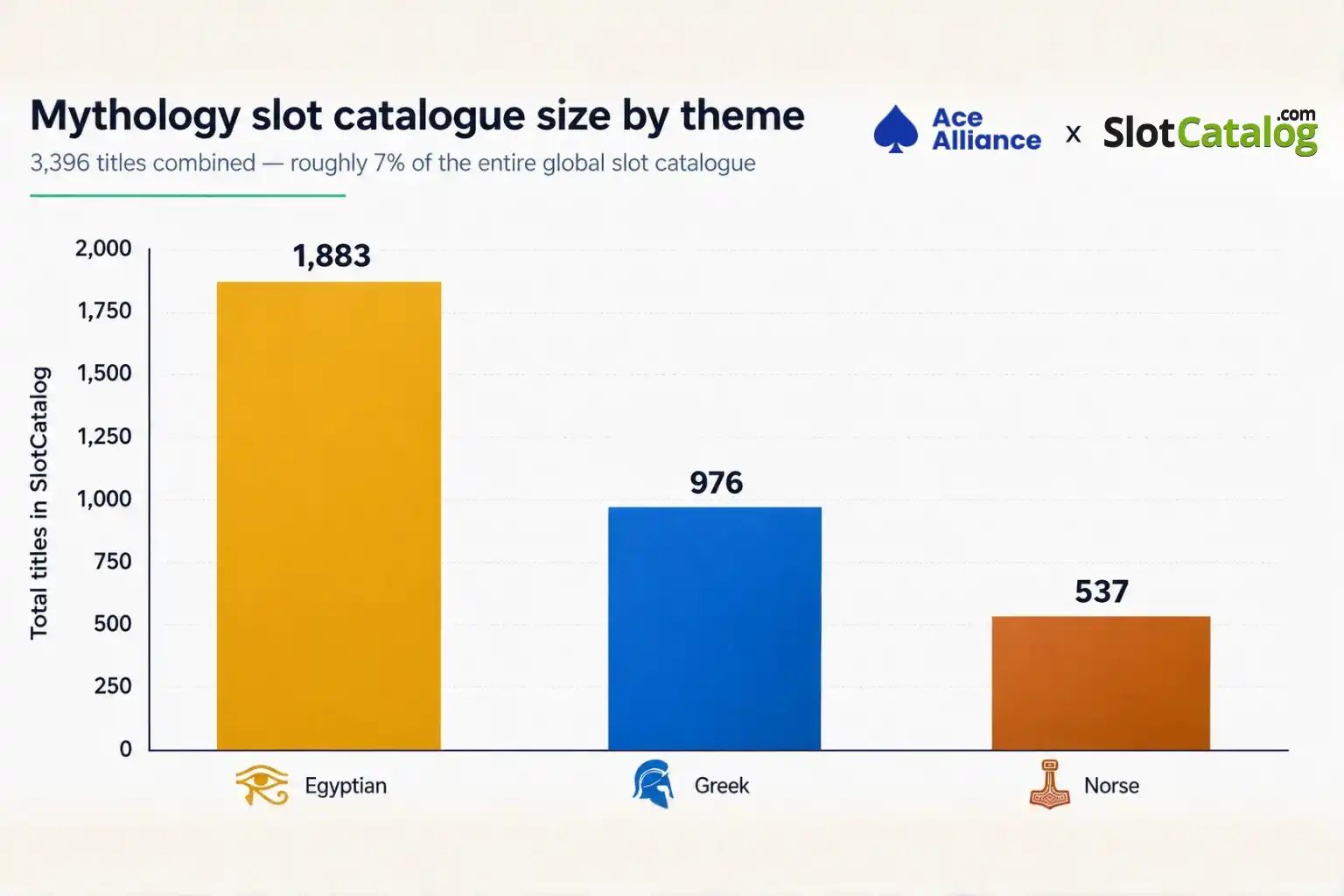
While reviewing the SlotCatalog database, a few patterns around mythology slots kept standing out, so we decided to dig deeper. Three findings shaped this report. First, Egyptian, Greek, and Norse mythology slots now account for roughly 7% of the global SlotCatalog database: 3,396 titles, or about one in every fourteen slot games. Second, among the studios most committed to these themes, mythology represents 10–13% of their portfolios on average, rising to 16–18% at the top end. Third, the category is still expanding, not contracting. April 2026 set an all-time high with 65 mythology slot releases in a single month. Beneath those headline numbers sits the more interesting story: three mythologies, three very different roles in the modern slot catalogue.
Report

Figure 1 — Total mythology titles in the SlotCatalog database, by theme.

Where Mythology Slot Popularity Came From

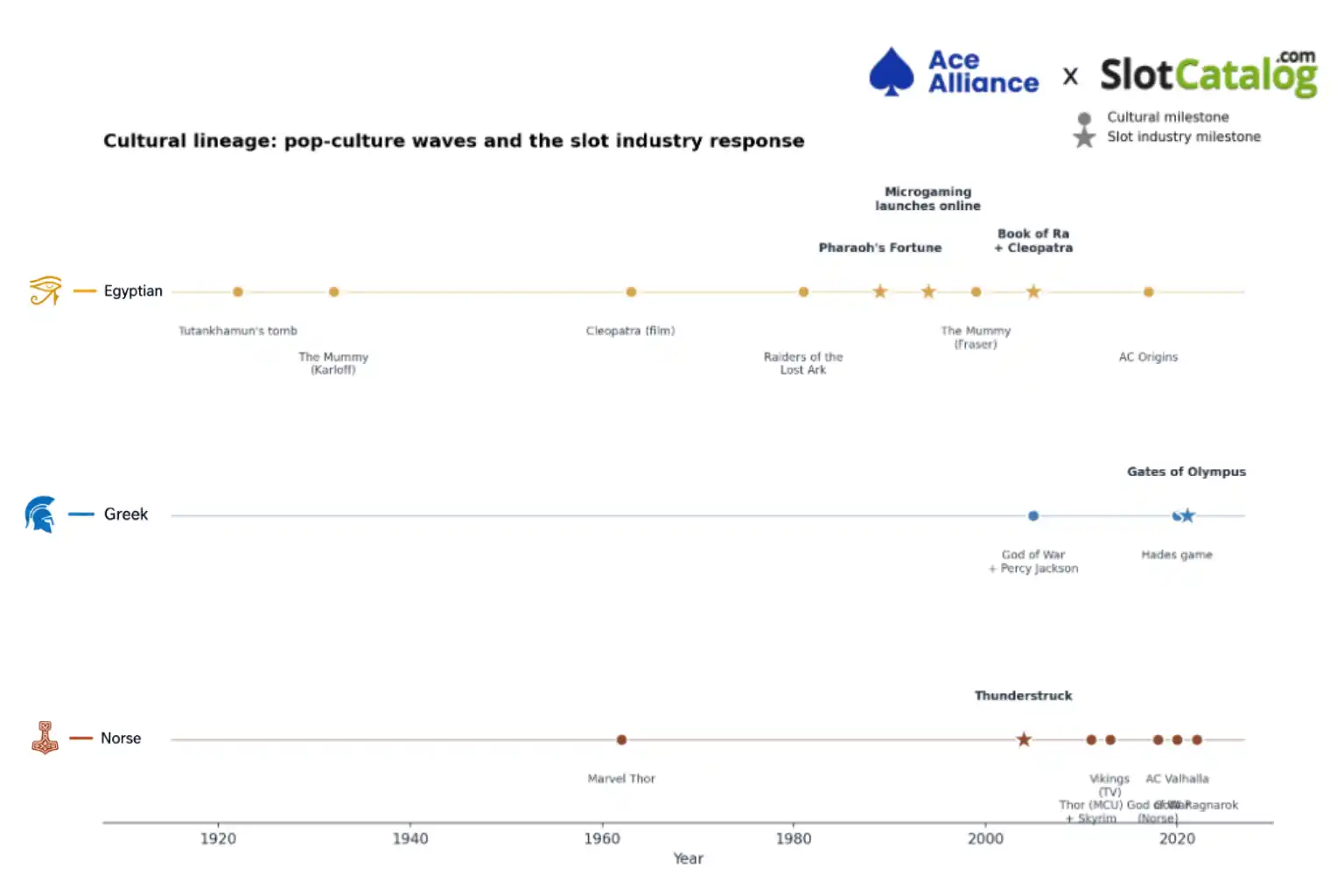
Mythology slots did not emerge in a vacuum. Each of the three themes rides a different cultural wave, and the size gap between the three catalogues tracks closely with the depth of cultural priming behind them.

Egyptian Slots
Greek Slots
Norse Slots

Egyptian Slots Had a Century-Long Head Start

Egypt had the longest runway. Howard Carter’s discovery of Tutankhamun’s tomb in 1922 triggered “Tutmania”, a cultural wave that shaped fashion, jewellery, architecture, and design. From there, Egyptian mythology stayed visible through The Mummy, Cleopatra, Raiders of the Lost Ark, Stargate, the Brendan Fraser Mummy franchise, Tomb Raider, and Assassin’s Creed Origins. The slot industry tapped that current early. IGT’s Pharaoh’s Fortune, a mechanical three-reel Egyptian title, appeared on land-based floors in the late 1980s before the theme travelled online with the wider casino industry. The genre crystallised in 2005, when IGT’s Cleopatra became a defining free-spins title, and Novomatic released Book of Ra. That release helped cement Egypt as the default mythology theme in slots.

Greek Slots Rode the Modern Gaming Wave

Greek mythology had a strong baseline through education and classical culture, but its modern commercial surge came from gaming and entertainment. Sony’s God of War franchise, especially the original Greek arc from 2005 to 2010, Rick Riordan’s Percy Jackson books, the later Disney+ series, and Supergiant’s award-winning Hades all helped bring Greek gods, heroes, and monsters back into mainstream entertainment. The slot market followed with its own inflection point. Pragmatic Play released Gates of Olympus on 25 February 2021, and the title quickly became Greek mythology’s equivalent of a Book of Ra moment. Its success helped define the category around cascading wins, scatter pays, and multiplier mechanics. The 2024–2026 catalogue surge in the SlotCatalog data is the copycat wave that followed.

Norse Slots Are Still Catching Up

Norse is the youngest of the three cultural waves. Marvel introduced Thor in 1962, but Norse mythology stayed comparatively niche for decades. The breakthrough came in clusters from 2011 onward, driven by Marvel’s MCU films, Bethesda’s Skyrim, History Channel’s Vikings, Ubisoft’s Assassin’s Creed Valhalla, and the God of War Norse reboot. Unlike Egyptian and Greek mythology, Norse awareness reached mass-market scale after the online slot industry had already matured. That timing helps explain why the Norse catalogue is smaller, more recent, and less saturated with legacy titles. It also explains why Norse slots are more often positioned as experimental flagships rather than catalogue fillers. The theme is still catching up to the cultural demand created across film, television, and gaming over the past decade.

The Takeaway: Slot Trends Lag Pop Culture

The takeaway is simple: slot popularity often lags pop-culture popularity by 10–20 years. By that logic, Norse output should keep accelerating through the late 2020s.


Figure 2 — Cultural milestones (circles) and slot industry milestones (stars) on a single timeline per theme.


The Volume Hierarchy: Three Themes Side by Side

The three mythology categories are not equal in scale. Egyptian slots have roughly twice the catalogue of Greek slots and around 3.5 times the catalogue of Norse slots. But scale alone does not decide which theme dominates a casino lobby. The table below shows the gap between catalogue depth, release momentum, provider volume, and flagship power.

Metric Egyptian Greek Norse
Total titles 1,883 976 537
Releases 2023 228 130 60
Releases 2024 221 119 53
Releases 2025 259 152 87
Releases 2026 YTD, Jan–Apr 94 60 38
Top provider Spinomenal, 49 Spinomenal, 53 Spinomenal, 19
Most-cited #1 title Book of Dead, Play’n GO Gates of Olympus, Pragmatic Play Thunderstruck II, Stormcraft
Indicative avg RTP ~95.5–96.5% ~96.0–96.5% ~96.0–96.5%
Scale Does Not Equal Lobby Power

The table shows Egypt’s catalogue advantage clearly, but it also shows why volume is not the whole story. The leading provider is the same across all three themes: Spinomenal, with 49 Egyptian, 53 Greek, and 19 Norse titles. Yet the most influential title in each category comes from a different studio. Play’n GO’s Book of Dead defines the modern Egyptian slot, Pragmatic Play’s Gates of Olympus anchors the Greek boom, and Stormcraft Studios’ Thunderstruck II remains the major Norse reference point. Each title created a different centre of gravity for its theme.

Norse Is Growing Fastest From the Smallest Base

The yearly release data also shows which category is growing fastest. Egyptian mythology releases increased by 14% from 2023 to 2025, rising from 228 to 259 titles. Greek releases grew by 17%, from 130 to 152 titles. Norse grew by 45%, moving from 60 to 87 releases over the same period. That growth comes from a smaller base, but it supports the cultural-lag argument from the previous section: Norse mythology is starting to convert recent mainstream awareness into slot catalogue volume.

Why Spinomenal Tops All Three Themes

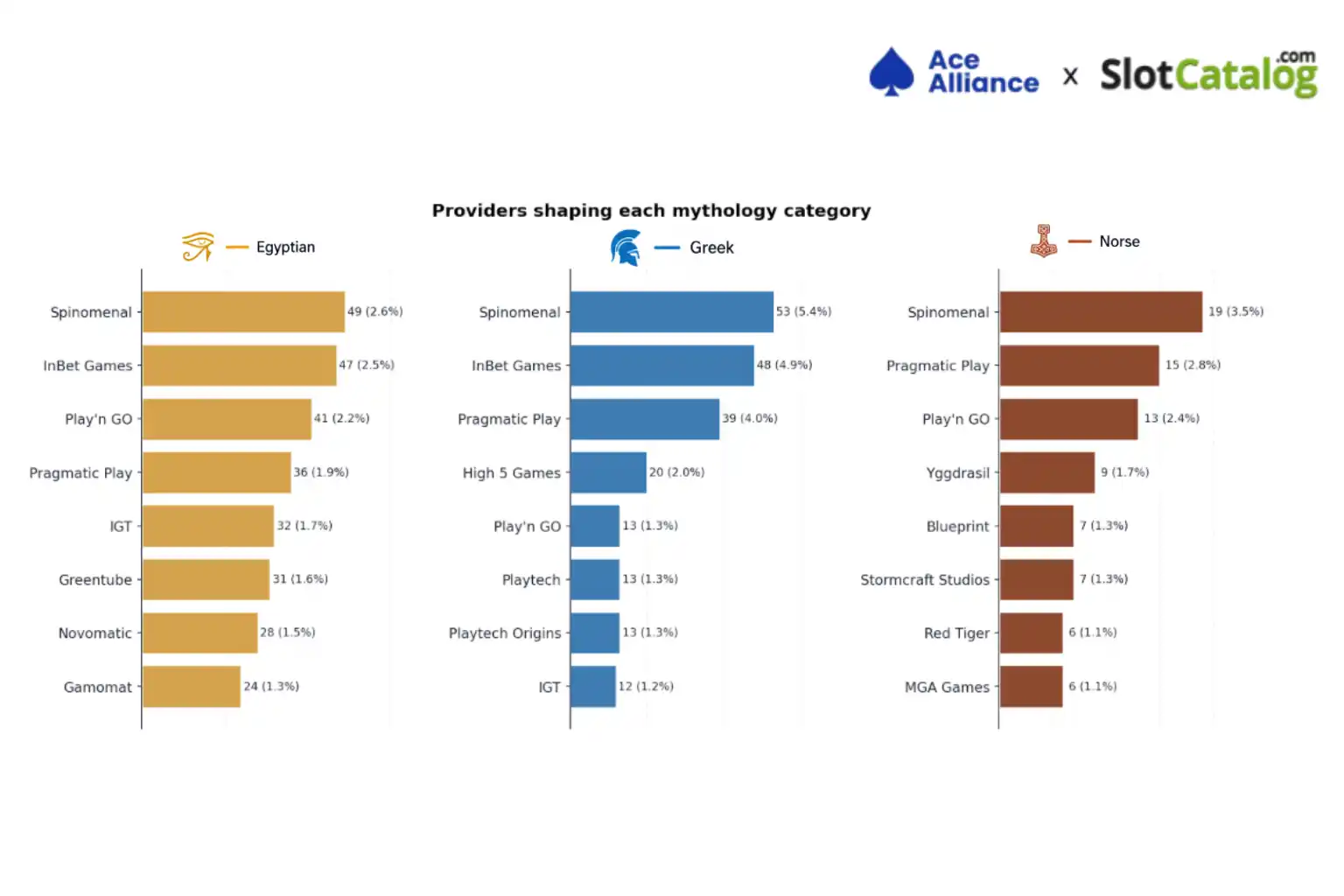
Spinomenal’s position across all three themes is not a coincidence. The studio built a high-output, theme-agnostic catalogue in the mid-2010s, giving operators a wide range of titles to license across different player preferences. Mythology became one of the most useful theme groups inside that model because it travels well across markets and needs little explanation. The same logic explains why InBet Games and Pragmatic Play also sit near the top of all three theme tables. Broad-portfolio studios over-index in mythology because it is one of the widest cultural nets available in slot design.

Methodology note: “Most-cited #1 title” reflects industry consensus across operator commentary, review aggregators, and award data. SlotCatalog’s internal popularity index can refine this on the published page.

Release Trajectories: Three Curves, 2020–2026

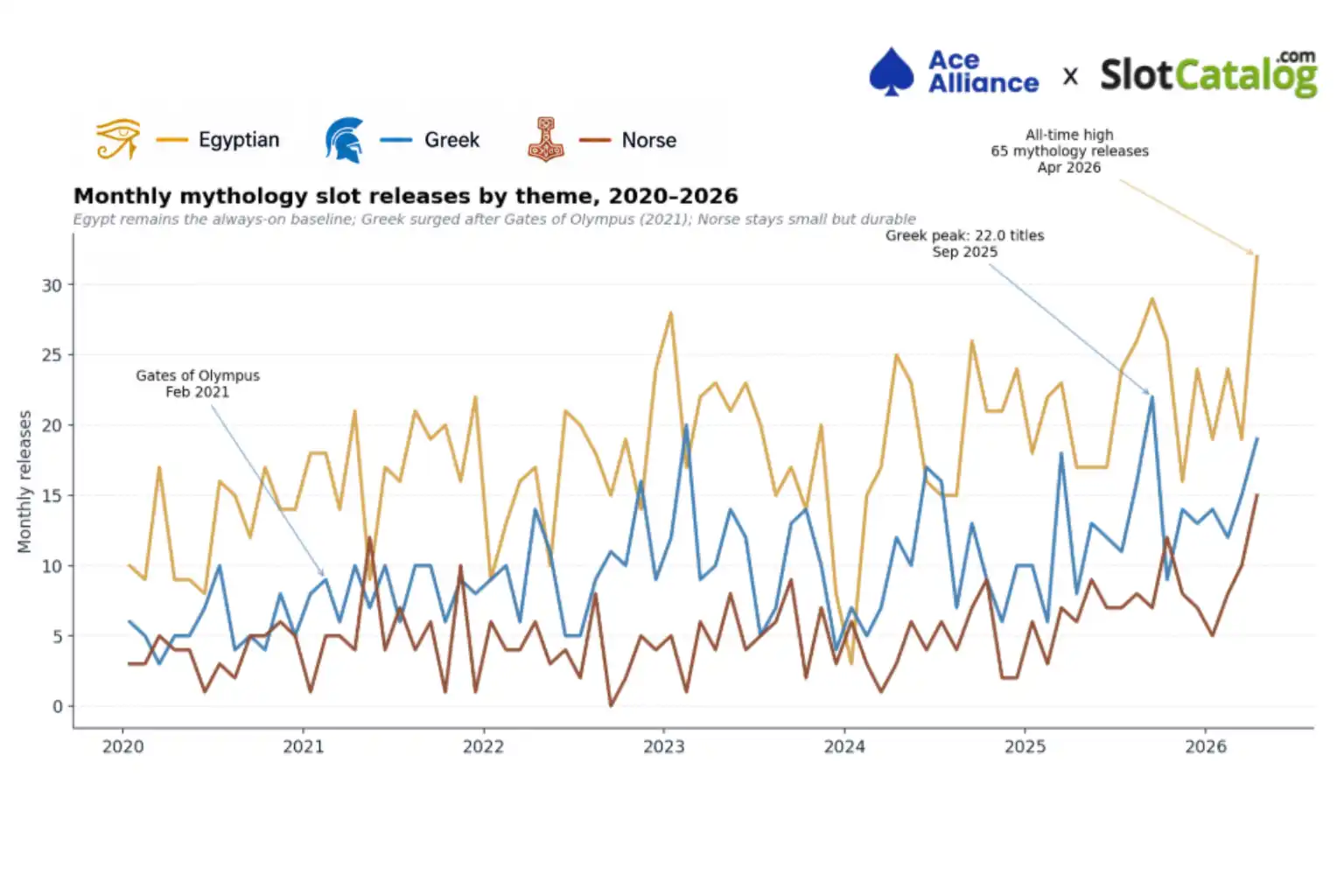
The monthly view since 2020 shows three distinct production patterns. Egyptian slots provide the category’s volume baseline, Greek slots show the sharpest acceleration, and Norse slots remain smaller but increasingly active.

Figure 3 — Monthly mythology slot releases by theme, January 2020 – April 2026.


Egypt: The Always-On Baseline

Egyptian slots have been the steady foundation of mythology output. Monthly releases stayed mostly between 10 and 32 titles across the six-year period, apart from one anomalous dip to three titles in January 2024. The broader trend is consistent growth rather than sharp volatility. Average monthly Egyptian output climbed from around 12 titles in 2020 to roughly 22 titles in 2025. That makes Egypt the category’s dependable volume engine: no dramatic peaks, no sustained drops, just steady catalogue expansion from the largest mythology theme in the market.

Greek: The Fastest Acceleration Curve

Greek slots show the steepest acceleration. Releases sat around five to ten titles per month through 2021. After Gates of Olympus launched in February 2021, operator demand for cascading-multiplier formats helped push the curve upward through 2022 and 2023. The category started producing frequent double-digit months, including a 20-title spike in February 2023. Greek output then reached its peak in September 2025, when 22 new Greek slots launched in a single month. By April 2026, monthly Greek output had reached 19 titles, putting it well above Egypt’s 2020 monthly average.

Norse: The Smaller Curve Turning Upward

Norse remains the smallest of the three curves, but its trajectory is clearly moving upward. Monthly output ranged from zero to 12 titles for most of the six-year period, with a brief 12-title outlier in May 2021. The real change arrived in 2025 and 2026, when Norse releases started breaking into double digits more consistently. April 2026 set a new record for the theme with 15 Norse releases in a single month. Just as importantly, that spike was not driven by one specialist studio. It reflects a broader field of providers experimenting with the theme.

April 2026 Shows the Category Is Still Expanding

The April 2026 all-time high of 65 mythology releases captures the moment all three trajectories moved upward at the same time. That matters because it shows the category is expanding, not contracting. Two patterns stand out. First, the spring spike may reflect studios and operators preparing mythology titles ahead of summer lobby rotations. Second, Norse’s takeoff from 2025 onward fits the cultural-lag pattern outlined earlier. Major Norse media moments from 2011 onward are now translating into slot production, suggesting the theme still has room to accelerate through the late 2020s.

Providers Shaping the Category

Looking at which studios actually produce these titles, three behavioural archetypes emerge: volume players, specialists, and flagship builders.


Figure 4 — The eight providers with the largest mythology output per theme.

Volume Players

Spinomenal, InBet Games, and Pragmatic Play operate a mass-output model built around broad catalogue coverage. Their mythology titles often use familiar mechanical frameworks: Egyptian books, Greek lightning, and Norse hammers applied across rapid release cycles. Mechanically, many of these games cluster around a limited number of proven math models, with theme-skinned art layered on top. Spinomenal is the clearest example. The studio has 16% of its 752-game catalogue in mythology themes, including 49 Egyptian titles, 53 Greek titles, and 19 Norse titles.

Specialists

A smaller group has built mythology into a category-defining identity. Yggdrasil routes 45% of its mythology output to Norse, with the Vikings Go to… franchise helping define what a modern Norse slot looks like. Stormcraft Studios, part of Games Global, owns the Thunderstruck franchise, which began in 2004 and has produced multiple sequels. 3 Oaks runs 18% of its 150-game catalogue as mythology, the highest concentration of any major provider, with a heavy Egyptian tilt. Gamomat at 16.8% and Octavian Gaming at 15.8% follow a similar specialist profile.

Flagship Builders

A third group produces fewer mythology titles but owns the franchises that define their themes. Play’n GO built Book of Dead. Greentube, through Novomatic, owns Book of Ra. Pragmatic Play owns Gates of Olympus. Playtech’s Age of the Gods anchors its Greek and cross-mythology presence with more than 15 entries. Stormcraft Studios owns Thunderstruck, while Yggdrasil owns Vikings Go to…. These studios do not compete primarily on volume. They compete on franchise depth.

The Franchise Extension Model

Mythology slots are one of the clearest examples of a franchise extension economy in iGaming. Once a title breaks through, providers often build a long tail of variants, spin-offs, sequels, and mechanic re-skins around the same recognisable IP.

The scale of franchise duplication is striking:

The strategic implication is consistent across every franchise. Once a mythology slot crosses a critical adoption threshold, the economics shift away from building new IP and toward extending existing IP. A Book of Ra Deluxe Win Ways costs less to position than a completely new Egyptian title, arrives with built-in player recognition, and gives operators an easier lobby story. That is why the catalogue keeps expanding even when the creative range is narrower than the release numbers suggest.

Visual Clichés: The Iconography Saturation Problem

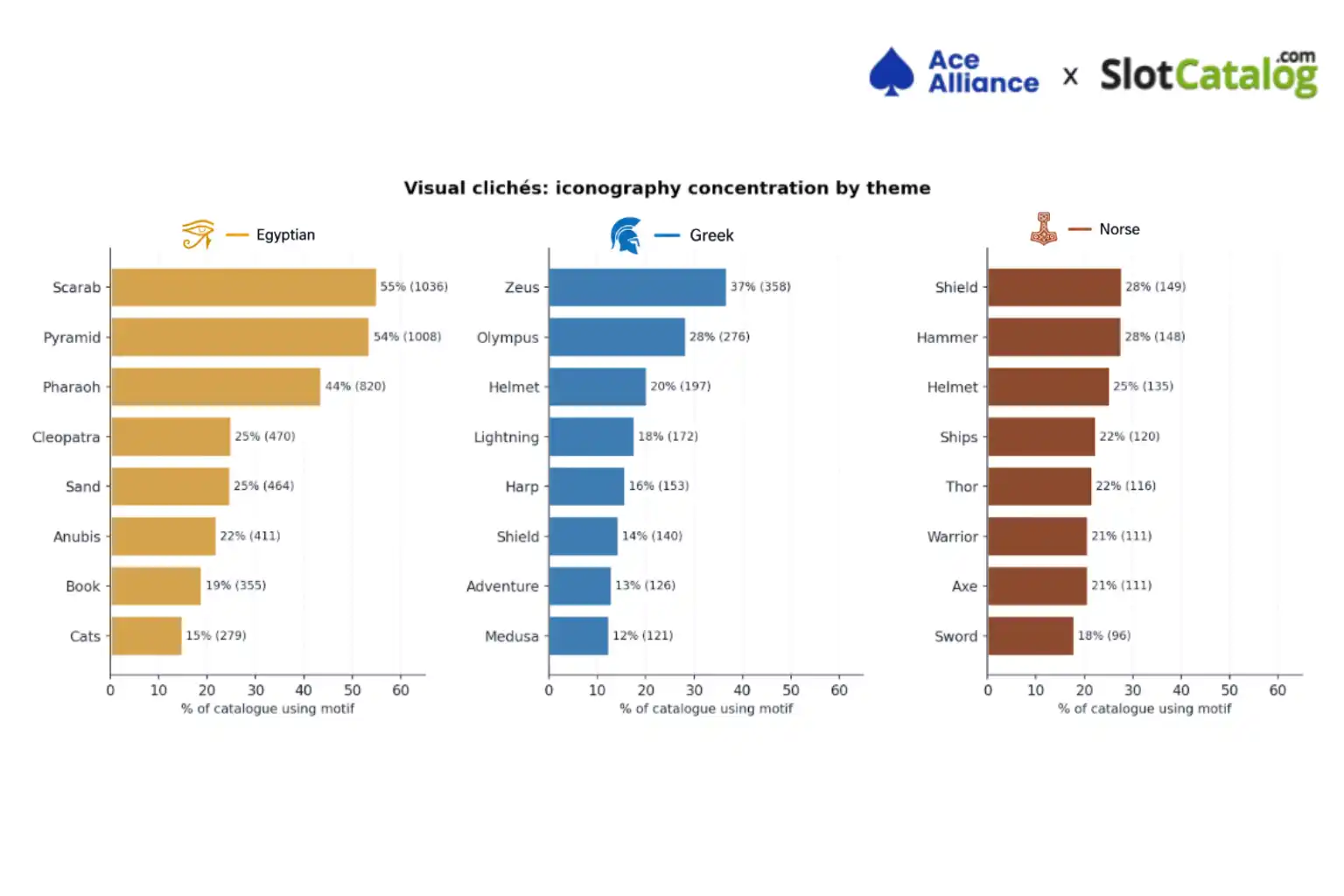
Counting how often the same visual motifs appear across a theme’s catalogue exposes one of the clearest structural differences between Egyptian, Greek, and Norse slots. The numbers show more than visual repetition. They show how much creative space each mythology still has left.


Figure 5 — The eight most-used visual motifs in each mythology category, expressed as a share of that theme's catalogue.

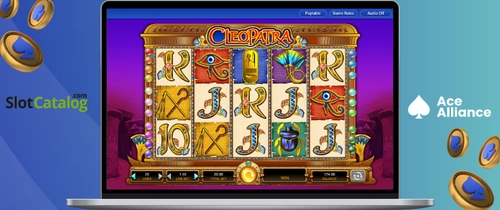
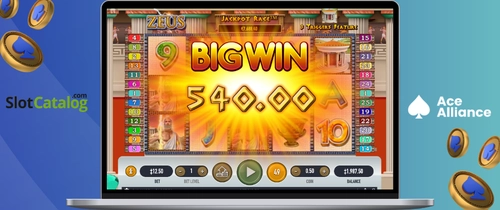
Laptop screen showcasing Egypt-themed Cleopatra by IGT.

Egypt: The Most Saturated Visual Language

Egypt is severely concentrated. Of 1,883 Egyptian titles, the Scarab appears in 1,036 games, or 55% of the category. The Pyramid appears in 1,008 titles, or 54%, while the Pharaoh appears in 820 titles, or 44%. More than half of every Egyptian slot ever published shares at least one of the category’s dominant visual cues. Add Cleopatra, Anubis, and the Book motif, and the visual vocabulary becomes even more fixed. This concentration is not simply lazy design. It reflects pop-culture pre-conditioning. The scarab, pyramid, and pharaoh are the objects players recognise fastest, which makes them useful lobby shortcuts. Providers keep returning to them because the visual semiotics already do part of the marketing work.

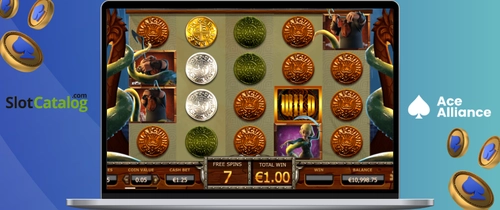
Laptop screen showing Norse-themed Vikings Go Wild by Yggdrasil Gaming.

The Book Motif Is a Mechanic, Not an Egyptology Reference

The Book motif appears in 355 Egyptian titles, or 19% of the category, but it is doing something different. Books were not central visual objects in ancient Egyptian culture in the way pyramids, scarabs, or pharaohs were. The Egyptian Book of the Dead was associated with papyrus, not a bound codex. In modern Egyptian slots, the closed leather-bound book is less a cultural reference than a mechanic identifier. After Book of Ra and Book of Dead became commercial hits, players learned to associate the book symbol with expanding-symbol bonuses and familiar feature structures. In that sense, the Book motif is not Egyptology. It is slot design language. It is the clearest example in the report of mechanics rewriting visual culture.

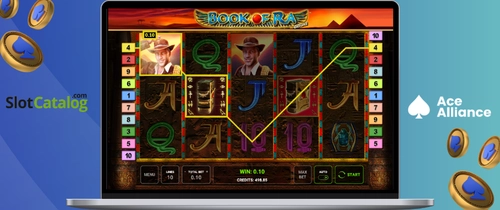
Laptop showcasing gameplay of Book of Ra by Novomatic.

Greek: More Gods, More Visual Flexibility

Greek mythology is moderately concentrated, but less visually locked than Egypt. Zeus appears in 358 titles, or 37% of the category. Olympus appears in 276 titles, or 28%, while the lightning bolt appears in 172 titles, or 18%. No single Greek motif crosses the 50% threshold. The reason is structural. Egyptian slot iconography centres on a relatively small cluster of recognisable figures and symbols. Greek mythology gives designers a much wider cast: Zeus, Poseidon, Hercules, Medusa, Pegasus, the Minotaur, Hades, Athena, Apollo, and others. Providers can rotate gods, heroes, monsters, and locations without losing the “Greek” cue. The source pantheon’s diversity directly creates the iconographic diversity visible in the data.

Laptop screen showing Norse-themed Vikings Go Wild by Yggdrasil Gaming.

Norse: The Visual Language Is Still Being Built

Norse is the least saturated of the three. Its leading motifs, including Shield at 28%, Hammer at 28%, Helmet at 25%, and Thor at 22%, never exceed 30% of the catalogue. That lower saturation reflects the source material. Egyptian mythology left tomb paintings, carved hieroglyphs, and fixed visual records. Greek mythology left pottery, sculpture, mosaics, and centuries of artistic interpretation. Norse mythology came mainly through oral sagas and Eddic poems, later recorded as text. There is no equally fixed visual record of Odin, Valhalla, or many Norse mythic settings. As a result, modern Norse slot iconography is still being assembled, giving providers more room to differentiate.

Strategic Read: Saturation Creates a Discoverability Ceiling

Iconography saturation creates a discoverability ceiling, and Egypt has hit it hardest. Its dominant motifs are locked in because a century of pop culture has conditioned players to recognise them instantly. Greek has more room because the source pantheon is broader. Norse has the most room because its commercial visual language is still being built.

That matters for operators and providers. A new Norse title can differentiate visually in ways a new Egyptian title often cannot. The Norse catalogue may be smaller, but its lower cliché density gives it a strategic advantage that catalogue size alone does not show.

Max Win and RTP: Where the Outliers Live

Two areas where mythology slots cluster at the extremes of the market are maximum-win potential and RTP. The outliers show how providers use headline numbers differently: max win as a volatility and marketing signal, RTP as a margin and differentiation signal.

Highest Declared Max Wins in Mythology Slots

Title Provider Max Win Released
Book of Mines Turbo Games 805,001x Apr 2024
Medea Royal Slot Gaming 150,000x Jan 2022
Book of Pharaoh 777 Jackpot Bigpot Gaming 144,000x Aug 2022
Book of Pharaoh Bigpot Gaming 144,000x Jul 2022
Apollo Pays Megaways Big Time Gaming 116,030x Feb 2022

Highest Declared RTPs in Mythology Slots

Title Provider RTP Released
Cards of Ra Jacks or Better Switch Studios 99.54% Feb 2024
Ed Jones and Book of Bastet Deluxe Extreme Spinmatic 99.00% Mar 2023
Ed Jones and Book of Bastet Xtreme Spinmatic 99.00% Jun 2022
Ed Jones & Book of Seth Xtreme Spinmatic 99.00% Dec 2021
Book of 99 Relax Gaming 99.00% May 2021

Max-Win Inflation Is a Marketing Race

Max-win inflation is real, and it says a lot about player psychology. Declared ceilings have climbed substantially over the past three years, and the pattern extends beyond the top five titles listed above. Recent 100,000x+ Greek and Norse titles just outside the top five, including Olympus Wins Super Scatter by Pragmatic Play and Odin Territory by Dragoon Soft, follow a pattern first pushed by Egyptian Book of… titles from 2022.

The mechanism is straightforward: players compare titles on max-win numbers before they spin. Once one provider in a theme publishes a 100,000x ceiling, others are pulled upward to compete. This is marketing competition, not necessarily math innovation. The underlying RTP barely moves; what changes is how volatility is distributed across the tail of the payout curve.

Ultra-High RTPs Are Usually a Smaller-Vendor Differentiator

RTPs above 99% appear mostly in lower-distribution titles from smaller vendors, and that is not a coincidence. A 99% RTP creates a very thin house edge, making the title less attractive to operators on margin terms. Larger providers can ship 96% RTP flagships because their distribution power, brand recognition, and lobby presence compensate. Smaller providers use 99% RTP as a way to stand out.

Neither extreme automatically correlates with player popularity. The most widely played mythology flagships usually sit in the 96.0–96.5% range, close enough to feel competitive for players while still preserving operator margin.

Methodology caveat: declared max-win multipliers are theoretical ceilings, not expected returns. A 100,000x max win does not mean an average player is likely to experience it. It means a single spin under ideal RNG conditions could reach that level. In practice, max win is a marketing number, not a payout forecast.

What This Means for Operators and Providers

The three mythology categories are not competing for the same shelf space. They fill three different strategic functions. The implications change depending on whether you operate the lobby or build the games.

For Operators

  • Egypt — the catalogue play. With 1,883 titles already in market and three visual motifs appearing in more than half of the category, Egypt’s strength is depth, not discovery. Franchise hits such as Book of Dead, Book of Ra, and the Cleopatra series still work well in promotional rotation. Most new Egyptian titles, however, risk getting buried quickly unless they offer a clear differentiation hook.
  • Greek — the flagship play. Greek is still in its post-Gates of Olympus boom window. A single proven hit can outperform a long tail of weaker alternatives. The data supports this: Greek monthly output reached a record 22 titles in September 2025, but the discoverability premium still sits with established names. Promotional ROI is strongest around confirmed flagships in this category.
  • Norse — the differentiation play. Norse has the smallest catalogue, the lowest cliché density, and some of the highest room for mechanical variation. That makes it the cleanest mythology theme for featuring a new title in the lobby. Discovery friction is lower than in Egypt or Greek, making Norse the strongest theme for experimental promotional placement.

For Providers

  • Egypt — do not enter without a hook. With 1,883 existing titles and over half the category sharing the same dominant visual motifs, a new Egyptian slot needs a sharper reason to exist. That could be a new math model, a fresher character angle, or a less familiar visual system. Without that, it joins the backlog on day one.
  • Greek — ride the wave, but differentiate. The Gates of Olympus formula, built around cascading wins, scatter pays, and multiplier-driven mechanics, is now table stakes. The 2024–2025 release surge is real, but the window for me-too entries is closing. Providers either need sharper execution inside the format or a mechanic the copycat field has not yet absorbed.
  • Norse — use the experimentation lane. Yggdrasil, Stormcraft, and Play’n GO dominate the major Norse franchises, but the catalogue is still small enough to leave room for new ideas. Competing on volume is difficult. Competing on mechanical innovation, franchise depth, or underused character angles is more promising. The character gap is especially useful: Thor appears in 117 tagged titles, while Loki appears in only 45. Freya, Tyr, and Heimdall barely register at all, leaving clear space for providers willing to move beyond the default hammer-and-thunder formula.

Looking ahead, Norse output should keep accelerating through the late 2020s as the 2011–2022 media wave around Marvel, Vikings, God of War, and Assassin’s Creed Valhalla continues feeding cultural pull-through. Providers building Norse capacity now may still be early.

Ace Alliance Expert’s Tip: Do Not Add Volume Without Differentiation

After reviewing the data, one rule stands out: mythology slots need a clear reason to exist beyond familiar gods, symbols, and settings. 

Ace Alliance Expert’s Tip: Do Not Add Volume Without Differentiation

Editor’s Tip: The Math-or-Iconography Test

Before adding another Egyptian-themed title to your portfolio or your lobby, apply a simple test: does it change the math model or the iconography? If neither, it’s expanding the backlog—not the catalogue. Norse remains the cleanest entry point for fresh mechanical ideas, and Greek’s flagship window is still open, but it’s closing. Catalogue volume alone hasn’t moved revenue in this segment for over a year.

Darko Ilievski
Darko Ilievski
Editor on Ace Alliance

Want a personalised version of this report? Reach out to Misha Kachanov, CBO at SlotCatalog, to find out more.