Ace Alliance Horizon & Speed Rome
Early Bird Passes Available! | November 2, 2026
Get Your Pass!
Table Of Content :

From Niche Product To Sportsbook Mainstay: The Rise Of Table Tennis

trust
Ace Alliance: Delivering Trust Through Expertise
From exclusive events and interviews to real-time market trends, Ace Alliance brings you unbiased, well-informed, and data-driven content. Our editorial team adheres to strict editorial standards, ensuring that the information you receive is not only relevant but also trustworthy.

Built by market experts hosting events since 2023, with our first event in Riga, Latvia gathering over 300 top level iGaming industry executives, Ace Alliance is able to provide you with reliable information from direct interaction with experts and leaders in the sector.
Darko Ilievski
Lead Editor
Updated:
Reading Time: 5 minutes
BETER CEO Gal Ehrlich speaks with a podcast host about table tennis as a betting product.

Table tennis emerged as a prominent betting product when the pandemic disrupted the global sporting calendar. Its continued growth, however, suggests that the category has developed into more than a temporary substitute for traditional sports.

In an interview recorded at a Setka Cup venue, BETER CEO Gal Ehrlich discussed the company’s origins in table tennis, the product’s performance since the pandemic and its role within a diversified sportsbook.

For operators, the wider question is not simply whether table tennis can generate betting activity. It is how fast, continuously available sports can support engagement, fill gaps in the event calendar and contribute to retention across regulated markets.

Blog
iGaming
Why Table Tennis Became More Than A Pandemic-Era Betting Trend

BETER also reports that table tennis represents a high-single-digit share of live-betting volume for many of its clients, reaching double digits in some cases.

From Pandemic Substitute To Permanent Product

Table tennis received considerable attention during the pandemic as football, basketball and other major competitions were suspended. Many industry observers expected demand to decline once the traditional sporting calendar returned.

Ehrlich acknowledged that there was an initial reduction in activity following the pandemic. BETER’s data indicates, however, that demand subsequently returned to growth and is now several times higher than the levels recorded in 2020–2021.

Product Characteristic Potential Operator Relevance
Continuous availability Provides 24/7 content between major fixtures and across different time zones
Short matches Creates rapid event cycles and faster market settlement
Familiar rules Reduces the barrier to understanding the product
Frequent in-play markets Supports live engagement throughout each match
Recurring tournaments and players Can build familiarity and repeat audience interest

These characteristics help explain why table tennis has remained relevant within an increasingly continuous betting environment. However, availability and betting frequency should be assessed alongside margin, retention, player value and responsible-gambling indicators.

A Mature And Competitive Market

Commercial table tennis has long been a highly competitive category, with numerous tournaments and suppliers competing for operator distribution and audience attention. In this environment, the quality of the underlying sporting content and the betting product itself comes to the forefront as a key differentiator.

That saturation is not unique to table tennis. Football, basketball and tennis also contain thousands of leagues, tournaments and individual events. In each category, the challenge is to distinguish reliable and relevant competitions from the wider volume of available content.

Ehrlich identified operational consistency, content quality, market depth and speed of engagement as important differentiators. Familiarity also matters. Regular viewers can learn a tournament’s format, follow recurring players and develop an understanding of its competitive patterns.

BETER says Setka Cup compares favourably with several established professional leagues on indicators such as turnover per event. As this comparison is based on the company’s own data, further independent benchmarks would be needed to assess its position across the market.

The broader point for operators is that content volume alone does not guarantee performance. A tournament must combine dependable delivery with a sporting product that audiences understand and are willing to follow repeatedly.

Sporting Credibility, Integrity And Market Access

Trading systems, data feeds and production technology are essential to delivering betting content, but they cannot create sustained engagement on their own. The underlying competition still needs credible matches, recognisable participants and meaningful sporting intensity.

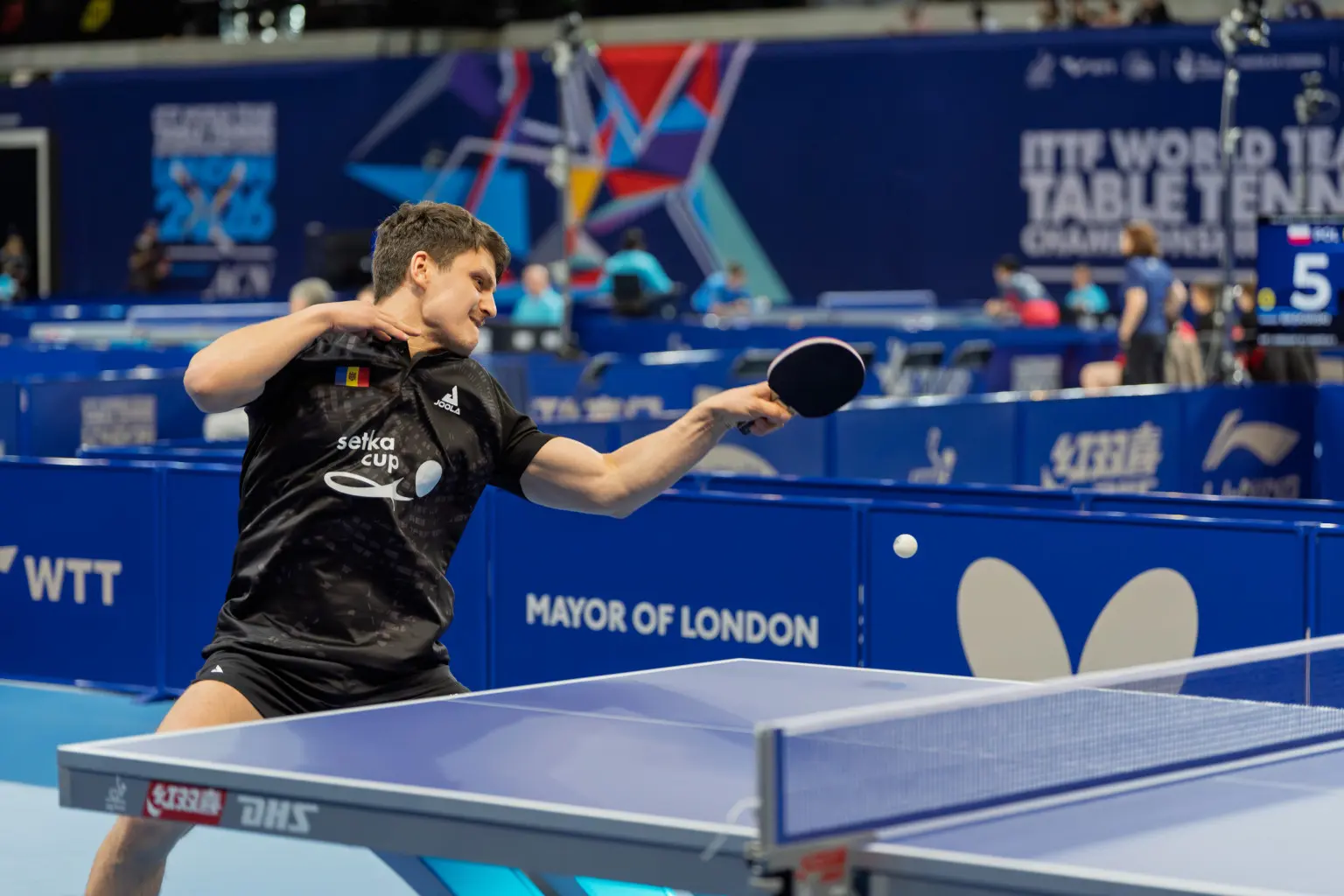
Setka Cup operates as an independent sports organisation and invests in its own development as a tournament operator, as well as its role within the wider table tennis ecosystem. These efforts have included sponsoring Moldova’s national team at the World Championships and supporting academy and training initiatives.

The company has also expanded Setka Cup content into regulated US states. This introduces an additional strategic consideration: content providers must adapt their products to different licensing, integrity and compliance requirements as they enter new markets.

Table tennis player wearing a Setka Cup shirt gestures with his paddle at the 2026 World Team Championships in London.

For the wider industry, such expansion demonstrates the importance of treating betting content as part of a broader sporting and regulatory ecosystem. Long-term growth depends on more than distribution. It also requires integrity controls, player development and a competition structure capable of supporting audience trust.

Fast event cycles and frequent in-play markets also introduce player-protection considerations. Operators should assess session intensity, changes in staking behaviour and the use of safer-gambling controls alongside conventional engagement measures. High betting frequency should not be treated as evidence of sustainable product performance on its own.

Complementing Major Football Tournaments

Major football tournaments attract substantial traffic, but matches are confined to specific periods of the day. Operators therefore need to decide how to maintain engagement between fixtures without distracting from the main event.

Esports and eFootball are often presented as solutions because they can provide rapid, continuous content. Ehrlich argued that table tennis can perform a similar function.

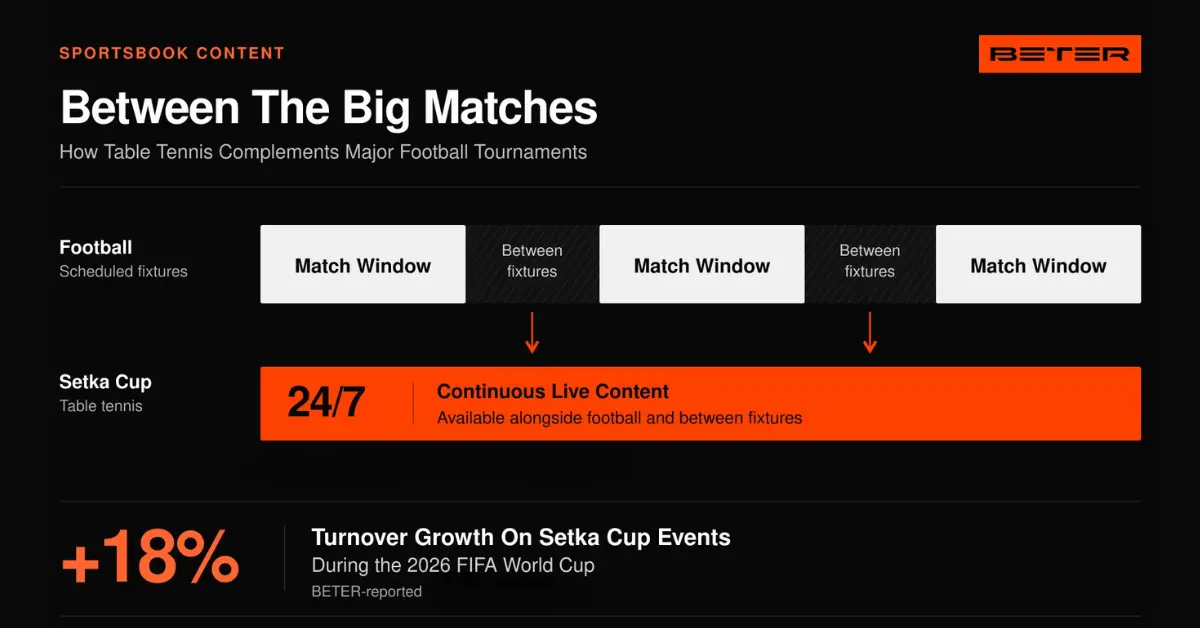
BETER reported that turnover on Setka Cup events increased by 18% during the 2026 FIFA World Cup. This continued a pattern observed during the 2022 tournament in Qatar and UEFA Euro 2024. It also aligns with Ace Alliance’s analysis of World Cup 2026 and European iGaming demand, which found that major tournaments can lift activity but do not automatically generate long-term value. Operators must still convert that increased interest into sustained engagement and retention.

BETER infographic showing football match windows alongside 24/7 Setka Cup table tennis content and 18% turnover growth during the 2026 FIFA World Cup.

In this context, table tennis is complementary content rather than a direct competitor to football. Its role is to provide additional live events during gaps in the schedule, giving users another familiar sport to follow while they wait for the next major fixture.

This approach may help operators maintain session continuity, although traffic alone should not be treated as proof of long-term value. Operators also need to assess repeat participation, retention, margin, player value and responsible-gambling indicators.

What Operators Can Take From The Category

Table tennis offers four wider lessons for sportsbook operators:

The commercial opportunity should be assessed through transparent and consistent data. Turnover, event volume and headline traffic provide only part of the picture. Operators should evaluate the product using KPIs covering acquisition, retention and sportsbook engagement, including repeat participation, margin, average stake, in-play betting share, player value and responsible-gambling indicators.

Table tennis appears to have established a permanent place within the live-betting portfolio. Its longer-term significance will depend on whether providers can maintain sporting credibility, meet regulatory expectations and demonstrate sustainable value beyond company-reported activity figures.