Ace Alliance iGaming Awards 2026
Check out the winners.
See The Winners!
Table Of Content :

Australian Study Finds Illegal Online Casino Participation Rising Sharply Since 2024

trust
Ace Alliance: Delivering Trust Through Expertise
From exclusive events and interviews to real-time market trends, Ace Alliance brings you unbiased, well-informed, and data-driven content. Our editorial team adheres to strict editorial standards, ensuring that the information you receive is not only relevant but also trustworthy.

Built by market experts hosting events since 2023, with our first event in Riga, Latvia gathering over 300 top level iGaming industry executives, Ace Alliance is able to provide you with reliable information from direct interaction with experts and leaders in the sector.
Altay
Altay Celikkaya
Content Manager
Updated:
Reading Time: 2 minutes

Australian adults are increasingly gambling online on casino games and poker machines that cannot legally be offered in the country, according to new research from the Australian National University (ANU). Published on 13 November 2026, the findings raise questions about the effectiveness of restrictions on offshore gambling ahead of major regulatory reforms in 2027.

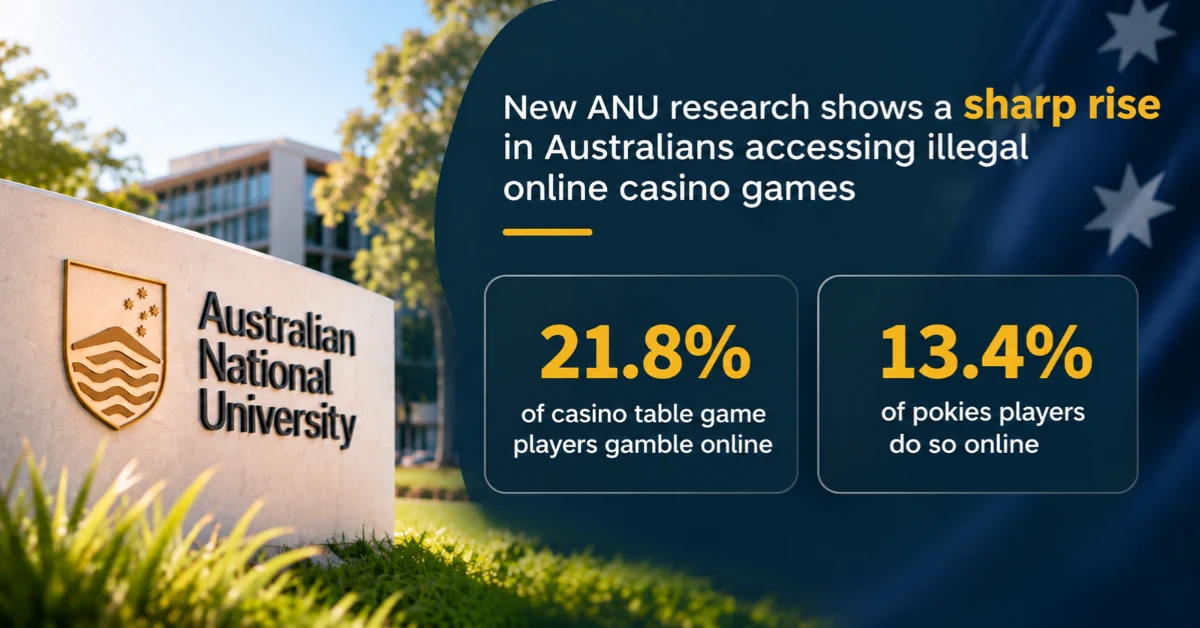
ANU research reveals online gambling rates of 21.8% for casino games and 13.4% for pokies.

Reports

Key Takeaways From ANU’s Gambling in Australia 2026 Study

  • The online share of casino table game players rose from 4.8% in 2024 to 21.8% in 2026.

  • Among electronic gaming machine players, the proportion gambling online increased from 6.5% to 13.4%.

  • Around 17% of Australian adults reported at least one indicator of gambling-related problems.

  • The survey of 3,482 adults provides a baseline for evaluating gambling reforms scheduled for January 2027.

Online Casino Participation Rises Despite Restrictions

ANU’s Gambling in Australia 2026 research draws on seven survey waves conducted between 2019 and 2026. Its latest data were collected in March 2026 and weighted against national population benchmarks.

Among people who played casino table games, the share reporting that they gambled online at least half the time increased from 4.8% in 2024 to 11.8% in 2025 and 21.8% in 2026.

For electronic gaming machines, commonly called pokies, the equivalent figure rose from 6.5% to 13.4% between 2024 and 2026. These percentages refer to participants in each gambling category, not the entire Australian population.

Providing online casino table games and pokies to Australians is prohibited under federal law. However, the survey does not identify individual offshore operators or quantify illegal gambling revenue. The researchers also caution that year-on-year differences were not tested for statistical significance.

Lead author Associate Professor Aino Suomi said:

This raises serious questions about the reach and effectiveness of existing consumer protections.

Gambling Risks Persist as Overall Participation Stabilises

The study found that approximately 60% of Australian adults participated in gambling, a level broadly stable since 2023. Yet about 17% scored at least one point on the Problem Gambling Severity Index, indicating a reported gambling-related problem over the previous year.

Online activity remains important across permitted products. About 90% of sports bettors and 71% of race bettors gambled online at least half the time, while 35% of adults used online gambling at least half the time.

These trends add context to ACMA’s latest action against illegal gambling websites, which brought its cumulative blocking total to 1,850 sites in November.

Implications for Operators and Regulators

The research provides a pre-reform benchmark rather than evidence that particular enforcement measures have failed. Australia plans to introduce tighter advertising controls, an opt-out register and further restrictions from January 2027.

ACMA has already published guidance on the 2027 gambling advertising restrictions, including conditions for digital platforms seeking to display wagering advertisements.

For licensed operators, affiliates and technology suppliers, the findings underline the importance of verifying market access, avoiding prohibited products and monitoring exposure to unlicensed services. International initiatives such as IAGR’s gambling licence-checking campaign also highlight the role of transparent authorisation.

The central question for regulators will be whether forthcoming reforms reduce illegal online participation and gambling-related harm, rather than merely shifting activity between channels.