Ace Alliance Horizon & Speed Rome
Early Bird Passes Available! | November 2, 2026
Get Your Pass!
Table Of Content :

Brazil Betting Ban Takes Effect as Regulated Market Starts to Close

trust
Ace Alliance: Delivering Trust Through Expertise
From exclusive events and interviews to real-time market trends, Ace Alliance brings you unbiased, well-informed, and data-driven content. Our editorial team adheres to strict editorial standards, ensuring that the information you receive is not only relevant but also trustworthy.

Built by market experts hosting events since 2023, with our first event in Riga, Latvia gathering over 300 top level iGaming industry executives, Ace Alliance is able to provide you with reliable information from direct interaction with experts and leaders in the sector.
Altay
Altay Celikkaya
Content Manager
Updated:
Reading Time: 6 minutes

Brazil’s regulated betting market has entered a rapid shutdown after President Luiz Inácio Lula da Silva signed Provisional Measure 1,394 on 25 September. By 27 September, authorities had already taken action against 506 suspected betting websites and begun monitoring digital advertising.

For operators and their partners, attention now turns to October 6th shutdown deadlines. Provisional Measure 1,394 is already in force but remains subject to consideration by Brazil’s Congress.

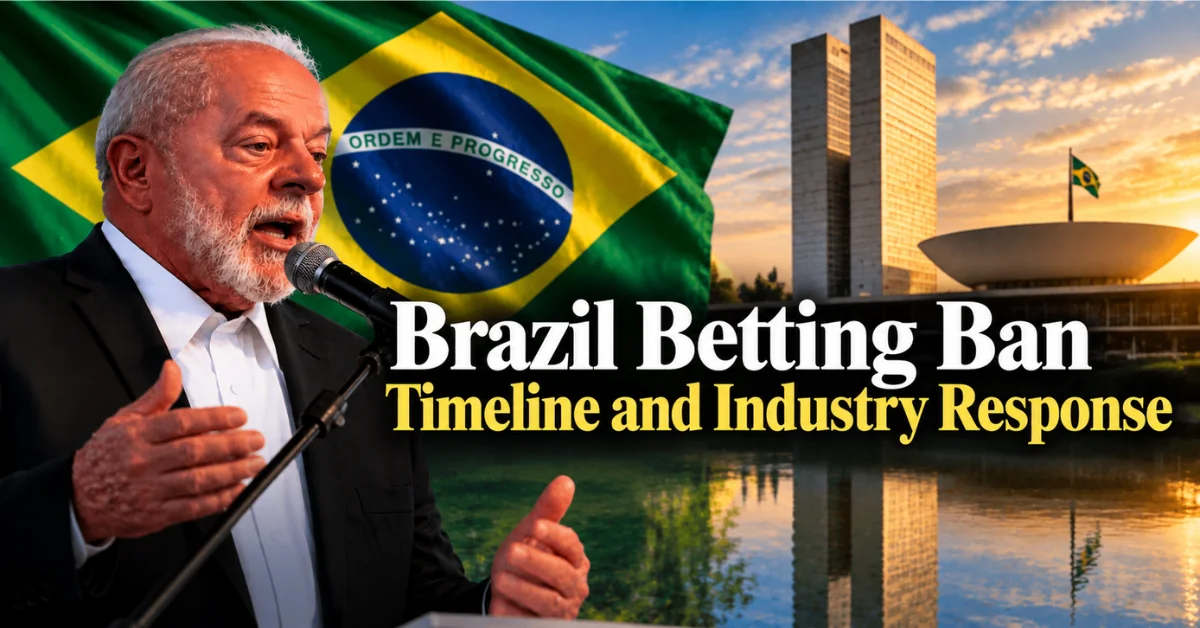
Brazil betting ban illustration featuring President Lula, the Brazilian flag and Brasília’s National Congress, highlighting the timeline and industry response.

Regulation & Compliance

Key Takeaways From Brazil’s Betting Ban

  • Provisional Measure 1,394 prohibits the operation, offering, intermediation, and advertising of fixed-odds betting in Brazil.

  • The prohibition covers both sports betting and online games and also applies to overseas businesses targeting people in Brazil.

  • Operators can no longer accept new funds into player transactional accounts, subject to limited exceptions related to the shutdown process.

  • Betting websites and apps must become unavailable 10 days after the measure is published.

  • Existing betting advertising and sponsorship material must be removed within the same 10-day period.

  • The government reported enforcement action involving 506 suspected betting websites over the weekend and is monitoring digital advertising.

  • Congress will now consider the provisional measure, meaning the longer-term legislative position remains in development.

What Brazil’s Betting Measure Changes

The new measure represents a fundamental reversal of the regulatory framework Brazil had spent several years building. It prohibits the exploitation, offering, intermediation and advertising of fixed-odds betting in physical and digital environments, expressly covering bets on real sporting events and online games.

The prohibition also applies to operators based outside Brazil when their services target people in the country. Existing federal, state and Federal District authorisations are set to expire 30 days after publication, with the measure stating that their termination does not entitle operators to reimbursement of authorisation fees or government compensation.

Importantly, the provisional measure is separate from another legislative proposal concerning criminal offences related to betting. While both form part of the broader government response, they are separate legal instruments.

How Brazil Reached This Point

Brazil’s regulated betting market began operating in January 2025. Ace Alliance’s review of its first year shows how quickly the market developed before the government issued Provisional Measure 1,394.

The timeline below traces the main legal steps that created Brazil’s regulated betting framework and the subsequent moves towards prohibition.

2018
2023
JAN 2025
APR 2026
SEP 2026

Fixed-odds sports betting authorised

Law 13,756 created a legal category for fixed-odds betting on sporting events in Brazil.

Federal licensing framework established

Law 14,790 set out rules for federally authorised sports betting and online games.

Regulated market opens

From 1 January, only operators authorised by the Secretariat of Prizes and Betting could offer fixed-odds betting nationwide.

Separate prohibition bill introduced

Lawmakers introduced Bill PL 1808/2026 on 14 April, proposing to prohibit fixed-odds betting. Ace Alliance covered the proposal at the time. It is separate from the provisional measure issued in September.

Provisional measure takes effect

President Lula issued Provisional Measure 1,394, prohibiting the operation, offer, intermediation and advertising of fixed-odds betting, subject to its transition provisions and review by Congress.

How the Betting Industry Responded

The Brazilian Institute of Responsible Gaming (IBJR) said the measure reverses a regulatory framework under which authorised operators had paid licensing fees, invested in compliance systems and entered commercial agreements.

The association warned that closing the legal market could push some bettors towards unlicensed operators. That remains the IBJR’s assessment, however, and the wider impact on betting activity is yet to be seen.

The National Association of Games and Lotteries (ANJL) said it was taking steps to challenge the measure in court, according to comments reported by Meio & Mensagem.

The Brazilian Association of Advertising Agencies (Abap) also responded to the measure. While acknowledging concerns around gambling-related harm, the association called for clear transition rules for businesses involved in betting advertising.

According to Allwyn’s update on Brazil’s regulation, Betano is preparing legal action to protect its rights under its five-year Brazilian operating licence while assessing other measures to mitigate the impact of the prohibition. Allwyn holds a 36.75% interest in Kaizen Gaming, the operator behind the Betano brand.

Based on its preliminary assessment, Allwyn expects the effect on its 2026 adjusted EBITDA margin to remain limited if the provisional measure stays in force for the rest of the year. The company cautioned, however, that the eventual financial impact will depend on how long the restrictions remain effective and whether its mitigation measures prove successful.

As Betano is accounted for as an equity-method investment, the impact on Allwyn would primarily be reflected through its share of the operator’s profit rather than through consolidated revenue. The measure may remain effective until early March 2027, including periods when Brazil’s Congress is in recess, unless it is rejected or fails to secure the required congressional approval.

Government Targets 506 Betting Sites

On 27 September, Brazil’s Ministry of Justice and Public Security said a task force involving the Justice and Finance ministries had identified 506 domains showing signs of irregular betting activity. The government said the action was intended to interrupt access to unauthorised platforms and prevent alternative domains from being used to continue offering betting to Brazilian users.

Authorities also turned their attention to digital advertising. Ciberlab, part of the National Public Security Secretariat, identified betting advertisements targeting Brazilian audiences across Meta, Google and TikTok. Its review of Google found approximately 1,960 advertisements linked to seven domains displayed in Brazil between 25 and 27 September.

The findings indicate that enforcement is already extending beyond the closure of licensed operators to the wider digital infrastructure through which betting services can continue to reach Brazilian consumers.

The Transition Timetable for Operators and Bettors

Operators now face a compressed shutdown timetable. Since MP 1,394 was published on 25 September, new funds can no longer be added to betting transactional accounts, except for narrowly defined funds needed to complete outstanding obligations. Operators also have 10 days to make betting websites and applications unavailable.

According to the timetable published by the Brazilian government, bettors have until 23:59 on 5 October to access their accounts and voluntarily withdraw available balances. Sites and applications are then expected to become unavailable from 6 October.

Open bets that remain unsettled at the end of the transition period will be voided and stakes returned in full, while winnings from bets settled before the deadline remain payable. Where balances cannot be returned through the initial process, remaining funds can be transferred to a specific Caixa Econômica Federal account for later repayment to the relevant account holders.

Closing customer-facing platforms does not end operators’ responsibilities. Regulatory, tax, anti-money laundering, responsible gambling and sports integrity obligations relating to their period of operation remain applicable, while relevant records must be retained for at least five years.

Advertising Affiliates and Sponsorship Face New Restrictions

The measure also has immediate consequences beyond operators. Betting communication, advertising, marketing and sponsorship targeting Brazilian audiences are prohibited across physical and digital channels, with existing promotional and sponsorship materials required to be removed within 10 days of publication.

The scope is broad, covering content that offers, promotes, publicises or facilitates access to fixed-odds betting regardless of format or remuneration model. This makes the transition particularly relevant to affiliates, influencers, media partners and sports sponsorship arrangements.

Digital promotion is already emerging as an enforcement priority. Authorities reported advertisements that remained active after the measure took effect and identified new ads launched on 25 September.

Brazil had been considering tighter marketing controls even before the ban. Ace Alliance previously covered a separate proposal to tighten betting advertising restrictions, including proposed changes affecting sponsorship and promotion. That proposal remains separate from the restrictions imposed through MP 1,394.

Why the Government Introduced the Ban

The government has presented the measure primarily as a response to concerns about gambling-related harm and household finances, linking betting participation to financial vulnerability and broader consumer protection concerns.

Finance Minister Dario Durigan said:

We are facing a public health issue involving online betting.

Those arguments represent the government’s stated rationale rather than an independent assessment of the regulated market. The decision nevertheless marks a significant departure from Brazil’s previous approach, which focused on bringing betting activity into a licensed framework while strengthening enforcement against operators outside it.

What Happens Next

For the industry, the immediate challenge is implementation. Operators and their commercial partners have only days to meet the October deadlines, while payment providers, advertising platforms and telecommunications infrastructure are also being brought into the enforcement framework.

The measure allows the Finance and Justice ministries to request that betting websites be blocked or redirected. Financial and payment institutions are generally prohibited from processing betting transactions, except where necessary to close operations and return player funds.

Attention will then turn to the legislative process. The Congressional record for MP 1,394 confirms that the Presidency submitted the measure on 25 September and that it is now before Congress. As of the latest tracker update available when this article was prepared, no amendments were listed.

Brazil’s regulated betting market is therefore already being dismantled while the political and legal process continues. For the B2B sector, that distinction is important. The operational deadlines are immediate and enforcement has begun, but the longer-term shape of Brazil’s betting policy will depend on what happens in Congress and any legal challenges that follow.