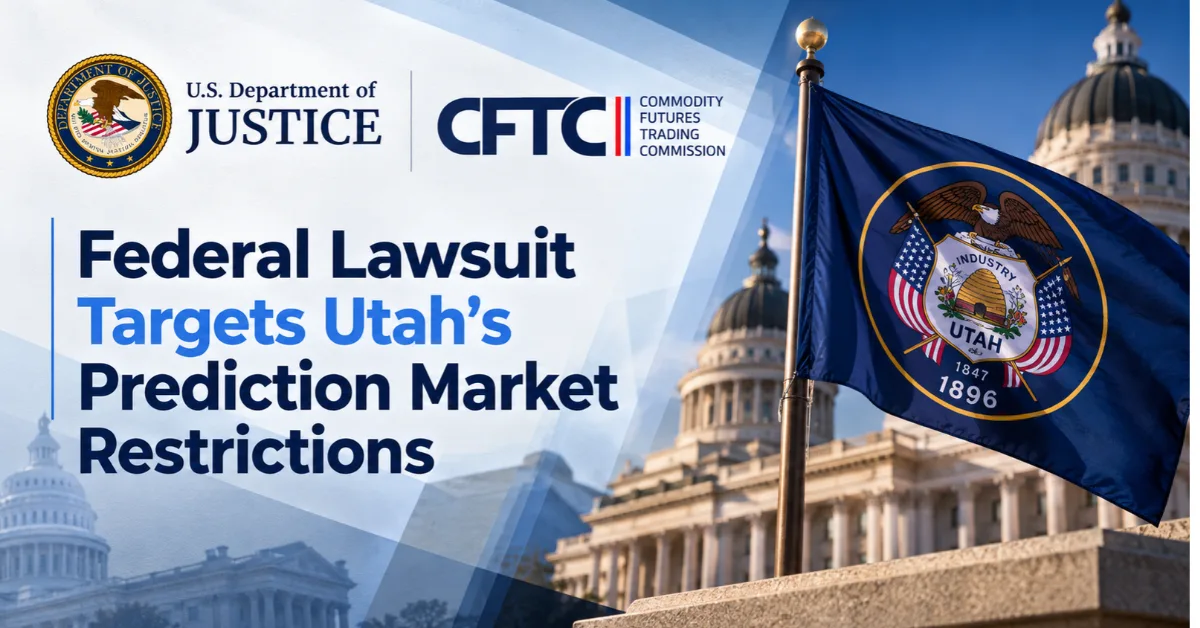
Home News DOJ and CFTC Sue Utah Over State Restrictions on Prediction Markets
DOJ and CFTC Sue Utah Over State Restrictions on Prediction Markets
Why Is the CFTC Taking Utah to Court?
Utah filed a state enforcement action against Kalshi and related businesses on 20 October, alleging that their event contracts constitute illegal gambling under state law.
The federal government disagrees with Utah’s authority to restrict transactions offered through CFTC-regulated exchanges.
In its 27 October official announcement, CFTC Chairman Michael S. Selig said:
Utah seeks to shut down prediction markets across a wide variety of markets.
The federal complaint seeks a declaration that federal law overrides Utah’s gambling restrictions when applied to transactions on CFTC-regulated markets. It also requests preliminary and permanent injunctions against relevant state enforcement actions.
The lawsuit does not seek to overturn Utah’s general gambling prohibition or authorise traditional sportsbooks in the state.
Federal Lawsuit Follows Kalshi's Earlier Utah Court Defeat
The latest action follows an August federal court ruling in Utah’s favour. As Ace Alliance previously reported, a federal judge rejected Kalshi’s argument that CFTC registration prevented the state from enforcing its gambling laws against sports event contracts.
The new lawsuit adds the federal government as a plaintiff in the regulatory jurisdiction dispute. It also builds on the CFTC’s earlier legal action against Arizona, Connecticut and Illinois.
What Does the Dispute Mean for Prediction Market Operators?
The outcome could influence how federally regulated prediction market platforms operate across states with different gambling restrictions. For operators and technology providers, the central question is whether CFTC oversight permits nationwide access to event contracts despite conflicting state gambling laws.
The dispute also comes as the regulator works to distinguish traditional sportsbooks from federally regulated derivatives markets.
No final ruling has been issued in the new Utah lawsuit. Until the courts clarify the boundaries between federal and state authority, prediction market operators face continued regulatory uncertainty across the US.