

Ace Alliance iGaming Awards 2026
Check out the winners.
See The Winners!
Table Of Content :

Rethinking Promotional KPIs: Infingame Links Player Motivation to Measurable Behaviour

trust
Ace Alliance: Delivering Trust Through Expertise
From exclusive events and interviews to real-time market trends, Ace Alliance brings you unbiased, well-informed, and data-driven content. Our editorial team adheres to strict editorial standards, ensuring that the information you receive is not only relevant but also trustworthy.

Built by market experts hosting events since 2023, with our first event in Riga, Latvia gathering over 300 top level iGaming industry executives, Ace Alliance is able to provide you with reliable information from direct interaction with experts and leaders in the sector.
Altay
Altay Celikkaya
Content Manager
Updated:
Reading Time: 5 minutes

Infingame, a leading aggregator in the iGaming industry, is suggesting casino operators rethink how they measure promotional performance, arguing that Challenges, Tournaments and Jackpots should not be judged against the same KPIs when each mechanic is designed to trigger a fundamentally different player behaviour.

Casino promotions are often placed on the same performance dashboard: participation rate, betting volume, GGR uplift, session length and retention are compared campaign by campaign, with the strongest number determining which mechanic is considered successful. According to Infingame, this approach can produce the wrong conclusion.
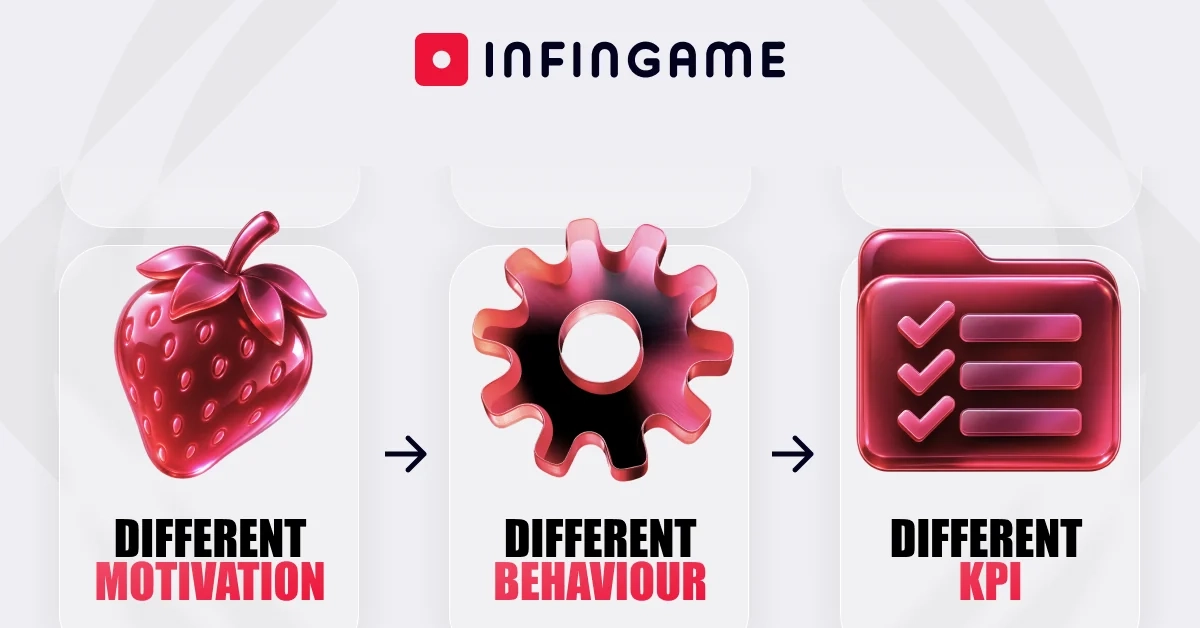
Infingame infographic linking player motivation, behaviour and promotional performance metrics.

A Challenge built around completing a defined number of spins, a Tournament built around competing for leaderboard position and a Jackpot built around the possibility of an unexpected win do not give the player the same psychological reason to participate. Measuring them as though they do risks rewarding the wrong behaviour, and potentially removing mechanics that are doing exactly what they were designed to do.

The principle Infingame proposes is straightforward: different motivation leads to different behaviour, and different behaviour requires a different KPI.
Jana Filagina, Chief Commercial Officer at Infingame said:

Operators have become much better at collecting promotional data, but having more data does not automatically mean measuring the right thing. If one mechanic is designed to create progression, another to intensify competition and another to sustain anticipation, we should not expect their strongest performance signals to look identical. The KPI has to follow the behavioural objective.

Affiliate & Marketing

Challenges: Measure Whether Players Actually Progress

Challenges are built around achievement: a player is given a defined objective and receives a reward after reaching it. That makes raw participation useful, but incomplete.

For Infingame, the more revealing Challenge metrics are completion rate, progression depth, time to completion, repeat Challenge participation and post-completion behaviour.

A campaign may attract a large number of entries but still be poorly calibrated if most players abandon it early. Conversely, a Challenge with a smaller initial audience can be commercially valuable if participants consistently progress, complete objectives and return for subsequent missions.

Operators should therefore look beyond the question of how many players started a Challenge and examine the full progression funnel: eligible, started, progressed, completed, repeated.

Drop-off between these stages can also become a product signal. If participation is high but completion is unusually low, the issue may be the difficulty threshold, reward value, campaign duration or the number of actions required. If completion is high but repeat participation is weak, the mechanic may be succeeding as a one-off incentive without creating a longer engagement loop. This makes completion and repeat behaviour, rather than entry alone, central measures of Challenge performance.

Tournaments: Participation is Only the Beginning

Tournaments solve a different psychological task. Their value comes from competition: players are not simply completing a personal objective but responding to rankings, other participants and a limited campaign window.

Infingame therefore recommends measuring Tournaments through participation, active competitors, rounds or bets per participant, leaderboard movement, session intensity, repeat sessions during the tournament and re-visits across the campaign period.

The distinction matters because two tournaments can produce similar participation numbers while creating very different player behaviour. A campaign attracting 10,000 participants who enter once is not necessarily stronger than one attracting 7,000 players who return several times, increase their activity and repeatedly compete for position.

Infingame already sees different Tournament formats producing different behavioural patterns. Volume-driven formats such as Bet Race tend to support longer sessions and greater wagering activity, while multiplier and peak-event mechanics can create stronger revisit behaviour and moments of heightened engagement. This is one reason operators should avoid applying even a single universal KPI framework across all Tournament formats.

The competitive layer itself should therefore be measured. Useful questions include whether players return after losing leaderboard position, whether activity intensifies as a campaign approaches its end and whether participants increase the number of rounds or sessions compared with their normal baseline.

Jackpots: The Value Is in Opting in and Staying Interested

Jackpots introduce a third behavioural model: anticipation. With Infingame’s Jackpot Chance, players can add an optional contribution to a regular casino round for a chance to win across four jackpot tiers: Mini, Minor, Major and Grand. Players can choose between 1x, 2x and 10x contribution levels, with higher contributions increasing their probability of winning. The mechanic is self-funded through player side bets and can operate across content from multiple providers.

That makes opt-in rate an important first KPI, but again, it should not be the last. Operators can also measure jackpot rounds as a share of total casino rounds or bets, continued participation after initial opt-in, contribution-level selection, movement between contribution levels, return behaviour among opted-in players and incremental GGR generated through side bets.

Live campaign data demonstrates why these metrics need to be considered together. Across observed client campaigns, average jackpot participation has reached 25% of casino bets, while 68% of players who joined during the first month remained opted in and active by month eight. In a separate campaign view, 73% of opted-in players returned in month two.

Looking only at initial opt-in would miss much of this picture. The more important question is whether anticipation remains strong enough for players to continue choosing the jackpot layer after its novelty has passed.

Every Promotion Deserves a Different Analysis

If every mechanic is ranked primarily by immediate GGR uplift, a progression mechanic may appear weaker despite improving repeat behaviour. If everything is ranked by participation rate, a highly competitive Tournament could underperform on paper despite substantially increasing activity among the players who join. If a Jackpot is judged mainly by session length, operators may overlook strong voluntary opt-in and incremental revenue from contributions.

The better approach is to establish the intended behavioural change before the campaign launches and select the primary KPI accordingly. For Challenges, that means asking whether players complete and repeat. For Tournaments, whether they compete and intensify activity. For Jackpots, whether they opt in and continue participating.

Secondary commercial metrics such as GGR, turnover, retention and LTV still matter, but they should show the downstream commercial effect of the behaviour rather than replace the behavioural KPI itself.

Infingame argues that promotional analytics should therefore move closer to experimentation: establish a behavioural hypothesis, define the target player segment, choose the mechanic that corresponds to that motivation, establish a baseline and then measure whether the expected behaviour changed.

Different motivation creates different behaviour. Different behaviour requires a different KPI.

About Infingame

Infingame is a leading game aggregator built to help operators move faster and scale smarter. Through a single API integration, the platform gives access to a portfolio of over 10,000 games from more than 100 providers, allowing partners to launch quickly without dealing with multiple integrations.

Delivered via a single API, Infingame offers unparalleled technical excellence, the industry’s fastest spin times, exclusive tournaments and strategic partnerships with top-tier operators in North America, LatAm and beyond. Spanning a portfolio of slots, crash games, sweepstakes and live casino, book a demo via the LinkedIn page, website or at [email protected].