Ace Alliance Horizon & Speed Rome
Early Bird Passes Available! | November 2, 2026
Get Your Pass!
Table Of Content :

New Zealand Online Casino Auction Begins Under New Tech Rules

trust
Ace Alliance: Delivering Trust Through Expertise
From exclusive events and interviews to real-time market trends, Ace Alliance brings you unbiased, well-informed, and data-driven content. Our editorial team adheres to strict editorial standards, ensuring that the information you receive is not only relevant but also trustworthy.

Built by market experts hosting events since 2023, with our first event in Riga, Latvia gathering over 300 top level iGaming industry executives, Ace Alliance is able to provide you with reliable information from direct interaction with experts and leaders in the sector.
Altay
Altay Celikkaya
Content Manager
Updated:
Reading Time: 4 minutes

New Zealand’s online casino licensing process moves to its second stage on 29 September, when the Department of Internal Affairs begins the auction for up to 15 licence opportunities. Successful bidders will gain only the right to submit a full application in October, with each operator limited to a maximum of three licences.

The auction follows the expression of interest period that closed on 14 August. It marks a significant operational step in the country’s transition towards a fully regulated online casino market, which is expected to become operational in 2027.

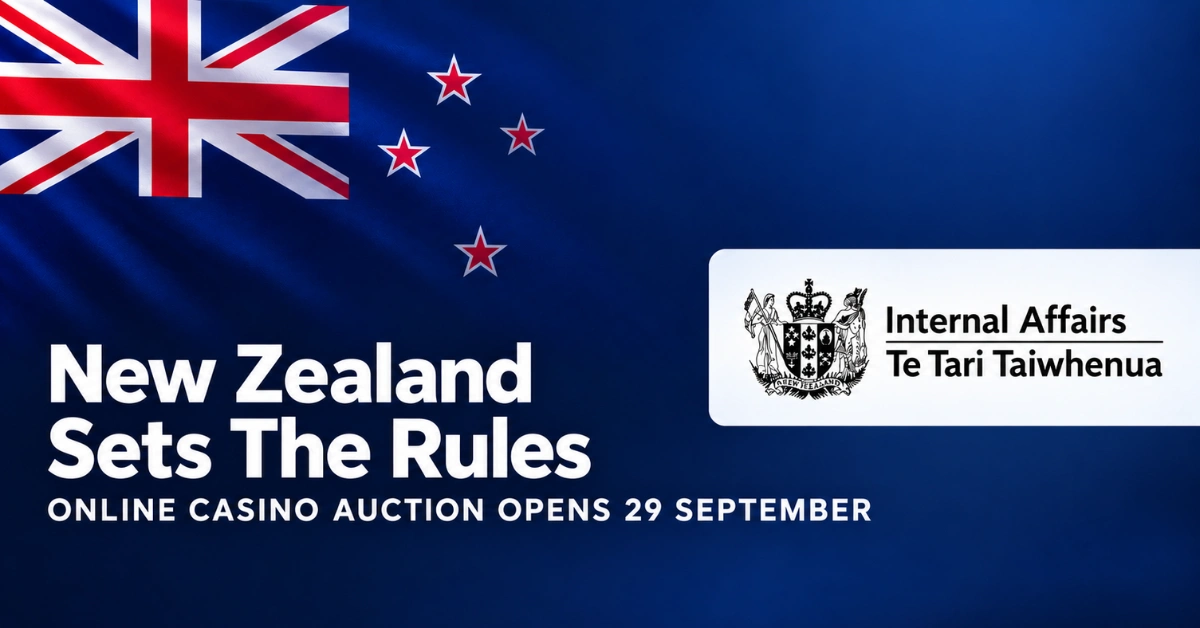
New Zealand flag and Department of Internal Affairs logo announcing the online casino auction opening on 29 September

Regulation & Compliance

Key Takeaways for New Zealand’s Online Casino Auction

  • The online casino licence auction is scheduled to begin on 29 September 2026

  • Successful bidders will receive the right to apply for a licence rather than an automatically approved licence

  • Full licence applications are expected to open in October

  • Up to 15 licences will be available and no operator may control more than three

  • New Zealand’s minimum technology standards are final and already in force

  • Additional testing and monitoring requirements remain a discussion draft and may change

  • Operators need to prepare technical evidence, supplier records and independent testing documentation

Ascending Auction Will Determine Who Can Apply

According to the DIA’s information for online casino providers, only applicants whose expressions of interest were accepted can participate in the auction.

The competitive process will use an ascending clock format. Participants will be presented with progressively higher price points and must decide whether to remain in the process or withdraw. The auction will continue until demand is aligned with the number of available licence opportunities.

The DIA said:

The competitive process will take place as an ascending clock auction.

This method is intended to establish a common market price while treating qualified participants consistently. However, operators should regard the auction payment as a market-entry cost rather than the purchase of regulatory approval.

Winning a lot provides the right to apply under the country’s three-stage licensing system. It does not confirm that the bidder is suitable to hold a licence or that its platform meets New Zealand’s regulatory standards.

The structure builds on the framework first outlined when New Zealand introduced its Online Casino Gambling Bill. That legislation established the proposed licence cap, competitive allocation process and central role of the Secretary for Internal Affairs.

Full Applications Will Test Operational Readiness

Successful bidders are expected to submit comprehensive business plans and detailed strategies covering advertising, consumer protection, harm prevention, compliance and market operations.

The DIA will use this information, together with material submitted during the expression of interest stage, to determine whether an applicant is suitable and capable of meeting its continuing obligations.

Operators should therefore have governance structures, compliance ownership and supporting documentation ready before applications open. Auction success without adequate operational preparation could leave a bidder unable to demonstrate that its business and technology are ready for the regulated market.

The application process also sits within a broader implementation timeline. Ace Alliance previously reported that New Zealand’s regulated online casino rollout was tracking towards early 2027, allowing the government additional time to complete secondary rules and regulatory systems.

Providers that have not applied for a licence will generally be required to cease offering online casino gambling in New Zealand from 1 December 2026. Existing providers with an application under consideration may continue operating under transitional provisions, but without advertising, until a decision is reached.

Final Technology Standards Are Already in Force

The DIA has published two distinct layers of technology requirements, and operators should not treat them as interchangeable. The Online Casino Gambling Minimum Standards 2026 are final. They took effect on 8 July and establish binding technical and operational requirements for licensed platforms.

The standards cover customer limit-setting tools, breaks in play, time-outs, self-exclusion, customer support, progressive jackpots, game design, random number generation and live dealer operations. They also include information-security, payment-processing and hosting requirements.

For example, payment service providers must comply with PCI DSS requirements. Online casino technology must also implement controls for system security, access management, monitoring, cryptography, secure development and technical vulnerability management. These requirements form part of the legal compliance baseline against which licence applicants and future operators will be assessed.

Testing and Monitoring Proposals Remain Draft

Separately, the DIA has released a September discussion draft covering testing and monitoring requirements. Both the final standards and the draft document are available through the department’s official online gambling resources page.

Unlike the minimum standards, the testing and monitoring document is not yet a final regulatory instrument. Its provisions should therefore be described as proposed requirements rather than settled obligations.

The draft outlines independent testing expectations for games, random number generators, live dealer operations and critical platform systems. It also covers source-code controls, change management, security assurance, return-to-player monitoring and periodic platform certification.

Applicants may need to maintain registers identifying games, RNGs, technology suppliers, software versions, hosting locations and test certificates. Operators would remain responsible for compliance even when technology is supplied by third parties.

Independent technical assessment is becoming a more formal component of market entry across regulated jurisdictions. Ace Alliance’s coverage of GLI’s accreditation as an iGaming testing laboratory illustrates how regulators increasingly rely on approved laboratories to verify system integrity without transferring the final approval decision.

For New Zealand bidders, the operational message is clear. Auction preparation cannot be separated from technical readiness. Operators must build an evidence base showing that their platforms, suppliers and internal controls satisfy the final minimum standards while remaining adaptable to testing proposals that may still change.