

Ace Alliance Horizon & Speed Rome
Early Bird Passes Available! | November 2, 2026
Get Your Pass!
Table Of Content :

Philippine House Bill Targets Online Gambling Advertising and Affiliate Marketing

trust
Ace Alliance: Delivering Trust Through Expertise
From exclusive events and interviews to real-time market trends, Ace Alliance brings you unbiased, well-informed, and data-driven content. Our editorial team adheres to strict editorial standards, ensuring that the information you receive is not only relevant but also trustworthy.

Built by market experts hosting events since 2023, with our first event in Riga, Latvia gathering over 300 top level iGaming industry executives, Ace Alliance is able to provide you with reliable information from direct interaction with experts and leaders in the sector.
Altay
Altay Celikkaya
Content Manager
Updated:
Reading Time: 3 minutes

Cebu Third District Representative Karen Hope Garcia has filed legislation that would prohibit the advertising, promotion, endorsement and sponsorship of online gambling across the Philippines. House Bill 10982 was filed on 26 August 2026 and read in the House on 1 September, when it was referred to the Committee on Games and Amusements. The measure remains a proposal and has not created an enforceable nationwide ban.

Its scope is designed around how digital gambling pencils products acquire customers rather than around traditional media. Affiliates, influencers, technology platforms and media owners would therefore have to follow its progress alongside operators.
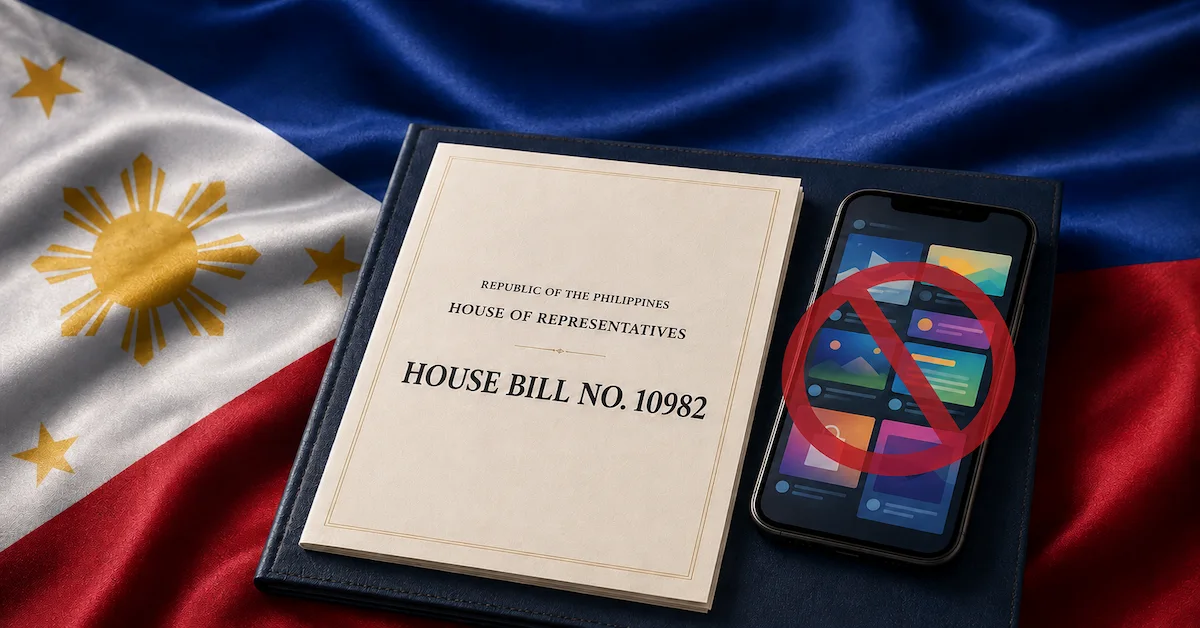
Philippine House Bill 10982 beside a smartphone displaying a ban on online gambling advertisements

Regulation & Compliance

Key Takeaways for the Philippine Online Gambling Market

  • House Bill 10982 remains pending and does not impose a nationwide advertising ban.

  • The proposal would cover affiliates, influencers, paid search, bonuses, referral codes, email and SMS.

  • Media platforms and advertising technology providers could face additional compliance obligations if the measure advances.

  • Stronger age and identity checks would form part of the proposed player-protection framework.

Proposed Controls Reach the Full Marketing Funnel

According to reporting on the House Bill 10982 proposal, the measure would cover television, radio, print, billboards, websites, mobile applications and social media. Reported provisions extend its reach to streaming services, search advertising, targeted digital campaigns, direct messages, email and SMS.

Promotional mechanics would also fall within the bill’s scope. Bonuses, free bets and referral codes would be treated as forms of advertising, while sponsorships and paid endorsements would be covered alongside conventional campaigns. This approach reflects how online gambling acquisition typically involves several marketing touchpoints before a user registers or makes a deposit.

Garcia linked the proposal’s broad scope to the ease with which promotional content can place gambling products directly in front of mobile users. She said:

Nobody asked for a casino on their phone, open 24 hours a day.

Her remarks underline the proposal’s focus on exposure driven by livestreams, social media promotions and referral-led acquisition, particularly when these channels reach young people or financially vulnerable audiences.

Affiliate Marketing Becomes a Direct Compliance Issue

The explicit inclusion of affiliate marketers would move third-party acquisition into the centre of regulatory risk. Operators could need stronger approval processes for affiliate content, traffic sources, promotional codes and audience targeting. Contracts may require rights to suspend campaigns, remove material quickly and audit how partners describe gambling products.

This direction is consistent with the Philippines’ wider enforcement campaign against unlicensed gambling networks, which has increased scrutiny of promoters, affiliates and facilitators directing users towards unauthorised platforms. For B2B suppliers, the exposure may extend beyond the advertiser to agencies, ad-technology providers, publishers and distribution platforms.

If the bill advances, businesses will need to distinguish ordinary editorial discussion from paid or incentivised promotion. They will also need geolocation and campaign-governance controls because content created outside the Philippines can still reach Filipino audiences through global platforms.

Licensed Gambling and Player Protection Remain Distinct

The proposal would prohibit online gambling promotion while regulating, rather than automatically banning, advertising for specified legal and licensed gambling activities. These include authorised casinos, Philippine Charity Sweepstakes Office products, horse racing and licensed cockfighting. The distinction will be important, but the final boundaries cannot be assumed while the bill remains in committee.

That policy tension is visible in PAGCOR’s planned player-protection app, which is intended to steer users towards authorised platforms and give them access to formal dispute resolution. A broad advertising restriction could reduce exposure to gambling while also changing how licensed businesses differentiate themselves from unlicensed competitors.

House Bill 10982 would strengthen age and identity verification for online accounts. This places marketing controls within a wider consumer-protection framework rather than treating advertising as an isolated issue.

Gambling Harm Shapes the Legislative Case

Garcia cited the risk that persistent promotion can normalise gambling and contribute to debt, addiction and family hardship. The debate comes after the launch of PAGCOR’s national problem gambling helpline, reflecting institutional attention to the social costs from round-the-clock digital access.

The bill’s official record confirms that it provides for judicial and administrative enforcement, treatment and rehabilitation, and penalties. Specific fine, imprisonment and platform-liability provisions should nevertheless be checked against the lodged text before publication or compliance decisions are based on them. Operators, affiliates and marketing suppliers should monitor committee action and any amendments rather than treating the proposal as the final regulatory model.