Ace Alliance Horizon & Speed Rome
Early Bird Passes Available! | November 2, 2026
Get Your Pass!
Table Of Content :

Philippines Q2 Gaming GGR Falls 20.3% as Electronic Segment Contracts

trust
Ace Alliance: Delivering Trust Through Expertise
From exclusive events and interviews to real-time market trends, Ace Alliance brings you unbiased, well-informed, and data-driven content. Our editorial team adheres to strict editorial standards, ensuring that the information you receive is not only relevant but also trustworthy.

Built by market experts hosting events since 2023, with our first event in Riga, Latvia gathering over 300 top level iGaming industry executives, Ace Alliance is able to provide you with reliable information from direct interaction with experts and leaders in the sector.
Altay
Altay Celikkaya
Content Manager
Updated:
Reading Time: 4 minutes

The Philippine gaming industry generated PHP88.14 billion in gross gaming revenue (GGR) during the second quarter of 2026, down 20.33% from PHP110.63 billion a year earlier, according to the Philippine Amusement and Gaming Corporation (PAGCOR).

The annual contraction was concentrated in electronic gaming. Revenue from E-Games, E-Bingo, bingo and poker fell 37.21% to PHP39.85 billion, while licensed casinos increased GGR by 2.93% to PHP45.38 billion. That divergence moved licensed casinos back ahead of the electronic segment as the market’s largest contributor.

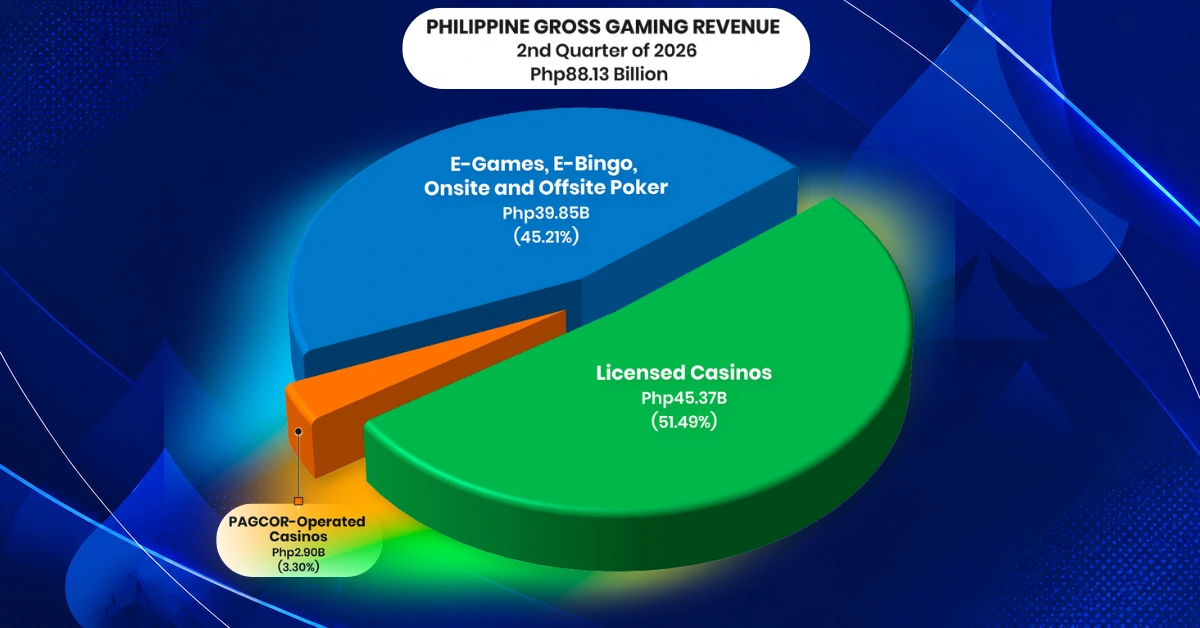
3D pie chart showing Philippine Q2 2026 gross gaming revenue of PHP88.13 billion.

Markets & Regions

Philippines Q2 GGR: The Market Shift at a Glance

  • Total gaming revenue: Philippine GGR reached PHP88.14 billion in Q2 2026, down 20.33% year on year but up 0.61% from Q1, indicating a sharp annual decline rather than a fresh sequential slowdown.

  • Electronic segment: E-Games, E-Bingo, bingo and poker generated PHP39.85 billion, down 37.21% from Q2 2025 and broadly flat quarter on quarter. Their combined market share fell from 57.37% to 45.21%.

  • Digital revenue mix: Electronic games contributed PHP36.25 billion, bingo operations PHP3.57 billion, and onsite and offsite poker a combined PHP35.37 million.

  • Licensed casinos: GGR increased 2.93% year on year to PHP45.38 billion, giving the segment a 51.49% market share and restoring it as the industry’s largest contributor.

  • First-half picture: Philippine GGR totalled PHP175.74 billion in H1 2026, down 18.17% from PHP214.75 billion a year earlier. PAGCOR’s own gaming-operation revenue fell 27.11% over the same period.

  • Why it matters: PAGCOR cited inflation and Middle East tensions, while the market also faced a high comparison base and payment-access restrictions introduced after Q2 2025. The published data does not quantify the effect of each factor, so no single cause can be assigned to the decline.

Electronic Gaming Drives the Annual Decline

PAGCOR’s official quarterly dataset shows that electronic games contributed PHP36.25 billion in Q2. Bingo operations added PHP3.57 billion, while onsite and offsite poker generated a combined PHP35.37 million.

Together, those activities represented 45.21% of industry GGR, compared with 57.37% in Q2 2025. Their combined revenue declined by PHP23.62 billion year on year, slightly more than the PHP22.49 billion reduction in total industry GGR.

PAGCOR Chairman and CEO Alejandro Tengco said the electronic-gaming weakness coincided with wider economic and geopolitical pressures.

The decline was driven by several factors, including the impact of inflation and the geopolitical crisis in the Middle East.

The regulator did not publish a more detailed breakdown of the causes behind the electronic segment’s decline.

The comparison also comes against a strong base. Electronic gaming reached PHP63.47 billion in Q2 2025, its highest quarterly result that year. In August 2025, after that comparison period, the Bangko Sentral ng Pilipinas suspended in-app gambling access through payment providers’ mobile apps and websites. PAGCOR later said the resulting e-wallet delinking disrupted player access and payment channels.

The published data does not isolate how much of the current decline reflects payment restrictions, economic pressure or other factors. It therefore supports identifying these as relevant context, rather than assigning the change to a single cause.

Licensed Casinos Regain the Largest Market Share

Licensed casinos generated PHP45.38 billion, equivalent to 51.49% of Q2 industry GGR. The segment’s 2.93% annual growth contrasts with the decline in electronic gaming and lifted its market share from 39.85% a year earlier.

Entertainment City and other National Capital Region properties accounted for PHP36.83 billion of licensed-casino GGR. Clark contributed PHP6.10 billion, greenfield-zone casinos PHP2.17 billion and Fiesta properties PHP278.66 million.

Casinos operated directly by PAGCOR produced a further PHP2.91 billion, down 5.42% year on year and representing 3.30% of the market.

Q2 Holds Broadly Stable Against the First Quarter

Although the year-on-year comparison is sharp, total GGR increased 0.61% from the PHP87.60 billion recorded in Q1 2026. Licensed-casino revenue rose 1.92% quarter on quarter, while electronic gaming was virtually unchanged, slipping 0.12%.

This indicates that the market was broadly stable between Q1 and Q2, even though both quarters remained below their respective 2025 comparisons. The lower 2026 baseline is still material: first-half industry GGR was PHP175.74 billion, down 18.17% from PHP214.75 billion in H1 2025.

PAGCOR’s own corporate results show the fiscal impact. The regulator reported that its total revenue fell 26.64% in the first half of 2026, while revenue from gaming operations declined 27.11%.

What the Change in Revenue Mix Means

Electronic and online gaming became the Philippine industry’s largest segment in 2025, contributing 50.77% of full-year GGR. The second-quarter result reverses that position, at least for now, and places licensed casinos back above half of the market.

For electronic-gaming operators and suppliers, the next quarters will show whether revenue has stabilised around the Q1–Q2 level or whether the annual decline persists. The operating backdrop has also changed: PAGCOR’s minimum guaranteed fee for gaming system administrators took effect on 1 April, while policymakers continue to debate the appropriate balance between consumer protection, market access and regulated online-gaming revenue.

For the wider market, the Q2 figures point to resilience in licensed casinos rather than a uniform decline across Philippine gaming. The principal weakness remains digital, and the available data does not yet demonstrate a return to the rapid electronic-gaming growth recorded in 2025.