
Ace Alliance Horizon & Speed Rome
Early Bird Passes Available! | November 2, 2026
Get Your Pass!
Table Of Content :

New Study Finds Election Prediction Markets Influence Voter Perceptions

trust
Ace Alliance: Delivering Trust Through Expertise
From exclusive events and interviews to real-time market trends, Ace Alliance brings you unbiased, well-informed, and data-driven content. Our editorial team adheres to strict editorial standards, ensuring that the information you receive is not only relevant but also trustworthy.

Built by market experts hosting events since 2023, with our first event in Riga, Latvia gathering over 300 top level iGaming industry executives, Ace Alliance is able to provide you with reliable information from direct interaction with experts and leaders in the sector.
Altay
Altay Celikkaya
Content Manager
Updated:
Reading Time: 2 minutes

A new study supported by the Brennan Center for Justice found that election prediction market odds can shape how voters assess candidates’ chances of winning. Published on 20 October 2026, the research showed that favourable market probabilities increased perceptions of a candidate’s likelihood of victory by 10 to 20 percentage points, even when traditional polling figures suggested otherwise.

The findings come as platforms including Kalshi and Polymarket gain visibility in US election coverage. The research also found widespread public scepticism about prediction markets and strong support for tighter regulation.
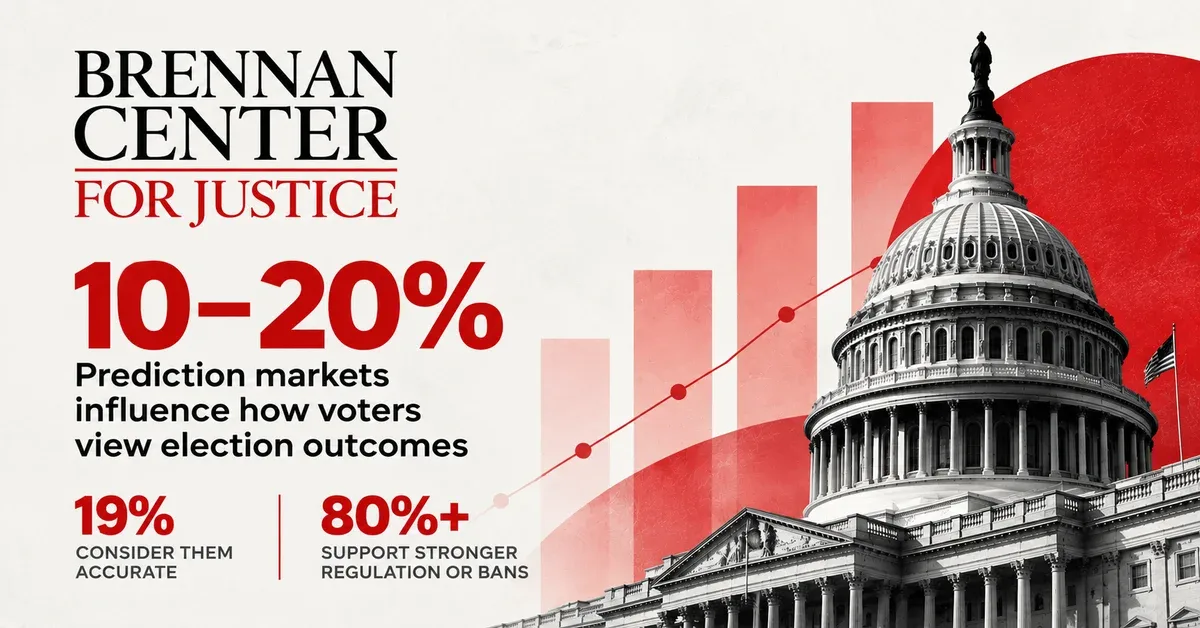
Brennan Center research graphic featuring the U.S. Capitol, election forecasts and key voter survey statistics.

Industry News

Key Takeaways From the Prediction Markets Study

  • The research surveyed 1,994 registered US voters on 21 September 2026.

  • Favourable prediction market odds increased perceptions of a candidate’s likelihood of winning by 10 to 20 percentage points.

  • Only 19% of respondents considered election prediction markets accurate.

  • More than 80% supported stronger regulation or bans on certain or all prediction markets.

  • The findings concern expectations about election outcomes, not changes in actual voting behaviour.

Market Probabilities Influence Expectations About Election Results

According to the Brennan Center’s published research, participants assessed hypothetical congressional candidates using background information, NBC News polling estimates and Kalshi prediction market probabilities. Researchers varied the polling figures and market odds independently to examine how each influenced expectations.

When a candidate’s Kalshi probability increased from 50% to 67%, respondents became 10 percentage points more likely to identify that candidate as the expected winner. At 84%, the increase reached 20 percentage points.

Lower probabilities produced the opposite effect. Candidates assigned a 16% probability were 19 percentage points less likely to be identified as likely winners. The researchers found that prediction market figures had an influence comparable to conventional polling estimates.

However, the experiment measured perceived electability rather than voting intentions or actual election results. It therefore does not establish whether exposure to prediction markets changes how people vote.

Public Scepticism Persists Despite Market Influence

The study identified a difference between respondents’ confidence in prediction markets and their responses to the probabilities presented. Only 19% considered election prediction markets accurate, compared with 37% who expressed confidence in traditional polling.

Similarly, 29% believed prediction markets represented public opinion, while 55% said the same about conventional polls. Unlike opinion polls, prediction market probabilities reflect prices determined through trading activity rather than responses collected from representative voter samples.

The findings add another dimension to ongoing US disputes over prediction market regulation, where regulators and market operators have contested the boundaries of federal and state authority.

Study Finds Widespread Support for Stronger Regulation

The research also examined respondents’ preferences for government oversight. Nearly half (48%) supported stronger regulation of prediction markets. Another 23% favoured banning certain categories, while 16% supported a complete ban—only 14% opposed regulation.

Researchers also tested whether warning participants about prediction markets reduced the influence of market probabilities. The warning produced no measurable change.

These findings emerge alongside wider regulatory developments, including the CFTC’s rulemaking process for prediction markets and state-level challenges involving Kalshi.

The study provides evidence that market probabilities can shape expectations even among sceptical respondents. Whether those effects extend to real-world voting behaviour remains an unanswered question.