Ace Alliance Riga
Ace Alliance Riga
Event Agenda | August 6-7, 2026
Sold Out
Table Of Content :

Inside The US Betting Industry’s $72m Political Campaign

trust
Ace Alliance: Delivering Trust Through Expertise
From exclusive events and interviews to real-time market trends, Ace Alliance brings you unbiased, well-informed, and data-driven content. Our editorial team adheres to strict editorial standards, ensuring that the information you receive is not only relevant but also trustworthy.

Built by market experts hosting events since 2023, with our first event in Riga, Latvia gathering over 300 top level iGaming industry executives, Ace Alliance is able to provide you with reliable information from direct interaction with experts and leaders in the sector.
Altay
Altay Celikkaya
Content Manager
Updated:
Reading Time: 4 minutes

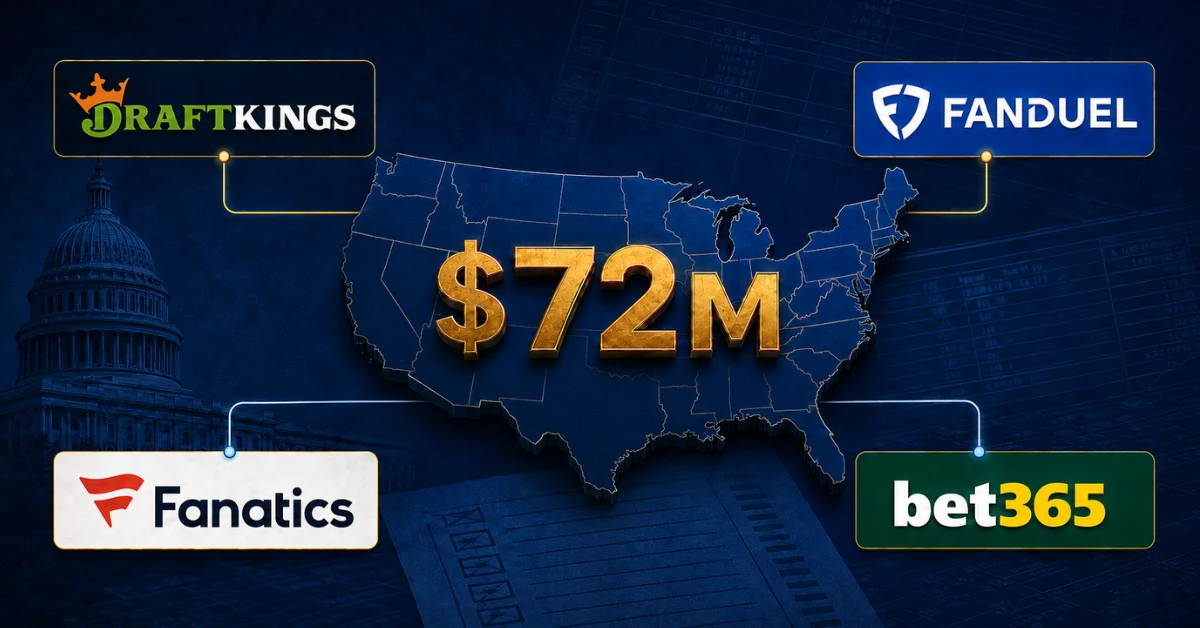
DraftKings, FanDuel, Fanatics and bet365 have committed $72 million to a bipartisan US political campaign as the betting industry seeks influence over elections and policy. The spending comes as major operators face state battles over market access and taxation alongside a growing federal–state dispute over the regulation of prediction markets.

Graphic illustration of the US betting industry’s $72 million political campaign, featuring four major operators and the US Capitol.

Regulation & Compliance

Key Takeaways From The Betting Industry’s $72m Political Campaign

  • Win for America received $72 million from DraftKings, FanDuel, Fanatics and bet365 through 30 June 2026.

  • DraftKings contributed at least $34 million, followed by FanDuel with $27 million.

  • Affiliated groups have backed candidates from both major parties, including in 34 Georgia legislative races.

  • State licensing, betting taxes and prediction-market regulation are increasing the commercial value of political influence.

  • The filings show the scale and destination of the money but do not establish a single shared policy objective.

Four Operators Back A $72m Election Campaign

DraftKings, FanDuel, Fanatics and bet365 have supplied $72 million to Win for America, placing the online betting sector among the largest sources of corporate political funding in the 2026 US election cycle.

The Federal Election Commission’s financial summary shows that the super PAC received the money between its registration on 5 November 2025 and 30 June 2026. It reported almost $69.9 million in disbursements, including $68.05 million contributed to other committees, and held approximately $2.1 million at the end of the period.

According to Reuters, DraftKings provided at least $34 million, and FanDuel contributed at least $27 million. Fanatics and bet365 each supplied $5.5 million.

The scale of the campaign marks a shift beyond conventional lobbying and trade-association advocacy. Major operators are now financing election activity across both parties as regulatory decisions become increasingly important to their growth strategies.

State Policy Battles Drive The Spending

Although Win for America is registered at federal level, much of its activity is focused on state politics. State lawmakers determine whether sports betting and online casino gaming can operate, how licences are awarded and how heavily operators are taxed.

Win for America has routed funds through American Future, which supports Democratic candidates, and the Republican-aligned American Conservative Fund. That structure allows the industry to support candidates according to regulatory priorities rather than a single party affiliation.

Reuters reported that the two groups directed more than $12 million into 34 Georgia legislative races. All but two of the supported candidates won. Georgia has repeatedly considered legalising sports betting, making the composition of its legislature commercially significant for companies seeking entry to the state.

The network has also been active in Pennsylvania, where policymakers have considered increasing online sports-betting taxes. Comparable fiscal pressure is emerging elsewhere, including New Jersey’s proposed temporary betting surcharge linked to World Cup costs.

Political funding does not guarantee a particular vote or regulatory outcome. However, its scale shows that operators increasingly treat elections as part of market-access and tax strategy.

Prediction Markets Raise The Federal Stakes

Prediction markets have added a federal dimension to a business traditionally regulated by individual states.

Platforms offering sports event contracts operate under Commodity Futures Trading Commission oversight. State regulators and the licensed gaming industry argue that these products can resemble conventional wagers while avoiding state licensing, gaming taxes and consumer-protection requirements.

The distinction is no longer simply a contest between sportsbooks and outside challengers. DraftKings, FanDuel and Fanatics have developed prediction-market products of their own. DraftKings’ 2025 annual report, for example, confirms that DraftKings Predictions launched in December 2025 under CFTC oversight.

Major operators therefore have interests in both systems. Their established betting businesses benefit from state licensing regimes, while prediction products may offer broader access through a federal framework.

That balance remains uncertain. As Ace Alliance previously reported, 41 state Attorneys General have urged the CFTC to preserve state authority over sports-related prediction markets.

Recent cases involving Kalshi have increased the uncertainty. New York filed a lawsuit on 31 July alleging that the platform was operating an unlicensed gambling business. A federal judge has also allowed Utah to enforce its gambling laws against Kalshi’s sports event contracts while litigation continues.

Those proceedings concern Kalshi rather than the operators funding Win for America, and they do not determine how other prediction products will be treated. They nevertheless show why federal policy and state enforcement now matter simultaneously to the betting sector.

Political Influence Becomes an Industry Strategy

Election funding is only one part of the sector’s expanding political activity. OpenSecrets data cited by Reuters shows that DraftKings spent approximately $900,000 on federal lobbying in 2025, more than twice its 2024 total. FanDuel spent $1.1 million, around seven times its previous annual figure.

The available filings do not prove that Win for America’s funds target prediction-market policy, nor do the four contributors necessarily share an identical regulatory agenda. Their businesses, products and state footprints differ.

The broader pattern is still clear. Licensing votes, tax proposals, enforcement actions and federal decisions can each change the economics of operating across the US. Supporting candidates and maintaining access to policymakers has therefore become a material part of how betting companies manage regulatory risk.

The $72 million campaign is significantly less for any single election result than for what it reveals about the industry. Political influence is moving closer to the centre of market-access planning as operators compete across state-regulated betting and federally overseen prediction markets.