2026 iGaming Trendbook
Expert Insights from 50+ Industry Leaders
Download Now
Table Of Content :

Ace Alliance x SlotCatalog Report: The Seasonal Slots Race – Easter vs St Patrick’s Day

trust
Ace Alliance: Delivering Trust Through Expertise
From exclusive events and interviews to real-time market trends, Ace Alliance brings you unbiased, well-informed, and data-driven content. Our editorial team adheres to strict editorial standards, ensuring that the information you receive is not only relevant but also trustworthy.

Built by market experts hosting events since 2023, with our first event in Riga, Latvia gathering over 300 top level iGaming industry executives, Ace Alliance is able to provide you with reliable information from direct interaction with experts and leaders in the sector.
Darko Ilievski
Lead Editor
Updated:
Reading Time: 8 minutes
Ace Alliance x SlotCatalog report cover image with blue gradient background, featuring the title The Seasonal Slots Race: Easter vs St Patrick’s Day and both brand logos.

Seasonal slots take centre stage in this report, examining how Easter overtook St Patrick’s Day in both new releases and operator visibility. Built for operators, product teams, and content strategists, this analysis breaks down saturation levels, provider behaviour, and performance metrics, showing how timing, catalogue size, and differentiation now shape seasonal slot success in 2025.

iGaming
Market Context: When More Becomes Less

In 2025, volume stopped translating into revenue. The global gambling market moves toward $600.98 billion, yet operators see stronger retention (up to 34%) only when seasonal campaigns feel consistent and clearly themed. Add more titles and the effect fades. Players don’t engage with clutter; they skip it.

Holiday slots sit in a narrow window. They hold long-term catalogue value, but their real performance depends on short promotional bursts. Operators highlight a handful of games (five, maybe eight) while the rest compete for limited visibility. Once a theme passes 200 titles, discovery tightens. New releases don’t just compete with each other; they compete with years of accumulated backlog. That’s where the decision shifts. Not which holiday to build for, but when to stop.

The Inflexion Point: Easter Surpasses St Patrick’s Day in 2025

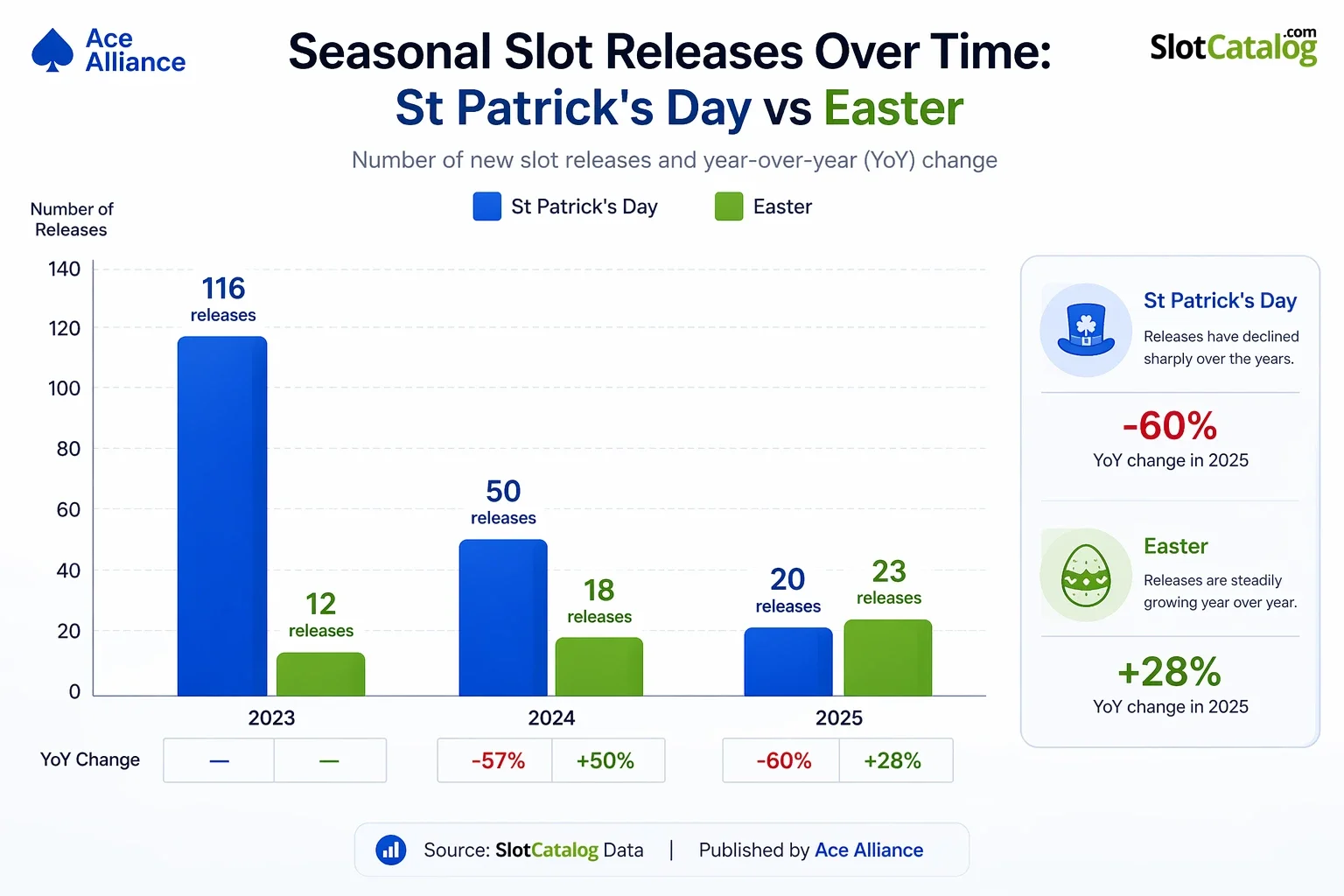
In 2025, Easter overtook St Patrick’s Day in new slot releases. Twenty-three Easter titles were launched, compared to twenty for St Patrick’s Day, the first time this shift appeared in recorded data. The numbers don’t sit there by chance. They reflect pressure building over several years.

Bar chart comparing seasonal slots releases for St Patrick’s Day and Easter from 2023 to 2025, showing a sharp decline for St Patrick’s Day and steady growth for Easter, with year-over-year percentage changes and Ace Alliance x SlotCatalog branding.

The trend starts in 2023. St Patrick’s Day peaked at 116 releases, then dropped to 50 in 2024, and fell again to 20 in 2025. That’s an 83% decline in two years. Fast, not gradual. Production ran ahead of demand, and the market corrected.

Easter followed the opposite path. Twelve releases in 2023, eighteen in 2024, then twenty-three in 2025. A 92% increase across the same period, driven by steady expansion rather than aggressive scaling.

The ratio tells the story clearly. In 2023, St Patrick’s Day outpaced Easter 10 to 1. By 2024, that gap had narrowed. By 2025, it flipped. Easter moved ahead despite a much smaller total catalogue, 71 games compared to 210. Depth alone didn’t protect St Patrick’s Day. Without clear variation between titles, volume turned into friction.

Provider Strategies: Volume Saturation vs. Controlled Expansion

Providers approached seasonal slots in two distinct ways. Some scaled aggressively, pushing high volumes of similar titles into operator lobbies. Others kept output limited, testing mechanics and adjusting based on performance. The difference becomes clear when comparing St Patrick’s Day and Easter.

St Patrick’s Day: High Concentration and Repeated Frameworks

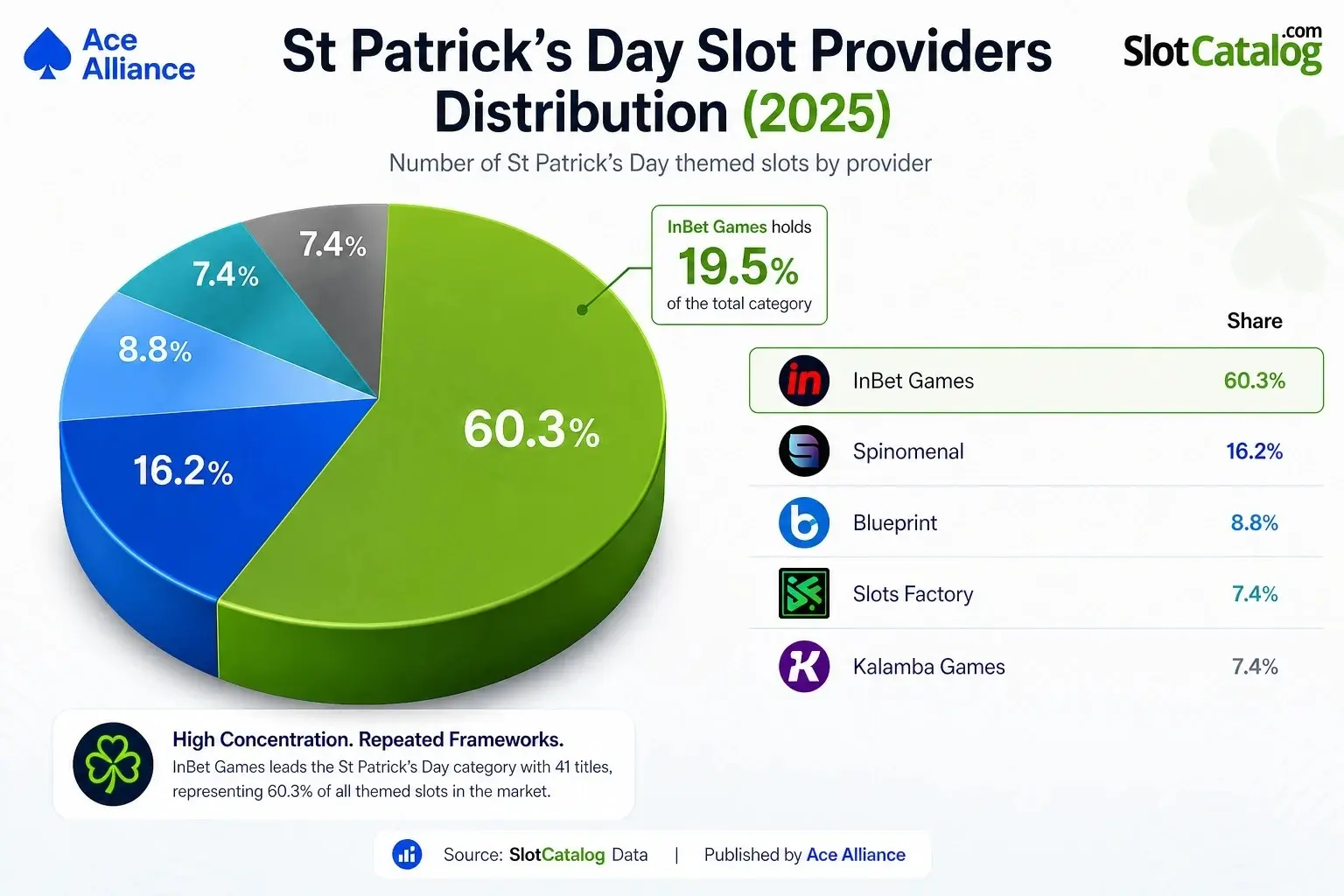
3D pie chart showing St Patrick’s Day slot provider distribution in 2025, with InBet Games dominating 60.3% of releases, followed by Spinomenal, Blueprint, Slot Factory, and Kalamba Games, branded with Ace Alliance and SlotCatalog.

InBet Games controls nearly 20% of the full 210-title catalogue. That level of output points to scale over variation.

The execution stays consistent. Core mechanics get reused across multiple releases, with Irish-themed visuals layered on top. Titles such as Irish Lucky Wheel Respin and Irish Secret follow the same structure—5×3 layout, 10 paylines, and scatter-driven bonuses. Minimal change between games.

This approach matched the demand in 2023, when operators needed volume. By 2025, it lost effectiveness. Lobbies filled up. Discovery narrowed. When multiple titles share the same structure, operators default to known performers. New entries struggle to secure placement.

Easter: Low Concentration and Mechanical Variation

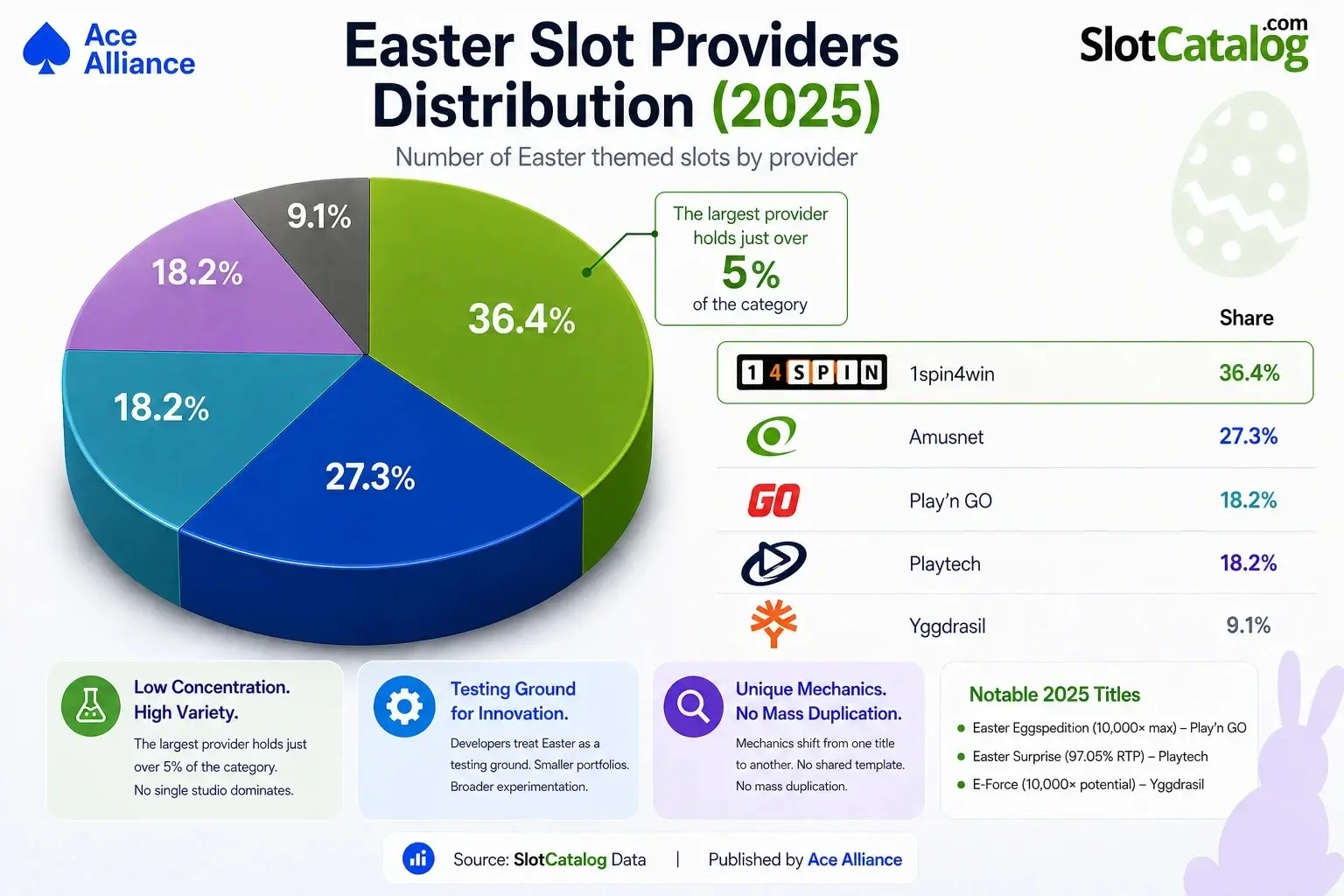
3D pie chart displaying Easter slot provider distribution in 2025, highlighting low concentration with 1spin4win leading at 36.4%, followed by Amusnet, Play’n GO, Playtech, and Yggdrasil, with Ace Alliance and SlotCatalog branding.

The leading provider, 1spin4win, with 4 titles, holds just 5.6% of the Easter category, far below InBet’s 19.5% share in St Patrick’s Day. Developers use Easter as a testing ground, working with smaller portfolios and wider experimentation, where mechanics shift from one title to another instead of repeating.

Titles such as Easter Eggspedition from Play’n GO introduce progression-based gameplay with a 10,000× max win, while Easter Surprise from Playtech offers 97.05% RTP with adjustable paylines, and E-Force from Yggdrasil combines seasonal visuals with sci-fi mechanics. There is no shared template and no mass duplication, so operators assess each title on its own, which improves visibility and increases the chances of selection.

Why St Patrick’s Day Lost Ground While Easter Gained

St Patrick’s Day didn’t lose momentum by accident. Volume pushed too far, variation stayed limited, and operators ran out of space to promote new entries. Easter avoided that pressure. Fewer titles, broader themes, and more room for experimentation kept it moving upward.

The Saturation Trap: From Peak to Contraction

The 116 releases in 2023 didn’t reflect healthy growth. They signalled oversupply. What followed came quickly, an 83% drop to 20 releases by 2025. Four factors drove that contraction:

  • Thematic exhaustion: Irish slots repeat the same visual set, shamrocks, leprechauns, pots of gold, rainbows, and Celtic motifs. After more than 200 titles, new releases struggle to stand apart. Players recognise the structure immediately. Without clear mechanical changes, another Irish slot adds little.

  • Single-day concentration: March 17 limits exposure. Operators promote a small group of titles during that window, usually five to eight. With over 200 options available, most games never surface. Placement becomes unpredictable, and quality alone doesn’t guarantee visibility.

  • Oversupply from dominant providers: InBet Games alone holds 41 titles, close to 20% of the full catalogue. That level of output points to production speed over variation. When multiple titles share similar mechanics, operators rely on familiar performers instead of testing new ones.

  • Performance pressure from legacy titles: Average RTP across St Patrick’s Day slots sits around 95.20%, lower than other seasonal categories. Older games with outdated math models pull the average down. New releases enter a category already weighed by weaker performance metrics, which makes them harder to justify from a commercial standpoint.

Easter: Lower Density, Wider Design Range, Stronger Metrics

Easter didn’t scale through volume. It grew through spacing and variation. From 2023 to 2025, releases increased by 92%, but the category stayed compact. Fewer titles. More room to experiment. That combination kept discovery open and allowed different mechanics to coexist without overlap.

  • Broader thematic range: Easter draws from multiple directions, religious symbolism, spring settings, egg hunts, family themes, and abstract concepts. That range slows repetition. Easter Eggspedition from Play’n GO pushes 10,000× max wins with progression-based gameplay. Easter Surprise from Playtech runs at 97.05% RTP with adjustable paylines. E-Force from Yggdrasil shifts into sci-fi territory. Same holiday. Different execution.

  • Flexible calendar placement: Easter moves each year, landing between late March and late April. That shift spreads promotional activity across different timeframes. Players don’t face identical campaigns year after year. Operators adjust schedules, extend visibility, and avoid stacking releases on a single fixed date.

  • Lower catalogue pressure: Easter holds roughly 5.08% of the seasonal slot market. St. Patrick’s Day sits at 15.01%. That gap reduces competition. Fewer titles compete for the same promotional slots, which increases the chances of new releases getting noticed. Operators searching for variety often turn to Easter to fill seasonal gaps.

  • Stronger performance metrics: Easter slots average around 95.65% RTP, slightly higher than St. Patrick’s Day. That difference points to newer releases built on updated math models. Less legacy weight. Better baseline performance.

2025 Standout Titles: What Actually Worked

The 2025 release cycle didn’t reward volume. It rewarded execution. Both themes produced new titles, but the direction differed. St Patrick’s Day leaned on familiar systems and incremental changes. Easter pushed wider, testing mechanics across different player segments and volatility ranges.

St Patrick’s Day: Familiar Systems, Minor Adjustments

The 20 releases in 2025 signalled stabilisation. Not expansion.

Studios relied on existing frameworks rather than building new ones.

Blueprint Gaming

continued to anchor its position with Megaways-based titles and bonus-buy features, maintaining its six-game presence within the theme.

Pragmatic Play

expanded its Irish portfolio using its standard volatility profiles and free spin mechanics, applied across Celtic visuals.

BGaming

introduced Mechanical Clover, one of the few titles that moved outside the standard approach. The game runs on a 5-payline structure that expands to 27 combinations through a Respin feature, with a 24,360× max multiplier. A steampunk layer replaces traditional Irish styling, creating some separation from the rest of the catalogue.

Kalamba Games

maintained its position with five total titles, focusing on feature-driven gameplay. Adjustable volatility and K-Boost mechanics added variation, though still within familiar boundaries.

The pattern stays consistent. Studios adjusted mechanics around the edges, but the core structure remained unchanged. No release shifted the direction of the category.

Easter: Broader Mechanics, Higher Win Potential

Easter titles in 2025 moved differently. More variation. More risk.

Play'n GO

led with Easter Eggspedition, pushing a 10,000× max win and a 96.29% RTP. The game uses progression-based mechanics instead of standard spin cycles, adding a layer of advancement beyond traditional formats.

Yggdrasil

released E-Force, combining Easter elements with a sci-fi setting and a 10,000× potential. The shift in theme alone sets it apart from conventional seasonal titles.

Playtech

approached the category from another angle with Easter Surprise. A 97.05% RTP (the highest in the segment), paired with 20 adjustable paylines and a 10,000× ceiling. Classic structure, but tuned for performance.

Rubyplay

filled the mid-range with J Mania Golden Eggs. A 2,300× max win and 96.47% RTP position it between high-volatility flagship titles and lower-risk options.

The pattern shifts here. Different mechanics, different pacing, different player targets. Easter didn’t rely on one model. It spread across several, and that spread gave each title space to stand on its own.

What This Means for Seasonal Content Strategy

Seasonal slot performance now depends on timing, catalogue size, and differentiation. Volume alone doesn’t secure visibility. Operators filter aggressively, and only a small portion of titles reach players during key windows. The data from St Patrick’s Day and Easter points to three clear constraints shaping future development decisions.

The 15% Saturation Threshold

St Patrick’s Day sits at 15.01% of the seasonal slot market, and production dropped 83% after reaching that level. That overlap isn’t random. Once a theme crosses roughly 15%, visibility tightens. Operators promote only 5 to 8 titles per event window, while a 210-game catalogue leaves around 97% without exposure. New releases compete against years of existing content, not just current launches. InBet Games alone holds 41 titles, about 19.5% of the category, which pushes supply beyond demand. At this stage, adding more titles doesn’t improve presence. It reduces it. Focus shifts. New entries need stronger mechanics or a different structure. Once a theme crosses 15% market share, additional volume reduces visibility instead of increasing it.

The Whitespace Effect

Easter holds around 5.08% of the seasonal market and recorded 92% growth over three years. Lower density changes how titles perform. With roughly 71 total games, each release faces less competition. Operators actively look for Easter content to balance seasonal campaigns, and “new Easter slot” carries more weight than another Irish-themed release. The broader thematic range slows repetition and allows different mechanics to coexist. This creates space. Fewer titles compete for the same positions, and operators have reasons to include them. Themes below 7% market share tend to show similar conditions, including Diwali, Thanksgiving, Lunar New Year, and Carnival. Lower catalogue density increases visibility per title and creates stronger entry conditions for new releases.

Quality Over Volume

The 2023 spike in St Patrick’s Day releases, with 116 titles, pushed volume beyond what the market could absorb. By 2025, output dropped to 20. The shift moved attention toward execution. Developers now focus on mechanical variation within existing themes, such as Mechanical Clover from BGaming, alongside higher max win targets where 10,000× has become common in Easter releases. RTP positioning also plays a role, with titles like Easter Surprise from Playtech reaching 97.05%. Adjustable volatility systems, including approaches used by Wazdan, add further differentiation.

Before adding a new seasonal title, one question matters: Does it outperform what already exists? Quality now determines inclusion, and volume without improvement leads directly to saturation.

Ace Alliance Expert’s Tip: Only Add What Beats the Benchmark

Ace Alliance Expert’s Tip: Only Add What Beats the Benchmark

Editor's Tip

I recommend applying a replacement test before moving forward with any new seasonal slot. If the title does not clearly outperform existing games in the theme through mechanics, math model, or visual direction, it should not be added. Expanding the portfolio without improving quality increases saturation.

Darko Ilievski
Darko Ilievski
Editor on Ace Alliance

Want to get your personalised report? Reach out to Misha Kachanov, CBO at SlotCatalog, to find out more.