Ace Alliance Horizon & Speed Rome
Early Bird Passes Available! | November 2, 2026
Get Your Pass!
Table Of Content :

Blask x Ace Alliance: Brazil iGaming Offshore Search Share Rises as Affiliate Coverage Falls

trust
Ace Alliance: Delivering Trust Through Expertise
From exclusive events and interviews to real-time market trends, Ace Alliance brings you unbiased, well-informed, and data-driven content. Our editorial team adheres to strict editorial standards, ensuring that the information you receive is not only relevant but also trustworthy.

Built by market experts hosting events since 2023, with our first event in Riga, Latvia gathering over 300 top level iGaming industry executives, Ace Alliance is able to provide you with reliable information from direct interaction with experts and leaders in the sector.
Darko Ilievski
Lead Editor
Updated:
Reading Time: 5 minutes
Centred Brazil betting ban illustration with a glowing globe, smartphone, padlock and falling chart.

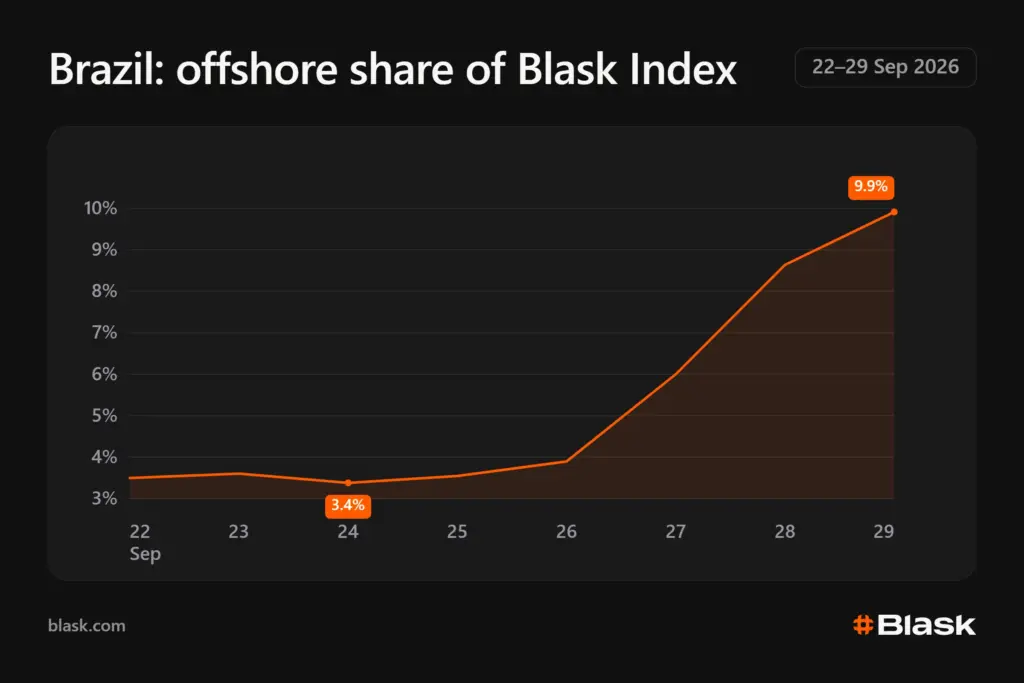
Brazil’s iGaming ban has immediate consequences for operators and affiliates preparing for the scheduled platform shutdown on 6 October. Blask data shows offshore brands’ search share rising from 3.4% to 9.9% between 24 and 29 September 2026, while combined affiliate coverage for the 20 most promoted brands fell 41.5% in the week ending 29 September. These figures capture changes in search visibility and promotional coverage during the transition.

Affiliate & Marketing
Markets & Regions
Regulation & Compliance
Uncategorized

Brazil iGaming Search Interest: A Daily Spike Within a Weekly Decline

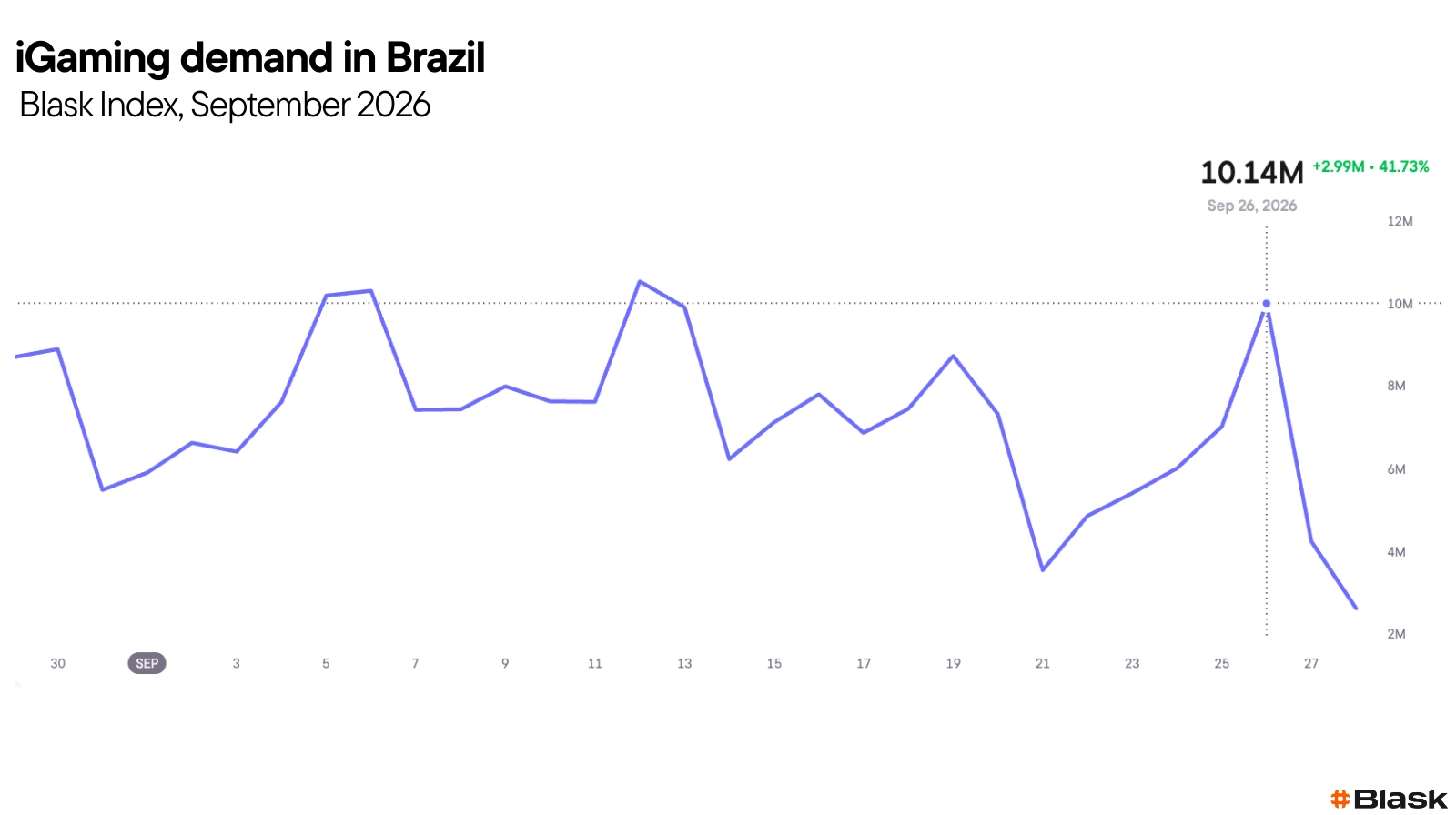
Blask’s weekly report shows Brazil’s iGaming search interest falling 20.1% during 21–27 September 2026 compared with the preceding week. The daily chart shows the Index reaching 10.14 million on 26 September before falling sharply over the following days, within a month that had already recorded several earlier peaks.

Blask chart showing Brazil’s iGaming interest rising on 26 September before falling sharply.

Source: Blask, Brazil weekly digest, 21–27 September 2026.

The daily spike and weekly decline describe different comparisons. Interest can rise sharply from one day to the next while the week’s overall reading remains below the previous week.

The reporting period also straddles the measure’s publication on 25 September. It includes four preceding days and the announcement’s immediate aftermath, providing an early view of the transition before the scheduled platform closure.

Blask’s methodology filters out negative-intent queries associated with complaints, disputes and media coverage. Further query-level evidence would be needed to establish what prompted the spike in filtered brand interest.

How the Betting Ban Changes Brazil’s iGaming Market

President Lula issued Provisional Measure 1,394 on 25 September. It prohibits the operation, offer, intermediation, and advertising of fixed-odds betting across physical and digital channels. Sports betting and online games are covered, while other lottery types authorised by law remain outside the prohibition.

The measure also reaches businesses based overseas that offer these products to people located in Brazil. Moving an operation offshore therefore does not remove it from the prohibition’s scope.

The Ministry of Justice and Public Security’s timetable sets voluntary withdrawals through 23:59 on 5 October, followed by platform blocking from 6 October. New funding into player accounts was restricted from publication, subject to limited exceptions for returning existing funds.

The government also prohibits contracting new betting advertising and sponsorship, while setting a transition deadline for existing material. For affiliates, that makes the status of promotional placements an immediate operational concern.

The Chamber of Deputies confirms that the measure is already in force but requires congressional approval to become permanent law. Our Brazil betting ban timeline and industry response provides the wider background.

Offshore Brands Gain Brazil iGaming Search Share

Blask’s updated analysis puts offshore brands’ share of Brazil’s Blask Index at 9.9% on 29 September, up from 3.4% on 24 September, the day before the measure was published.

That is an increase of 6.5 percentage points, with the share almost tripling over five days. Blask reports that 9.9% was the highest daily offshore share recorded since the regulated market launched on 1 January 2025.

Blask chart showing offshore search share in Brazil rising from 3.4% to 9.9%.

Source: Blask, supplied Brazil iGaming ban analysis; chart covering 22–29 September 2026.

The figures show offshore brands taking a larger proportion of tracked search interest. Establishing whether their absolute interest also increased requires the corresponding Index values: a share can rise even while absolute interest falls, if the wider market contracts faster. Player migration and changes in betting transactions would require separate evidence.

On 27 September, the Brazilian government reported action against 506 suspected betting websites.

The enforcement figures describe suspected supply, while Blask measures search interest. Website counts do not establish how many players used those services or how much money they handled.

Our report on newly detected unauthorised domains examines separate industry monitoring after the prohibition, adding context to the supply-side picture.

Brazil iGaming Affiliate Coverage Falls 41.5%

Blask’s 29 September snapshot shows combined affiliate coverage for the 20 most promoted brands falling from 715 a week earlier to 418, a decline of 41.5%. All 20 brands in the snapshot lost coverage.
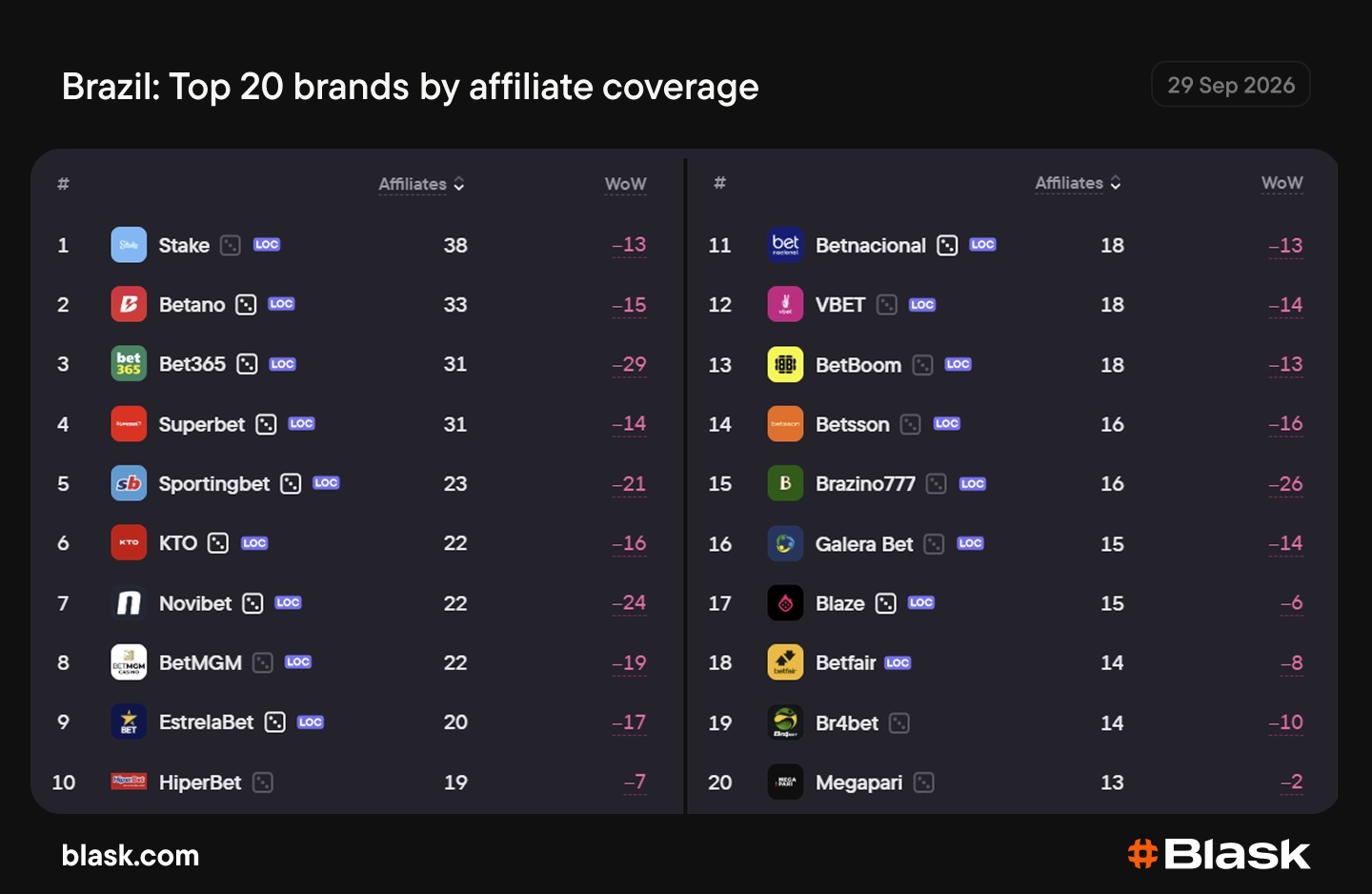
Blask table showing Brazil’s top 20 brands by affiliate coverage on 29 September 2026.

Source: Blask, supplied Brazil iGaming ban analysis; affiliate snapshot dated 29 September 2026.

Bet365 recorded the largest decline, falling from 60 affiliate sites to 31. Stake became the most widely covered brand in the snapshot, although its own count fell from 51 to 38. Betano’s coverage dropped from 48 sites to 33.

Blask’s affiliate coverage metric counts how many tracked sites carry each brand. Because a publisher can feature several brands, the combined total can count the same website more than once. The decline measures reduced coverage across the selected brands; publisher closures, traffic changes and lost commissions require separate data.

The contraction coincides with restrictions on betting intermediation and advertising. It provides an early measure of reduced brand coverage before the scheduled platform blocking.

Smart Social CEO Luiz Felippe Correia de Almeida points to the pressure on affiliates concentrated in one market:

Affiliates that depend only on Brazil are under the most pressure.

Brazil iGaming: Priorities for Operators and Affiliates

Brazil’s policy change alters the commercial meaning of continued search interest. A brand can still attract searches while restrictions prevent it from accepting new deposits or running normal acquisition campaigns.

The latest figures also show why search share and affiliate coverage should be monitored separately. A brand’s relative search position can improve while its promotional coverage falls, and neither measure alone establishes its commercial performance.

Operators and affiliates can use the transition to review several practical areas:

Our Kenya iGaming demand analysis examined an interest spike around postponed football fixtures. Brazil presents a different planning problem: the event changes whether businesses can continue serving that interest.

The immediate business priority is to establish which activities must stop, which obligations remain and how partner exposure is distributed. Data collected after the scheduled closure can then help assess whether the search-share shift and decline in affiliate coverage continue.

References

Additional research: Blask, Brazil’s iGaming ban: offshore share triples as affiliate coverage shrinks, supplied to Ace Alliance by email; data through 29 September 2026.