Ace Alliance iGaming Awards 2026
Check out the winners.
See The Winners!
Table Of Content :

Clash of the Prediction Market Titans: Kalshi vs Polymarket in the Battle for US Prediction Market Demand

trust
Ace Alliance: Delivering Trust Through Expertise
From exclusive events and interviews to real-time market trends, Ace Alliance brings you unbiased, well-informed, and data-driven content. Our editorial team adheres to strict editorial standards, ensuring that the information you receive is not only relevant but also trustworthy.

Built by market experts hosting events since 2023, with our first event in Riga, Latvia gathering over 300 top level iGaming industry executives, Ace Alliance is able to provide you with reliable information from direct interaction with experts and leaders in the sector.
Bearded man with long dark hair in a light gray suit and black tie at an anniversary event.
Darko Ilievski
Lead Editor
Updated:
Reading Time: 6 minutes
Kalshi and Polymarket logos centred on a glowing blue US map.

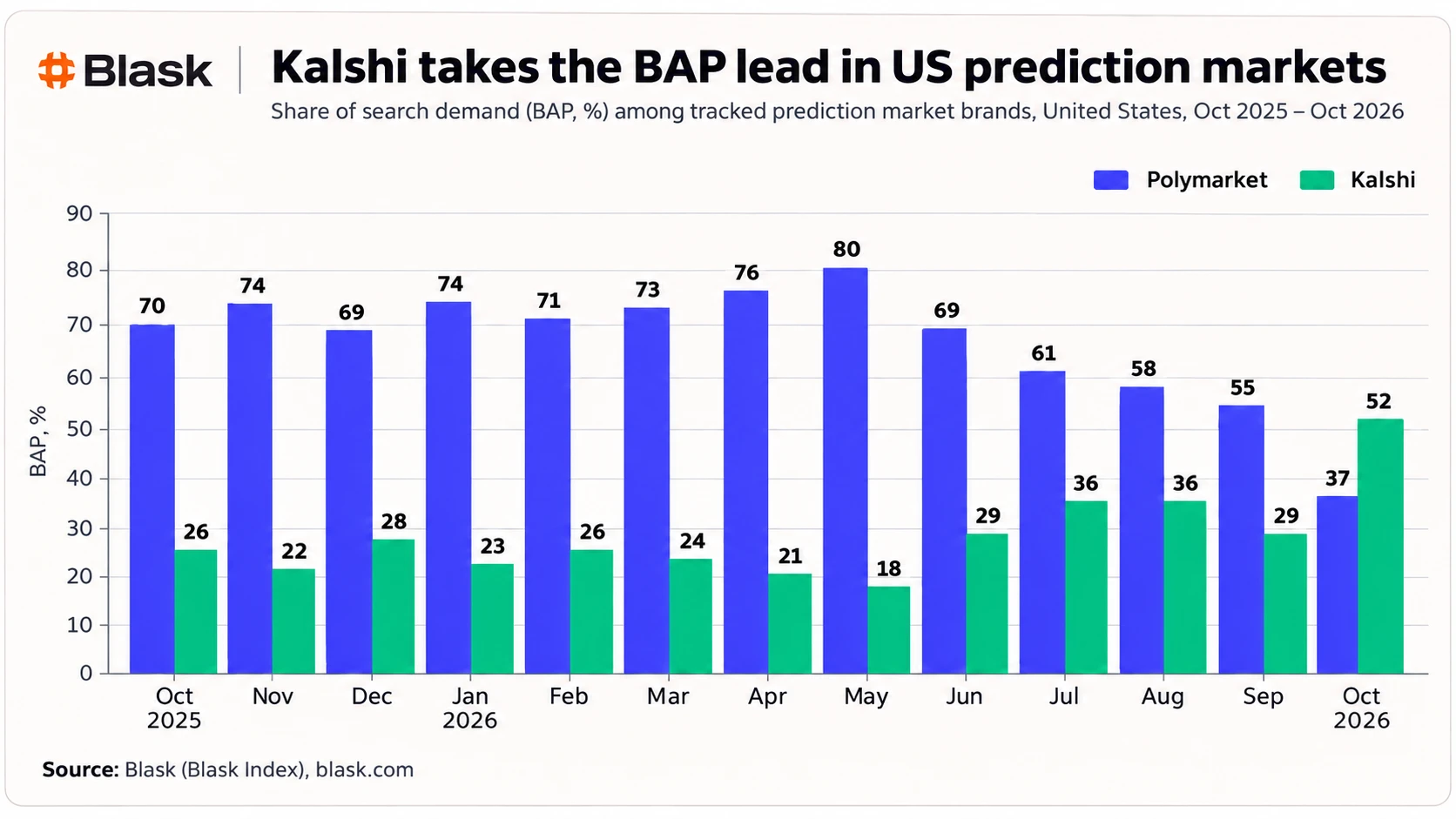
Kalshi ended Polymarket’s 29-month lead in US prediction market searches in October 2026. Kalshi captured 51.8% of tracked branded search demand, against 37.5% for Polymarket, according to Blask. Days later, as the US midterm results came in, Polymarket returned to the top of the daily rankings.

Both exchanges had been courting US sports fans since 2025. Kalshi extended its reach through a brokerage app, and Polymarket made sports the starting point for its US return. By October 2026, both had NBA deals and football parlays accounted for about two-thirds of Kalshi’s reported notional trading volume. Sport gave the exchanges another way to reach people between major political events.

Analysis
Markets & Regions

Kalshi Got a Head Start as Polymarket Prepared Its US Return

Kalshi introduced sports event contracts in January 2025. In March, Robinhood opened a prediction markets hub inside its brokerage app with Kalshi-powered contracts on the men’s and women’s NCAA basketball tournaments. March Madness gave Kalshi a way to put sports trading in front of people who already used Robinhood to invest.

By early October, Kalshi was testing what it called a combo around Monday Night Football. Customers could tie a team’s result and a player’s performance to a single contract, applying the logic of a sportsbook’s same-game parlay to an exchange.

Polymarket was preparing its US return. In July, it acquired the parent company of derivatives exchange QCX and its clearinghouse in a $112 million deal. In October, Intercontinental Exchange, the owner of the New York Stock Exchange, agreed to invest up to $2 billion and distribute Polymarket’s event data to institutional investors.

Polymarket began rolling out its US app to waitlisted users in December, starting with sports contracts on NFL and NBA games. It entered the rollout with a sizeable search lead. In October 2025, it held roughly 70% of tracked US prediction market search demand, against about 26% for Kalshi. By May 2026, Polymarket had removed its waitlist and launched its US iOS app.

Baseball Put the Rivalry in the Stadium

In March 2026, Major League Baseball made Polymarket its official prediction market exchange. The agreement gave Polymarket exclusive use of MLB marks in prediction markets and access to official league data.

Kalshi signed with individual teams in August. At Dodger Stadium, its deal included LED signage and naming rights for the Gold Glove Bar. The Los Angeles Dodgers joined the Atlanta Braves, Boston Red Sox, San Diego Padres, and San Francisco Giants in Kalshi’s five MLB club partnerships.

On 26 October, the NBA named both brands its preferred prediction market exchanges. Their agreements covered marketing rights and access to official Sportradar data for settling contracts. The league also set terms for eligible markets and required the exchanges to share information about suspicious trading.

Kalshi Took the Search Lead During Football Season

Polymarket still drew nearly 80% of tracked US prediction market search demand in May 2026. Kalshi reached about 36% in July and August before slipping to about 29% in September. Its move into first place in October came with a 153% month-on-month rise in its Blask Index. Polymarket’s index dipped 3%, and its share went from 54.6% to 37.5%. Together, the two brands accounted for 89.3% of the category that October, down from roughly 96% a year earlier.

Graph displaying BAP from October 2025 to October 2026.

Blask’s US search shares for Kalshi and Polymarket, October 2025 to October 2026. Chart labels are shown as whole percentages.

Kalshi put football at the centre of its marketing at NFL kickoff. In an advert released on 10 September, former NFL running back Marshawn Lynch checks a market on the eventual pro football champion during a stop at a convenience store. The advert took a season-long outcome to a football audience. Same-game combos gave that audience a product for the individual fixtures along the way. Polymarket also announced a partnership with LeBron James focused on football in September 2026, adding another athlete campaign to the competition for sports audiences.

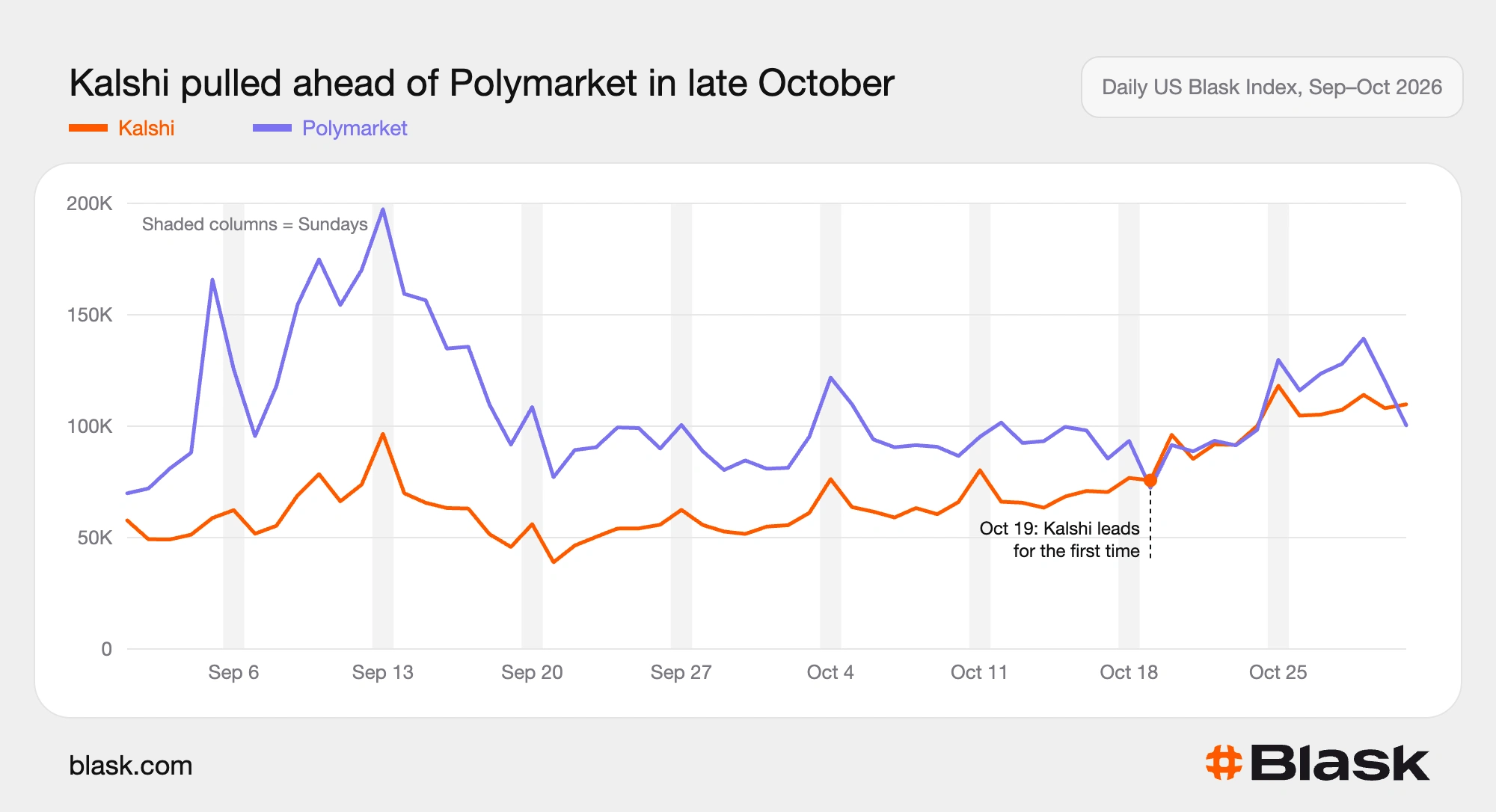
Blask’s daily data shows when that interest arrived. From 10 September to the end of October, Kalshi’s average Sunday search demand was 14.6% above its average on other days. Polymarket’s Sunday uplift was almost identical at 14.8%, so game days lifted interest in both exchanges rather than favouring Kalshi. Kalshi’s strongest September day was 13 September, the first Sunday of the NFL season.

Kalshi first moved ahead of Polymarket on the daily ranking on 19 October, the first time in the two months Blask reviewed. Most of its October gain came in the last two weeks of the month. Branded search data does not separate football-related searches from other interest in either brand, so these patterns show timing rather than football’s share of demand.

Line chart of daily US Blask Index for Kalshi and Polymarket, September to October 2026, with Sundays shaded.

Daily US Blask Index for Kalshi and Polymarket, 1 September to 31 October 2026. Shaded columns mark Sundays.

The Midterm Count Put Polymarket Back in Front

Polymarket led in US prediction market search demand each day from 25 to 30 October, the week the NBA announced deals with both exchanges.

As the midterm results came in on 4 November, US search demand for tracked prediction market brands reached about four times its October daily average, according to Blask. Polymarket took 51.5% of the day’s demand, ahead of Kalshi at 47.5%. It was Kalshi’s strongest search day of the year to that point. The surge lasted a single day, and the 2 March peak was about 7% higher.

Kalshi led in a separate tally of trading across 11 midterm markets. It recorded $127.4 million in volume, more than four times Polymarket’s $30.6 million, according to Gaming America figures cited by Blask.

What the Rivalry Means for Sportsbooks and Affiliates

Prediction market brands accounted for 43% of combined US branded search demand across the prediction market and traditional iGaming brands that Blask tracks in October. That was up from 34% in September and 31% in October 2025.

The comparison covers all traditional iGaming brands Blask tracks in the US, including casino and sports betting operators, both onshore and offshore. The share is calculated by dividing the combined Blask Index of prediction market brands by the combined index of both groups.

Both categories had already grown month on month in September. The US Blask Index rose 41% for prediction markets and 14% for traditional iGaming. That gives sportsbooks a reason to track how their own search demand moves around the same fixtures.

October widened the gap. Prediction market demand rose another 41.5% month on month, while demand for traditional iGaming brands fell 5.9%.

DraftKings had started offering event contracts by December 2025, when it launched its Predictions app with sports and finance markets. It then extended its existing NBA partnership to cover the product under the league’s October prediction market agreements.

Blask tracks the prediction market products of DraftKings and FanDuel separately from the operators’ main brands, which cover both casino and sports betting. From September to October, demand for the main DraftKings and FanDuel brands fell 11.4% and 8.5%. Their prediction market products grew 12.3% and 11.6%, from much smaller bases: in October, they equalled about 3% and 4% of their parent brands’ demand. The data shows the two moving in opposite directions, not customers switching between products.
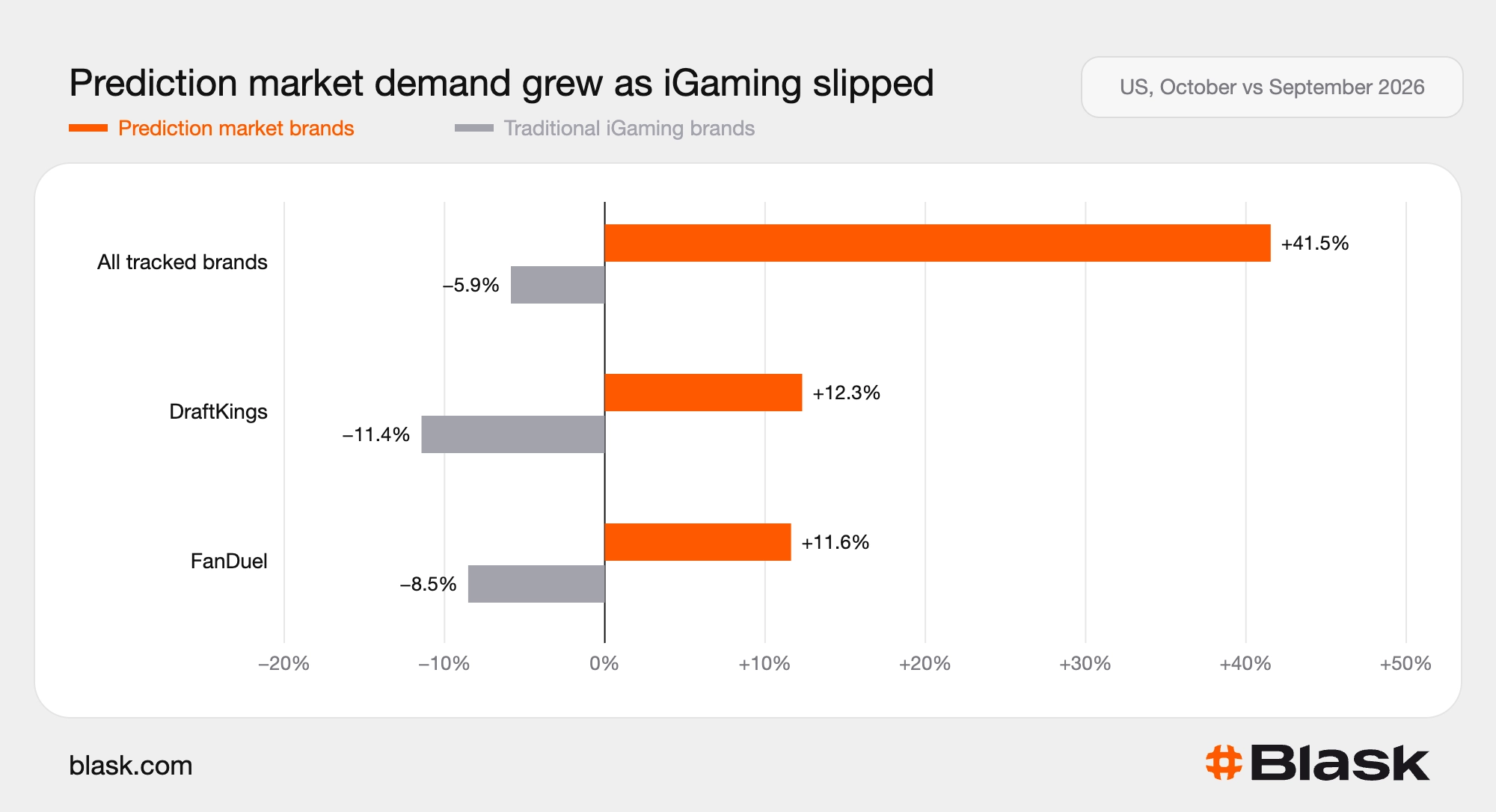
Bar chart of October 2026 month-on-month changes in US Blask Index for prediction markets, traditional iGaming, DraftKings and FanDuel.

Month-on-month change in US Blask Index, October vs September 2026. DraftKings and FanDuel shown separately for their main brands and prediction market products.

For sportsbooks, the overlap is visible on the fixture calendar. A Sunday game can provide the basis for a sportsbook promotion and a prediction exchange’s multi-leg contract. A match preview might send one reader to a sportsbook odds comparison and another to an explanation of how a contract settles. Tracking those paths can show the affiliate which coverage attracts interest. Outbound clicks by product, and any conversions the partner reports, can show where that interest leads.

The next test is whether Kalshi holds its lead during the weeks after the midterms. Demand on ordinary weekdays will help show how far its search gains extend between games.

References