
Game provider affiliate programmes give affiliates a way to move upstream before casino offers even come into play, especially when working with slot games affiliate programmes built around demos, assets, and early release visibility. Most affiliates stick to the same operators and bonuses. That creates overlap. Providers don’t pay commissions—casinos do—but they control the content that drives clicks. This page breaks down how that layer works and when it actually makes sense to use it.
Affiliate SERPs look crowded for a reason. Everyone targets the same keywords and pushes the same operators. “Best casino” pages compete on layout tweaks and bonus comparisons, but the offer underneath barely changes. That creates a ceiling. Traffic comes in, but differentiation stays thin.
The shift happens earlier.
Providers release games first. They control demos, assets, and the early signals around which titles gain traction. Affiliates who follow that flow publish sooner and capture demand before casino pages catch up.
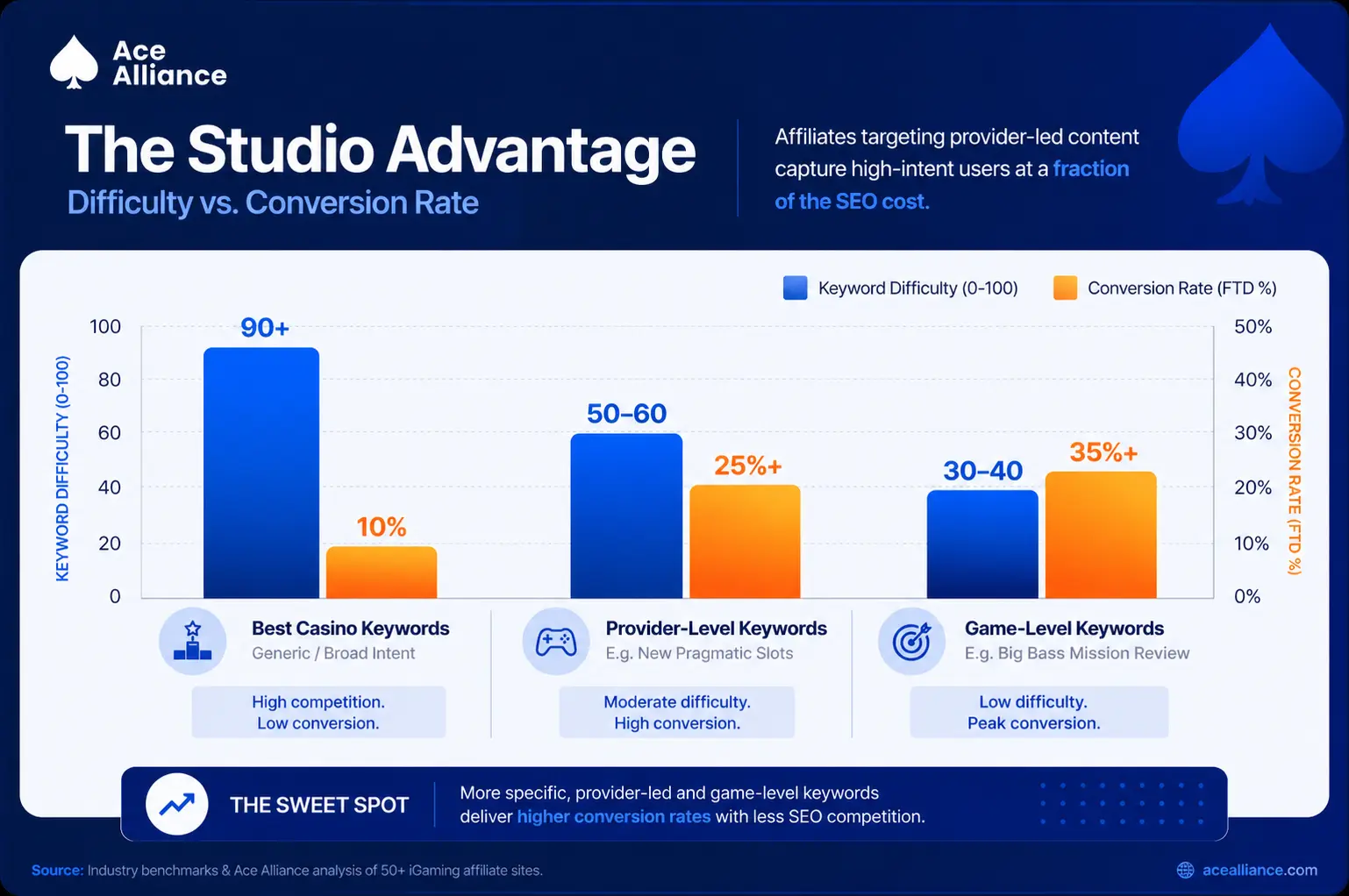
The data supports that pattern. High-difficulty casino keywords attract broad traffic but convert at lower rates. More specific queries (new slot releases or individual game reviews) face less competition and convert better because the user already knows what they want.
Release volume keeps feeding that gap. In 2024, Pragmatic Play maintained a steady output of new titles, with around 6–8 slot releases per month and more than 70 new games reaching the market over the year. Most smaller studios operate at a much lower pace, often focusing on a limited number of releases annually.
That creates a steady stream of new, lower-competition entry points for affiliates willing to move early.
At its core, the iGaming affiliate ecosystem operates across two distinct layers:
| Layer | Function |
|---|---|
| Provider | Games, demos, and marketing assets |
| Casino | Player accounts and monetisation |
Game providers sit at the starting point of the user journey. They develop the slots, supply demo versions, and produce the visual and promotional materials that introduce players to a game. Casinos then take that initial interest and convert it into revenue through deposits, bonuses, and account management.
User behaviour reflects this structure. Players rarely begin with a payment method or a specific casino brand. Instead, they engage with a game first. Often through a video, a stream, or a demo. That first touchpoint originates from the provider side.
In practice, slot game provider affiliate programmes supply the building blocks: new game releases, playable demos, visual assets, and campaign mechanics such as tournaments or prize drops. Casinos package these elements into offers and handle the commercial side of the relationship.
Affiliates sit between these two layers and control visibility. They decide which games appear in front of users and how they are presented. This positioning matters. Provider platforms influence performance before a user clicks through to a casino, while operators handle conversion after that point.
If content fails to capture attention early in the journey, the conversion layer never comes into play.
The term “game provider affiliate programmes” often creates confusion, particularly for affiliates used to traditional casino partnerships.
These programmes do not operate as direct revenue channels. You won’t find revenue share agreements, CPA deals, or player tracking linked to earnings. Game providers do not pay affiliates for traffic or conversions.
Instead, what they offer functions more as an operational layer.
Provider platforms typically include:
These platforms support content creation rather than monetisation.
For example, BGaming provides a self-service Affiliate Hub where affiliates can generate demo links, adjust balances, and download visual assets. Pragmatic Play distributes campaign materials tied to its Drops & Wins promotions, allowing affiliates to align content with active events. Hacksaw Gaming focuses on mobile-first creatives, supplying short-form content suited for platforms like TikTok and Instagram.
These tools don’t generate revenue directly, but they influence performance upstream. Affiliates use them to build more engaging content, improve user interaction, and increase click-through rates.
Revenue still comes from casino affiliate programmes. Provider platforms simply strengthen the path that leads to those conversions.
The best slot game provider affiliate programmes are not just asset libraries. They help affiliates move faster, localise content, and build stronger game-led pages before casino competition catches up. Some of the strongest slot companies for affiliates stand out through demo access, asset quality, campaign support, and early visibility around new releases.
BGaming built one of the few open-access hubs in the industry. You register at aff.bgaming.com, wait 24–48 hours, and start pulling assets. No long approval chain.
The standout feature sits in demo customisation. You can generate links with fixed balances and specific currencies. A €100,000 demo session for a streamer. A BRL setup for Brazilian traffic. It takes seconds.
The platform also includes a Big Win library. Raw footage of large multipliers, ready for editing. No overlays. No restrictions.
GEO insights add another layer. Titles like Aztec Clusters trend in Brazil, while Lucky 8 Merge Up performs better in Germany. BGaming surfaces that data directly.
This setup works well for affiliates focused on social content, streaming, and fast production cycles.
Pragmatic runs campaigns at scale. The key driver sits in its promotional system, often referred to as Enhance™.
Drops & Wins sits at the centre. Players win random prizes while playing slots, with shared prize pools across multiple casinos. Affiliates don’t just promote the game—they promote the event around it.
Daily drop schedules come ready. You align your content with those timelines. No guesswork.
Asset packs include game icons, character artwork, and localised descriptions across more than 30 languages. That cuts production time for multi-GEO sites.
Replay-style tools also help showcase max wins or highlight moments, which work well on landing pages.
Pragmatic fits affiliates running scaled SEO sites, media buyers, and anyone targeting multiple markets.
Hacksaw leans into high volatility and strong visuals. Titles like Wanted Dead or a Wild and Chaos Crew already circulate heavily on social platforms.
Their creatives match that environment. Vertical formats. Clean visuals. Built for mobile screens.
A clip that fits perfectly into a phone layout performs better than one that needs editing. Hacksaw provides ready-to-use content, which speeds up production.
They also include interactive banners tied to their scratchcard roots. Users can engage directly on the page instead of just viewing a static image.
Roadmap access adds another edge. Affiliates can see upcoming releases months in advance and build “coming soon” pages early.
This setup suits affiliates focused on short-form video and younger audiences.
Nolimit City works especially well for affiliates targeting experienced slot players. The brand is known for high-volatility games, bold mechanics, and features that appeal to players who want more than standard slot reviews.
Its Replay tool is the main affiliate-friendly feature. Instead of embedding a regular video, affiliates can generate a link that recreates a specific spin inside the game engine. The result feels more interactive than a clip because the user sees the spin play out in the actual game environment.
Affiliates can use these links in big-win breakdowns, game reviews, feature explanations, or showcase pages. For content built around volatility, max win potential, bonus rounds, and unusual mechanics, Nolimit City gives affiliates stronger material to work with.
Relax Gaming gives affiliates a different type of content opportunity, especially through its jackpot and game-data ecosystem. The most obvious example is Dream Drop, where affiliates can use widgets and API feeds to display live jackpot values directly on their site.
That creates urgency because the numbers update in real time. Instead of writing static jackpot content, affiliates can show players the current prize pool and build pages around active jackpot interest.
Relax Gaming also provides useful game-level details, including RTP ranges, volatility, hit frequency, and feature information. That supports more detailed reviews for players who want to understand how a game plays before trying it.
This setup works best for affiliates creating analytical slot content, jackpot pages, provider guides, and comparison articles aimed at more experienced players.
| Provider | Asset Quality | Demo Tools | GEO Targeting | Best For |
|---|---|---|---|---|
| BGaming | 4K raw video | Advanced | High | Streamers / social content |
| Pragmatic Play | Web-optimised | Standard | Very strong | SEO / global campaigns |
| Hacksaw Gaming | Mobile-first | Basic | Medium | Short-form / social traffic |
| Nolimit City | High-detail data | Replay tools | Low | Hardcore reviews/experts |
| Relax Gaming | Strong game data / jackpot feeds | Widgets / API feeds | Strong | Jackpot pages / analytical reviews |
Game provider platforms and casino affiliate programmes operate at different stages of the same process. One drives engagement before the click, the other converts it into revenue. The table below breaks down how they compare in practice.
| Aspect | Provider Platforms | Casino Programmes |
|---|---|---|
| Role | Content & discovery | Monetisation |
| Payments | No direct payouts | Rev share / CPA |
| Tools | Demos, assets, campaigns | Tracking, commissions |
| Timing | Before the click | After the click |
| Goal | Engagement | Conversion |
Affiliates don’t use these platforms out of curiosity. They use them because they improve performance.
Most sites pull the same banners from casino dashboards. Users scroll past without noticing. Provider assets feel different. Game-specific visuals and real gameplay clips hold attention longer and create a stronger first impression. That difference shows up in engagement metrics almost immediately.
Providers release games before casinos build full landing pages. That gap might last a few days, but it’s enough. Affiliates who publish early reviews, demo pages, or clips secure rankings before competition arrives. Timing drives visibility.
Providers track how games perform across regions. Certain titles pick up faster in Brazil, others in Germany or Sweden. Affiliates who follow that signal can align content with markets already showing demand. That reduces guesswork and improves targeting.
Some hubs allow you to adjust demo balances and currencies. A €1,000 balance feels different from €10. Showing the correct currency for a region builds trust. Small changes, noticeable impact. Better engagement before the click.
Access to provider platforms alone does not improve performance. The outcome depends on how those tools are applied within an affiliate strategy.
In practice, affiliates use provider resources to shape user interaction before the click:
TikTok / Reels → Demo clips: Affiliates source short gameplay clips from provider libraries and edit them for quick distribution. Bonus rounds and high-multiplier wins tend to generate the strongest engagement and drive initial traffic.
SEO pages → Embedded demos: Playable demos are integrated directly into content, allowing users to interact with the game instead of relying on static descriptions. This typically increases time on page and improves engagement signals.
Streamers → Custom balances: By adjusting demo balances and session settings, streamers create longer and more dynamic gameplay sessions. This results in more highlight moments and reusable content.
GEO targeting → Localised UX: Affiliates align currency, language, and presentation with the target market. These adjustments reduce friction and make the content feel more relevant to the user.
Each of these approaches serves the same purpose: capturing attention early and increasing the likelihood of a user progressing to the conversion stage.
Here is what our Lead Editor at Ace Alliance has to say about game provider affiliate programmes in 2026:

A common pattern I’ve noticed is affiliates gaining access to provider platforms, pulling a few assets, and expecting performance to follow. In most cases, it doesn’t.
What consistently works is using each tool with a clear objective.
Short demo clips tend to perform best when they focus on specific moments—bonus rounds or high-multiplier wins—and are used to capture attention on social platforms. Pages that include embedded demos often keep users engaged longer, simply because interaction replaces passive reading. Streamers who adjust demo balances usually generate more usable content, as longer sessions create more highlight moments to repurpose.
GEO adjustments also play a role. Content that reflects local currency and language tends to hold users for longer, which reduces early drop-off.
Each tool serves a different function, but the outcome stays the same. The more effectively you hold attention before the click, the better everything that follows tends to perform.
User behaviour changes depending on where your traffic comes from. The same game, layout, or offer won’t perform the same way across regions. Affiliates who adjust for this tend to see stronger engagement and better conversion rates.
Embedding demos can improve engagement, but they need to be handled carefully. If not, they can slow your page down and hurt performance.
One common issue is stacking multiple iframes. This increases load time, especially on mobile devices, where most users are browsing. Slower pages tend to rank lower and create a weaker user experience.
Lighter embed solutions usually perform better. Fewer scripts mean faster loading and smoother interaction. It’s also important to test across devices. A demo that works well on desktop may not perform the same way on mobile. Small delays or lag can lead users to leave before they engage.
Page speed still plays a role in everything. Faster pages keep users engaged and help maintain search visibility.
Most affiliate strategies start at the casino level. By that point, the game already exists, the campaigns are already live, and dozens of similar pages are already competing for the same traffic.
Working with provider platforms shifts that starting point.
Instead of reacting to what’s already trending, you get access to games as they’re released, along with the demos and assets that introduce them to players. That creates a window where competition stays lower, and user intent runs higher.
The difference isn’t in the tools themselves, but in how early they’re used. Affiliates who move at that stage tend to capture attention before the rest of the market catches up.
That’s where the advantage sits, closer to the source, before the click even happens.
Game provider affiliate programmes don’t pay commissions directly. Instead, they give affiliates access to demos, assets, and campaign materials. These tools help improve content performance, while actual revenue still comes from casino affiliate programmes that convert the traffic.
Yes, they serve different roles. Slot games affiliate programmes focus on content and visibility (providing demos and promotional assets) while casino affiliate programmes handle monetisation through revenue share or CPA deals once users register and deposit.
They improve performance by giving affiliates earlier access to games, better visual assets, and tools like demo embeds. This helps capture user interest sooner, increase engagement on-page, and drive more qualified clicks toward casino offers.
Providers like BGaming, Pragmatic Play, and Hacksaw Gaming offer strong affiliate tools, including demo hubs, campaign assets, and content resources. Each suits different strategies, from social media to SEO-driven traffic.
Yes, but access may depend on traffic quality or approval. Beginners can still benefit by using demos and assets to build content, but results usually improve once there’s a clear strategy behind how those tools are applied.



