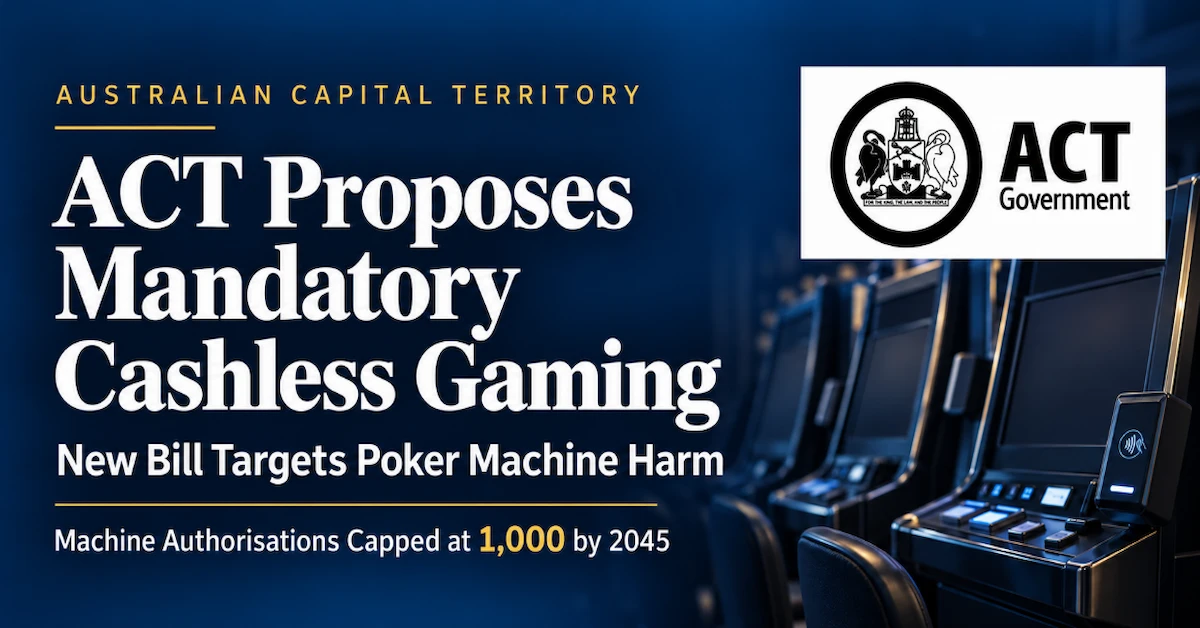
Home News ACT Introduces Bill for Mandatory Cashless Gaming and Poker Machine Cuts
ACT Introduces Bill for Mandatory Cashless Gaming and Poker Machine Cuts
Account-Based Gaming Would Reshape Venue Operations
Under the government’s published reform framework, players would register with a venue, provide identification, load funds onto a player account card and set a maximum loss limit before gambling.
Accounts would record spending and losses within a venue. Clubs would also enforce a 15-minute break after every hour of continuous poker machine play.
ACT Minister for Gaming Reform Marisa Paterson said in the official announcement:
The gambling industry’s responsibility does not end at providing entertainment.
For operators and technology suppliers, implementation would require reliable account records and controls that consistently apply the agreed restrictions. Australia’s recent Palmerbet BetStop investigation demonstrated how inaccurate customer details can undermine automated player-protection checks.
The technical challenge also has parallels with Illinois’s proposed expansion of gambling self-exclusion, where extending protections across physical gaming locations requires supporting systems and implementation rules.
Machine Reductions Establish a Long-Term Supply Target
The bill would require surrendering at least 500 gaming machine authorisations every four years until the territory reaches a maximum of 1,000 by 2045.
The target concerns authorisations, so it is important to distinguish permitted machine capacity from the number of machines operating at any given time.
For clubs, the proposed pathway creates a longer-term planning issue alongside the immediate work of adapting payment and account systems. Business planning would need to consider future machine capacity and the operational requirements of the remaining machines.
The focus on gambling availability sits alongside wider debates over venue access, including proposed UK changes to gambling premises licensing, although the jurisdictions use different legal mechanisms.
Payment Restrictions Follow Separate Implementation Routes
The ACT framework distinguishes between removing ATMs and preventing EFTPOS cash withdrawals. The ATM ban forms part of the bill, while EFTPOS withdrawal restrictions would be introduced through a separate regulation.
The government’s guidance provides for a 12-month transition for account-based gaming and ATM removal. It describes a shorter commencement period for the separate EFTPOS measure.
These different routes mean venues will need to track the legislation and supporting regulations individually when scheduling changes to payment arrangements and gaming operations. Parliamentary approval, notification and commencement remain necessary steps before the bill’s proposed requirements become enforceable.