Ace Alliance Horizon & Speed Rome
Early Bird Passes Available! | November 2, 2026
Get Your Pass!
Table Of Content :

Bally’s Pays Chicago $4 Million as VGT Dispute Escalates

trust
Ace Alliance: Delivering Trust Through Expertise
From exclusive events and interviews to real-time market trends, Ace Alliance brings you unbiased, well-informed, and data-driven content. Our editorial team adheres to strict editorial standards, ensuring that the information you receive is not only relevant but also trustworthy.

Built by market experts hosting events since 2023, with our first event in Riga, Latvia gathering over 300 top level iGaming industry executives, Ace Alliance is able to provide you with reliable information from direct interaction with experts and leaders in the sector.
Altay
Altay Celikkaya
Content Manager
Updated:
Reading Time: 3 minutes

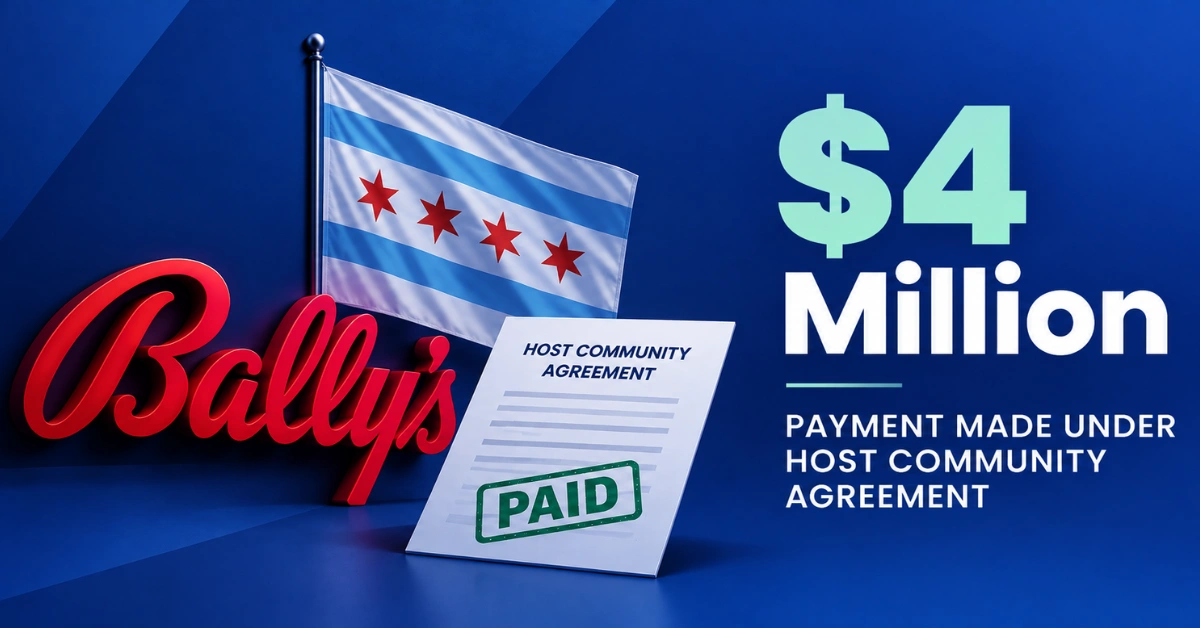
Bally’s has paid Chicago $4 million under its Host Community Agreement while continuing to challenge the city’s move to introduce video gaming terminals, or VGTs. The payment covers two $2 million annual impact fees required under the agreement. The dispute comes as Bally’s reassesses parts of its $1.7 billion permanent Chicago casino project. Several elements of the development have already been scaled back or paused.

Bally’s logo and Chicago flag beside a paid Host Community Agreement graphic highlighting the company’s $4 million payment to the city.

Regulation & Compliance

Key Takeaways From the Bally’s Chicago VGT Dispute

  • Bally’s has paid the full $4 million annual impact fees required under its agreement with Chicago.

  • The operator continues to argue that VGT expansion changes the competitive conditions surrounding its casino investment.

  • Parts of the permanent casino development have been paused, and 136 jobs have been affected by construction changes.

  • Chicago is moving forward with a local permitting process for VGT operators despite the continuing dispute.

  • The disagreement could shape how future gambling expansion is assessed alongside major land-based casino investments.

Host Community Agreement Sits at the Centre of the Dispute

The 2022 Host Community Agreement requires Bally’s Chicago to pay a $2 million annual direct impact fee and a further $2 million indirect impact fee.

Crucially, the agreement provides a mechanism for good-faith renegotiation if certain developments adversely affect the casino. One condition applies when a new form of lawful gaming is authorised, licensed and begins operating in Chicago beyond a minimal or test basis.

That clause has become central to Bally’s position as Chicago prepares for VGTs in bars, restaurants and other eligible venues. The operator argues that wider access to gaming machines could alter the commercial assumptions behind its original casino proposal.

Illinois already has thousands of licensed video gaming locations, and proposed changes to the Illinois gambling self-exclusion framework would eventually extend player protection measures into the video gaming network.

Casino Construction Changes Add Pressure

The VGT dispute is unfolding while Bally’s adjusts parts of its Chicago development. Construction on some non-gaming elements was paused in August, while 136 workers were laid off as the company revised its plans.

Bally’s says it still intends to complete the casino. However, the hotel component has been reduced from the 500 rooms originally planned to 100 rooms, while work on additional amenities has faced delays.

The changes raise a broader question for Chicago over how distributed gaming revenue should be balanced against a large destination casino. Similar cannibalisation concerns are already part of the state’s policy debate. A renewed Illinois online casino bill has faced resistance from stakeholders concerned about the impact of new gambling channels on retail casinos, employment and the existing VGT sector.

For operators and investors, the dispute therefore goes beyond one annual payment. It tests how contractual protections for major casino developments interact with later regulatory decisions that expand gambling access.

Bally’s VGT Interest Adds Another Layer

The latest discussions have also drawn attention to Bally’s previous interest in the VGT business. Gold Rush Gaming owner Rick Heidner disclosed that the two companies had held talks over a potential acquisition or partnership, although no agreement was reached.

That history complicates the debate because Bally’s opposition is focused on the effect of VGT expansion on its Chicago casino rather than the gaming format itself.

The dispute also comes as the wider Bally’s-linked business faces pressure across several markets. Recent Bally’s Intralot Q2 results showed lower adjusted EBITDA as higher UK gaming taxes weighed on profitability.

What Happens Next for Bally’s Chicago

Chicago has started developing its local permit process for VGT businesses, indicating that implementation is continuing while the contractual disagreement remains open. Bally’s, meanwhile, has now made the annual payment that had previously been considered a possible source of leverage.

The next issue is whether the company and city can resolve their competing interpretations of the Host Community Agreement without a prolonged legal battle. Any renegotiation could affect the financial commitments attached to the casino and influence the pace or scope of the remaining development.

For the wider US gaming sector, the outcome will be closely watched as an example of what happens when a city expands distributed gaming after securing a major casino investment based on an earlier market structure.