

Ace Alliance iGaming Awards 2026
Check out the winners.
See The Winners!
Table Of Content :

Ireland Proposes Eight Gaming Categories Under New Licensing Framework

trust
Ace Alliance: Delivering Trust Through Expertise
From exclusive events and interviews to real-time market trends, Ace Alliance brings you unbiased, well-informed, and data-driven content. Our editorial team adheres to strict editorial standards, ensuring that the information you receive is not only relevant but also trustworthy.

Built by market experts hosting events since 2023, with our first event in Riga, Latvia gathering over 300 top level iGaming industry executives, Ace Alliance is able to provide you with reliable information from direct interaction with experts and leaders in the sector.
Altay
Altay Celikkaya
Content Manager
Updated:
Reading Time: 3 minutes

Ireland has taken another step toward regulating its online casino market, with the Gambling Regulatory Authority of Ireland (GRAI) proposing eight categories of games that could be offered under the country’s new gaming licences. The draft regulations also introduce requirements covering game fairness, outcome transparency and the disclosure of winning probabilities.

Submitted to the European Commission on 19 November 2026 through its Technical Regulation Information System (TRIS), the proposal represents a necessary legislative step towards implementing gaming licences under the Gambling Regulation Act 2024. The EU standstill period is currently scheduled to end on 22 February 2027.
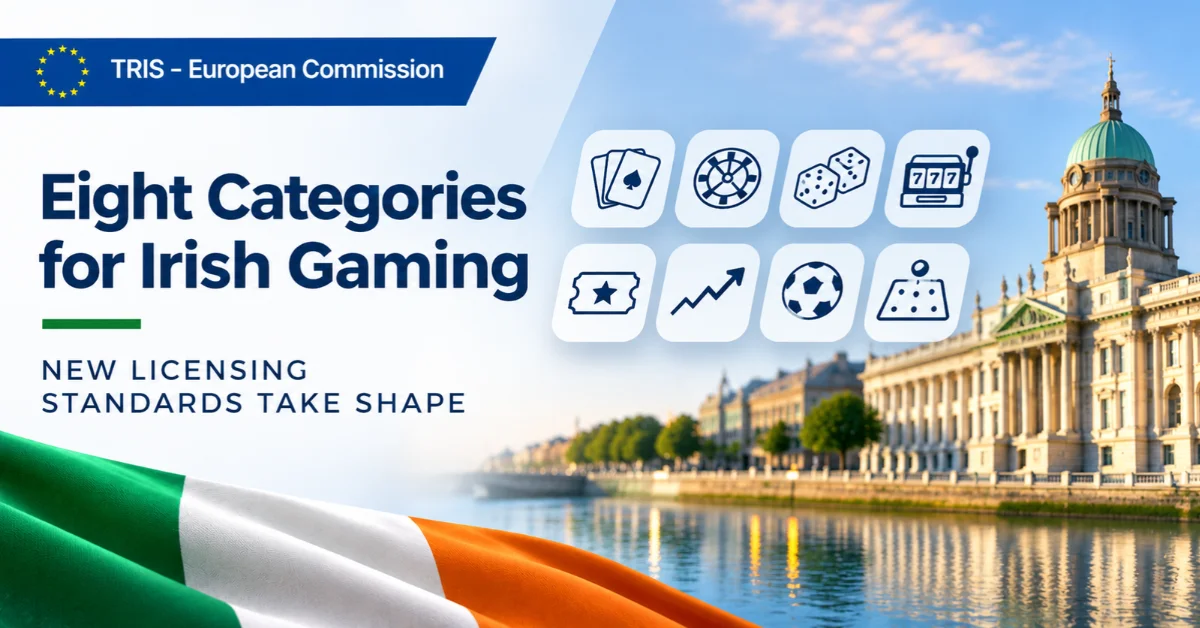
European Commission TRIS notification on Ireland’s proposed gaming categories and licensing rules

Regulation & Compliance

Key Takeaways From Ireland’s Proposed Gaming Regulations

  • Ireland has proposed eight gaming categories covering traditional casino products and newer digital game formats.

  • Individual gaming licences would specify which prescribed games operators are authorised to offer.

  • All eight categories would require clear disclosure of winning probabilities before gameplay begins.

  • Additional technical requirements would address game fairness, randomness and outcome transparency.

  • The GRAI received 123 responses during its public consultation.

  • The proposed regulations remain subject to EU review until at least 22 February 2027.

Eight Gaming Categories Under Ireland’s Proposed Framework

Developed under Section 86 of the Gambling Regulation Act 2024, the draft regulations establish the types of games that could qualify for authorisation.

The eight proposed categories are:

Including contemporary digital formats alongside established casino products reflects the regulator’s intention to accommodate a diverse gaming market.

However, inclusion within a prescribed category would not automatically authorise an individual product. Operators would still require the appropriate permissions under Ireland’s gambling licensing and enforcement framework.

Game Transparency and Fairness Requirements

The proposal places particular emphasis on making information about winning chances available before gameplay. Depending on the product, disclosures could include return-to-player (RTP) percentages, house edge, odds or event probabilities. Where outcomes may depend on participant skill or decisions, information explaining the relevant mechanics would also be required.

The draft introduces additional safeguards tailored to individual game formats. Card games would require secure random shuffling, while reel-based products would need to clearly display relevant paylines and winning combinations.

Crash-style games and simulated sports products would be subject to randomness requirements. Ball-drop games would also need to display the object’s trajectory, potential award positions and outcome. For game studios, aggregators and platform providers, these requirements could affect product documentation, interface design and technical compliance assessments.

Industry Consultation Highlights Need for Flexibility

The GRAI received 123 consultation responses from operators, suppliers, consultants, representative organisations and members of the public. Although respondents broadly supported establishing defined gaming categories, concerns centred on whether restrictive technical definitions could accommodate future product innovation.

In its submission to the European Commission, the GRAI said:

The list has the goal of being lean and technologically neutral.

The regulator also referenced research into gambling-related harm in Ireland, highlighting the public interest in bringing gaming activity within a supervised licensing system.

What the Proposal Means for Ireland’s 2027 Gaming Market

The development follows earlier reports that funding constraints could delay Ireland’s remote gaming licensing rollout until 2027. Ireland’s approach also comes amid wider European gambling reforms, including Finland’s first gambling licence approvals ahead of its 2027 market launch.

For operators and B2B suppliers targeting Ireland, the draft provides a clearer basis for assessing game portfolios and identifying potential compliance requirements ahead of licensing.

Nevertheless, the conclusion of the EU standstill period should not be interpreted as a confirmed market launch date. The regulations remain in draft form, and businesses will need to monitor their final adoption alongside further GRAI licensing guidance.