
Ace Alliance iGaming Awards 2026
Check out the winners.
See The Winners!
Table Of Content :

Lula Defends Brazil Betting Ban as Economic Claims Face Scrutiny

trust
Ace Alliance: Delivering Trust Through Expertise
From exclusive events and interviews to real-time market trends, Ace Alliance brings you unbiased, well-informed, and data-driven content. Our editorial team adheres to strict editorial standards, ensuring that the information you receive is not only relevant but also trustworthy.

Built by market experts hosting events since 2023, with our first event in Riga, Latvia gathering over 300 top level iGaming industry executives, Ace Alliance is able to provide you with reliable information from direct interaction with experts and leaders in the sector.
Altay
Altay Celikkaya
Content Manager
Updated:
Reading Time: 4 minutes

Brazilian President Luiz Inácio Lula da Silva has defended the country’s nationwide betting ban, claiming that restrictions on gambling are already benefiting household spending, retail sales and industrial production. However, the latest official economic figures do not yet establish whether the shutdown has delivered those benefits.

The remarks, made during Lula’s nationally televised address on 8 November 2026, come as Brazil’s betting industry faces ongoing legal challenges and uncertainty over the future of its regulated market. For operators, suppliers and investors, the debate raises questions about the economic consequences of prohibition and the evidence being used to justify it.
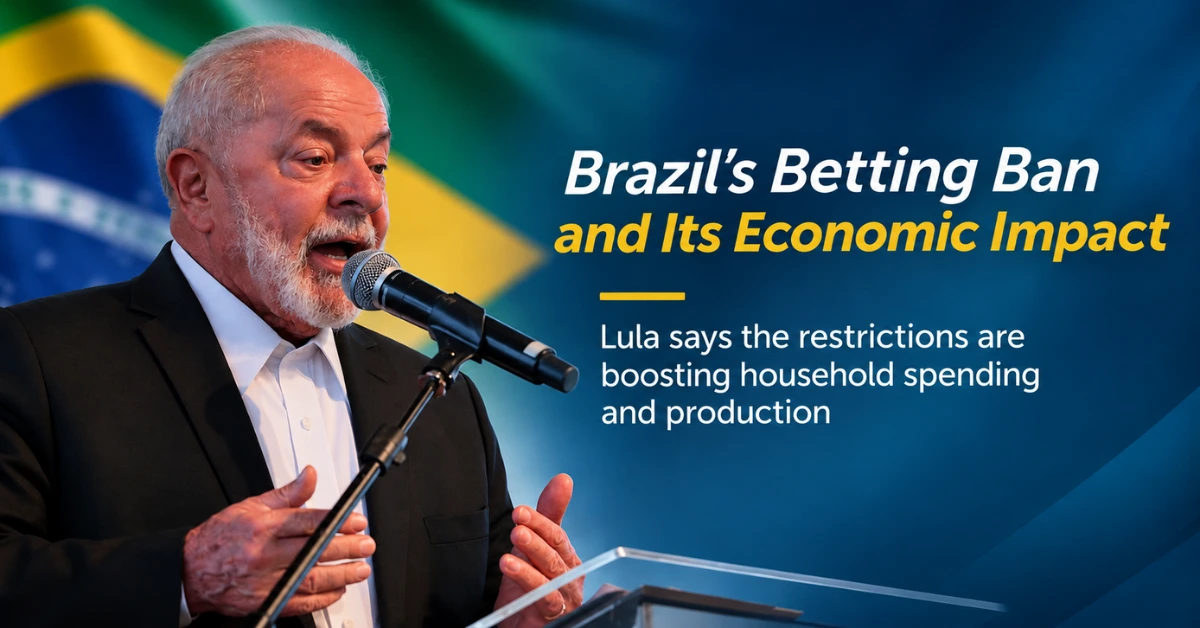
Lula speaks against a Brazilian flag backdrop as debate over the betting ban continues.

Regulation & Compliance

Key Takeaways From Lula's Brazil Betting Ban Claims

  • President Lula claims Brazil’s betting ban is redirecting household spending towards retail businesses and other economic activities.

  • Official IBGE data shows industrial production fell 0.8% in September, although the figures largely predate the betting shutdown.

  • The latest available official retail data covers August, meaning the economic impact of the October shutdown cannot yet be established.

  • Brazil’s Supreme Federal Court has not issued a final ruling on the betting ban, while Congress continues reviewing the legislation.

  • Operators, suppliers and affiliates face continued uncertainty over market access, commercial agreements and future regulations.

Lula Claims Betting Ban Is Supporting Brazil's Economy

During his 8 November address, Lula argued that eliminating betting expenditure would allow Brazilian families to redirect more money towards everyday purchases, supporting retail businesses and domestic production.

According to the official transcript of Lula’s speech published by Agência Gov, the president considers gambling restrictions part of his administration’s broader efforts to improve household finances and stimulate economic growth.

Speaking in Portuguese, Lula said:

The end of betting is already having a positive impact on the economy.

He also argued that reduced gambling expenditure had increased consumer spending and contributed to stronger retail and industrial activity.

The comments reinforce the government’s position on Brazil’s nationwide betting ban, introduced through Provisional Measure 1,394/2026 on 25 September.

The legislation prohibits the operation, offering, intermediation and advertising of fixed-odds betting, covering sports betting and online casino games. It also applies to offshore operators targeting Brazilian consumers, though it excludes other legally authorised lottery products.

Under the Ministry of Finance’s implementation timetable, betting websites and applications were required to become unavailable from 6 October.

Do Official Economic Figures Support Lula's Claims?

While Lula has presented the ban as economically beneficial, available national statistics do not yet demonstrate a direct relationship between reduced betting activity and increased spending elsewhere.

According to the Brazilian Institute of Geography and Statistics (IBGE), industrial production declined 0.8% month-on-month in September 2026. Output was also 2.5% lower than in September 2025.

The figures, published on 5 November, present a more complicated picture than the economic recovery described by the president.

However, September’s industrial data largely predates the betting shutdown, which took full effect in early October. It therefore cannot confirm or disprove whether the restrictions subsequently improved production.

Retail figures present a similar limitation.

The latest available IBGE monthly retail trade survey covers August 2026, when retail sales volume increased by just 0.1% compared with July. Those figures were recorded before the betting ban.

More recent data will be needed to determine whether household expenditure previously directed towards gambling has shifted into retail consumption.

Even then, establishing a direct causal relationship would require accounting for other factors, including income growth, inflation, employment and changes in consumer confidence.

The economic debate comes as legal uncertainty continues over Provisional Measure 1,394/2026.

On 3 November, Brazil’s Supreme Federal Court (STF) held a public hearing examining the prohibition’s legal, economic and social consequences.

Justice Luiz Fux indicated that Congress and the executive branch might better address some aspects of the dispute. However, as Ace Alliance’s report on the Supreme Court hearing notes, the court did not issue a final ruling.

Industry associations have challenged the restrictions, arguing that removing licensed betting platforms could push consumers towards unregulated operators and weaken existing protections.

Meanwhile, the government maintains that prohibition is necessary to address gambling-related harm, household debt and consumer vulnerability.

The dispute has also extended to professional sport. Brazilian football clubs have warned of potential sponsorship revenue losses linked to the betting ban, highlighting financial consequences beyond gambling operators.

These competing concerns make the government’s economic arguments especially important as lawmakers consider the legislation’s future.

What Does This Mean for Brazil's iGaming Industry?

For operators, platform providers, payment processors and affiliates, Lula’s latest remarks suggest that the government remains committed to defending the prohibition.

His emphasis on household consumption also introduces another dimension to the policy debate. Beyond consumer protection, the administration is presenting gambling restrictions as a potential tool for redirecting spending into other sectors.

However, the official data currently available does not prove the economic benefits.

For businesses previously active in Brazil, several issues remain unresolved, including the possibility of renewed licensing, restrictions on commercial partnerships and the longer-term treatment of offshore gambling services.

Operators considering future market entry will also need to assess whether the current prohibition survives legislative and judicial scrutiny.

What Happens Next for Brazil's Betting Market?

Brazil’s Congress continues to review Provisional Measure 1,394/2026. The current deliberation period runs until 23 November 2026, with the measure entering an urgency phase on 9 November.

Meanwhile, the Supreme Court’s constitutional proceedings remain unresolved.

Additional economic releases will provide a clearer picture of consumer spending and industrial activity following the betting shutdown, although those figures alone will not establish the ban’s economic impact.

For Brazil’s iGaming industry, the immediate question is whether the restrictions will remain in place or be amended through Congress or the courts.

Until those decisions are made, businesses face an uncertain regulatory outlook, while the government’s claims about the economic benefits of prohibition await stronger supporting evidence.