Home News Missouri Orders Six Prediction Markets to Halt Sports Event Contracts
Missouri Orders Six Prediction Markets to Halt Sports Event Contracts
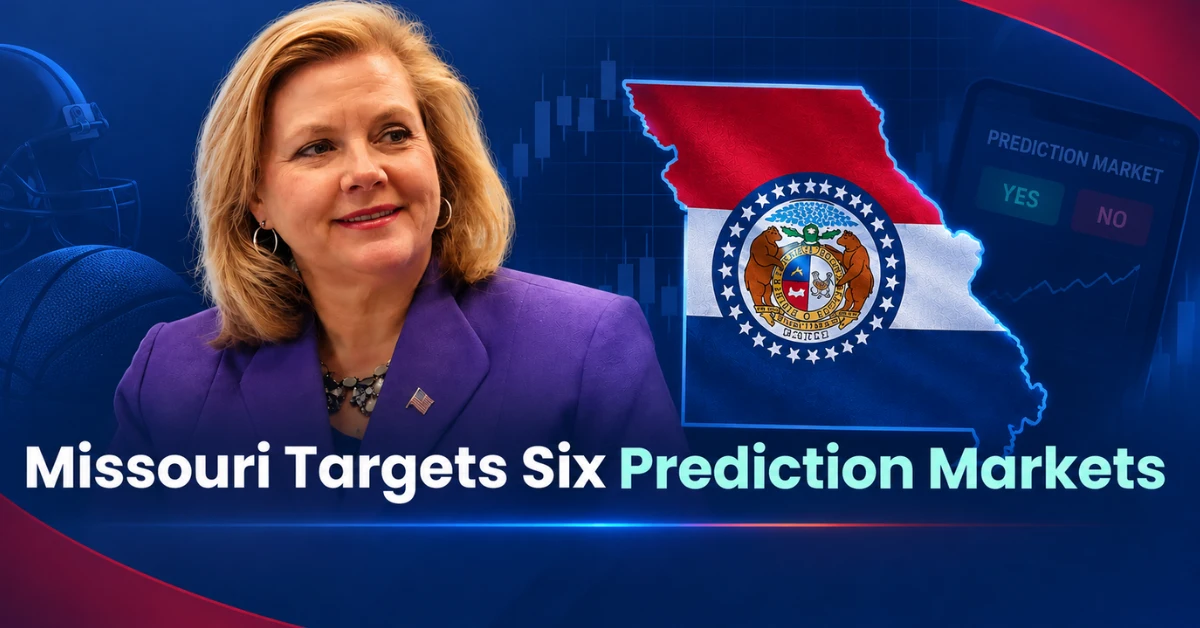
Missouri Targets Six Prediction Market Operators
According to the Missouri Attorney General’s official 18 September announcement, the state has directed Polymarket, Kalshi, Crypto.com, Novig, Underdog and Robinhood to cease offering sports event contracts unless they obtain the appropriate Missouri Gaming Commission authorisation and meet state requirements.
Missouri legalised regulated sports wagering after approving Amendment 2 in 2024, with the market launching on 1 December 2025. The framework places sports betting under the Missouri Gaming Commission and applies a 10% tax to sports betting gross receipts. It also requires age controls preventing anyone under 21 from placing sports wagers.
Hanaway said:
Companies cannot repackage sports bets as ‘event contracts’ to avoid Missouri law.
That statement reflects Missouri’s legal position rather than a settled nationwide classification of prediction-market contracts.
Operators Face Compliance or Market Exit
The official cease-and-desist letter sent to Polymarket is dated 16 September and gives the company two immediate options. It can stop offering the products in Missouri or seek a state licence, meet applicable tax and fee requirements and comply with Missouri’s age restrictions. The letter asks Polymarket to confirm compliance or cessation of sports wagering activity within 30 days.
The Attorney General’s Office said noncompliance could lead to state enforcement action. However, the central legal issue remains disputed. Missouri argues that the Commodity Exchange Act does not prevent states from applying their gambling laws to sports-related event contracts.
Prediction-market platforms have taken a different position in several legal disputes. Kalshi, for example, has maintained that its event contracts operate through a federally regulated derivatives market rather than a conventional sportsbook. That same question was recently examined during a Texas Senate hearing on prediction-market regulation, where state gambling authority and federal derivatives oversight were presented as competing regulatory frameworks.
State Authority Becomes a Wider US Issue
Missouri’s action follows several 2026 court disputes over whether states can regulate sports-related prediction contracts.
Earlier in September, an Iowa federal court rejected Kalshi’s request to block state gambling enforcement while litigation continues. The ruling did not resolve the underlying case. Still, the judge found that Kalshi had not shown a sufficient likelihood of success at that stage on its federal preemption argument.
The Ninth Circuit also recently allowed Nevada to enforce its gaming laws against Kalshi’s sports-event contracts, rejecting the operator’s federal pre-emption argument in that proceeding.
For prediction-market operators and B2B partners, Missouri’s orders add another jurisdiction where market access may depend on how sports event contracts are classified. The immediate focus is now on whether the six named operators change their Missouri offerings, pursue licensing options or challenge the state’s interpretation through further legal action.