

Ace Alliance Horizon & Speed Rome
Early Bird Passes Available! | November 2, 2026
Get Your Pass!
Table Of Content :

Thailand Blocks 945,075 Online Gambling URLs in Fiscal 2026

trust
Ace Alliance: Delivering Trust Through Expertise
From exclusive events and interviews to real-time market trends, Ace Alliance brings you unbiased, well-informed, and data-driven content. Our editorial team adheres to strict editorial standards, ensuring that the information you receive is not only relevant but also trustworthy.

Built by market experts hosting events since 2023, with our first event in Riga, Latvia gathering over 300 top level iGaming industry executives, Ace Alliance is able to provide you with reliable information from direct interaction with experts and leaders in the sector.
Altay
Altay Celikkaya
Content Manager
Updated:
Reading Time: 2 minutes

Thailand blocked 945,075 URLs linked to illegal online gambling during fiscal 2026 as authorities expanded court-ordered restrictions and cooperation with major digital platforms.

The figure covers October 2025 through September 2026. According to the Ministry of Digital Economy and Society’s official update, 835,207 gambling-related URLs were subject to court blocking orders, while another 109,868 were restricted through cooperation with digital platforms. The figures refer to individual URLs, not unique gambling websites or operators.
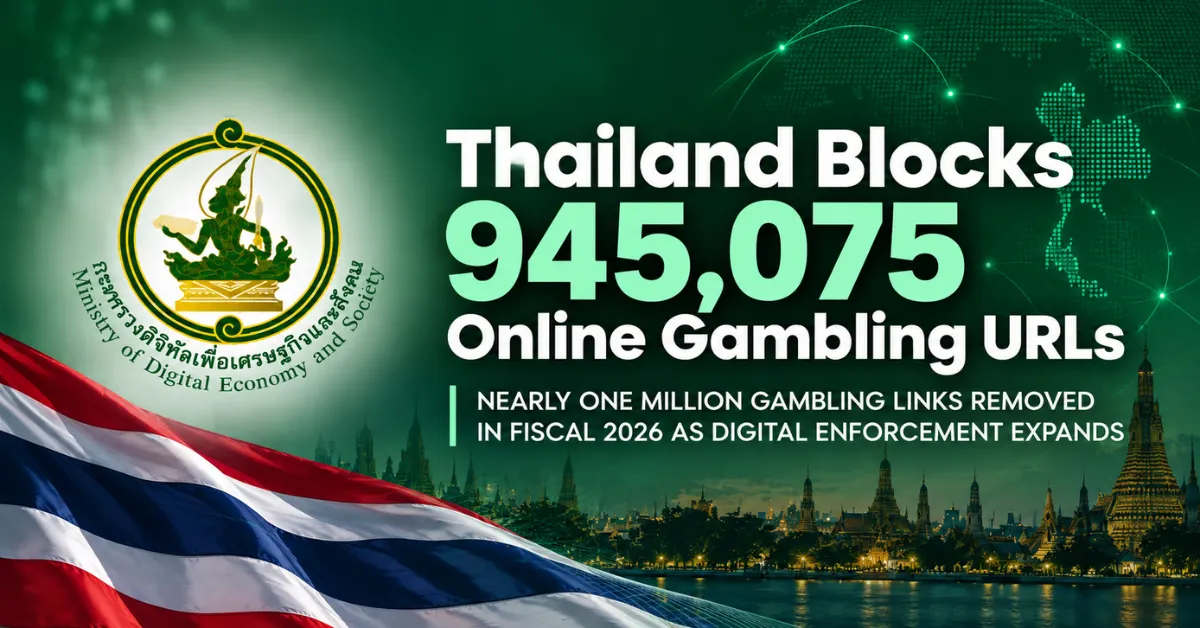
Thailand’s Ministry of Digital Economy and Society emblem, national flag and Bangkok skyline illustrating the removal of 945,075 online gambling URLs during fiscal 2026.

Regulation & Compliance

Key Takeaways From Thailand’s Online Gambling Crackdown

  • Thailand blocked or removed 945,075 gambling-related URLs during fiscal 2026.

  • Court orders accounted for 835,207 of the total URLs.

  • Digital platforms helped restrict a further 109,868 URLs.

  • Authorities are using artificial intelligence alongside police intelligence and public reports.

  • Thailand plans deeper cooperation with search engines, Meta and TikTok.

  • Future measures will focus more on children, young people and students.

AI and Court Orders Drive URL Blocking

The court-ordered total included 749,546 URLs identified through proactive measures led by the ministry and another 85,661 based on information from the Royal Thai Police.

Authorities have increasingly used artificial intelligence to detect gambling websites and illegal online content, combining automated identification with police intelligence and public reports.

Thailand had already demonstrated that approach during the World Cup, when authorities blocked 13,888 gambling-related URLs in an enforcement campaign covered in Ace Alliance’s analysis of unregulated World Cup betting. The latest full-year total shows the significantly larger scale of Thailand’s ongoing digital enforcement programme.

Digital Economy and Society Minister Chaichanok Chidchob said:

“Solving online gambling and illegal URL problems cannot be done by one agency alone,” translated from Thai.

Search Engines and Social Platforms Face Greater Role

Thailand now plans to expand enforcement beyond direct URL blocking. The ministry said it will work with search engine providers to reduce access to gambling websites and related content through search results.

A proposed reporting mechanism would also allow members of the public, including young people, to submit information about gambling-related content and their online experiences. A working group would analyse those reports, coordinate with platforms including TikTok and Meta and forward relevant information to police.

That infrastructure-level approach reflects a wider enforcement challenge identified in research on the global unlicensed gambling market, where mirror domains, advertising channels and platform access can allow illegal operators to continue reaching players even after individual domains are blocked.

The ministry also plans closer cooperation with education, interior, and security agencies to raise awareness of online gambling risks, particularly among children, young people, and students.

The focus aligns with broader concerns across Southeast Asia. A recent UNODC assessment of illegal online gambling in the region linked unregulated platforms with youth debt, social-media acquisition and organised criminal networks.

For B2B stakeholders, Thailand’s latest figures show enforcement moving beyond traditional domain blocking towards a broader digital ecosystem strategy. Search visibility, social platforms, AI detection and public reporting are increasingly becoming part of the same enforcement framework, raising the importance of distribution channels and platform compliance alongside direct operator activity.