

Ace Alliance Horizon & Speed Rome
Early Bird Passes Available! | November 2, 2026
Get Your Pass!
Table Of Content :

US iGaming Revenue Rises 16.5% as Sportsbook Revenue Contracts

trust
Ace Alliance: Delivering Trust Through Expertise
From exclusive events and interviews to real-time market trends, Ace Alliance brings you unbiased, well-informed, and data-driven content. Our editorial team adheres to strict editorial standards, ensuring that the information you receive is not only relevant but also trustworthy.

Built by market experts hosting events since 2023, with our first event in Riga, Latvia gathering over 300 top level iGaming industry executives, Ace Alliance is able to provide you with reliable information from direct interaction with experts and leaders in the sector.
Altay
Altay Celikkaya
Content Manager
Updated:
Reading Time: 3 minutes

US commercial gaming revenue reached $20.39 billion in the second quarter of 2026, rising 5.1% from the same period last year. The latest Commercial Gaming Revenue Tracker from the American Gaming Association shows that iGaming and traditional casinos expanded while quarterly sports betting revenue contracted for the first time outside pandemic-affected periods. iGaming generated $3.03 billion, up 16.5%, whereas sportsbook revenue slipped 0.2% to $3.91 billion despite a 7.8% increase in handle. The gap was driven by lower hold, demonstrating that stronger betting activity does not automatically produce higher operator revenue. World Cup wagering made that divergence particularly visible in June.
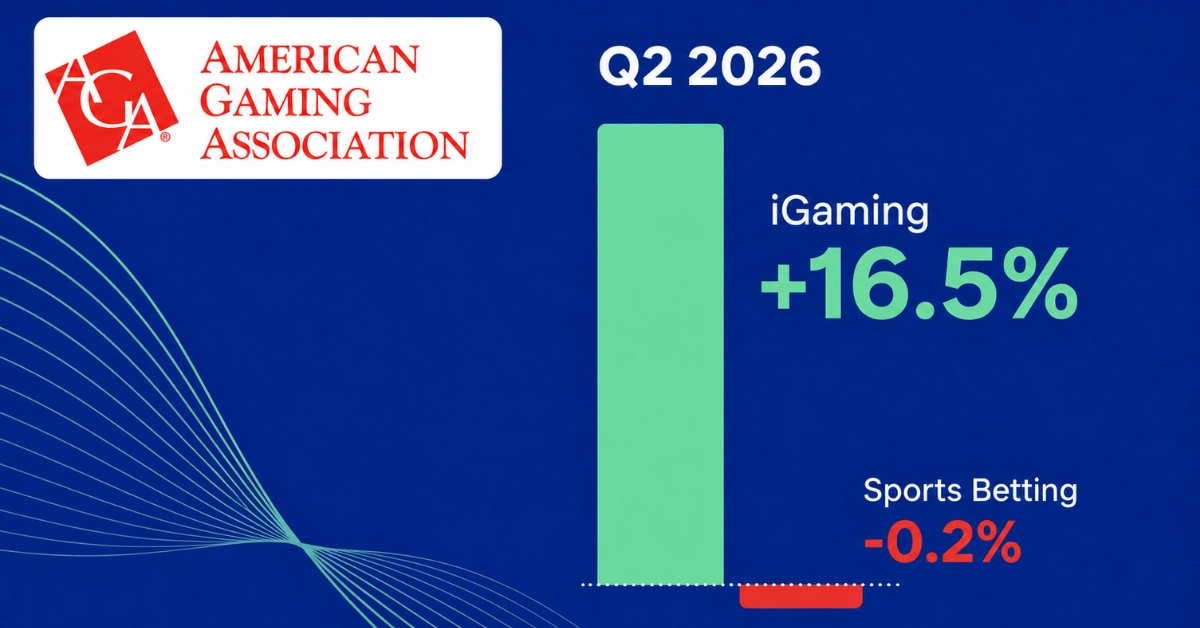
American Gaming Association Q2 2026 graphic showing iGaming revenue rising 16.5% while sports betting revenue declines 0.2%

Markets & Regions

Key Takeaways From US Gaming’s Q2 Revenue Split

  • US commercial gaming revenue increased 5.1% year on year to $20.39 billion in Q2 2026.

  • iGaming generated $3.03 billion and posted the strongest annual growth among the three major verticals at 16.5%.

  • Sports betting revenue declined 0.2% to $3.91 billion even as handle rose 7.8% to $38.84 billion.

  • A lower hold of 10.1% prevented stronger wagering activity from translating into quarterly sportsbook growth.

  • June showed the World Cup effect most clearly as handle increased 26% while betting revenue fell 18.3%.

  • State gaming tax revenue rose 3.3% to $4.53 billion, the slowest quarterly growth since late 2020.

Commercial Gaming Growth Extends Beyond Digital Channels

Revenue increased year on year in 28 of the 38 commercial gaming states covered by the AGA. Traditional casino gaming remained the largest part of the regulated market, producing $13.43 billion in Q2 and growing 4.5%. Slot revenue rose 4.2%, while table game revenue increased 3.2%.

The figures strengthen the picture presented in the AGA’s H1 2026 gaming outlook, which found that industry executives remained broadly confident despite macroeconomic pressure and regulatory uncertainty. The Q2 data provides evidence of continued consumer spending, but the slower growth in gaming taxes and the sportsbook contraction show that performance was not uniform.

June was comparatively flat at market level. Commercial gaming revenue reached $6.36 billion for the month, only 0.5% higher than in June 2025. Slots grew 1.9%, whereas table game revenue fell 1.2%.

Regulated iGaming Maintains Double-Digit Growth

iGaming was the clearest growth engine during the quarter. Revenue increased 16.5% to $3.03 billion, significantly outpacing both traditional casino gaming and sports betting. June revenue reached $999.2 million, representing a 19.9% annual increase and placing the monthly market close to the $1 billion threshold.

The regulated revenue increase sits alongside a more complex picture in the wider US iGaming market. Separate H1 2026 analysis found that overall user demand declined 9% and projected revenue fell 1.8%, with licensed operators absorbing more of the slowdown than offshore brands.

The difference reflects the metrics and segments being measured. The AGA tracks reported revenue from state-regulated operators, while the broader market analysis also considers offshore demand and projected earnings. For B2B stakeholders, the two datasets indicate that regulated iGaming can continue to expand even when wider demand indicators and channelisation remain under pressure.

World Cup Handle Fails to Protect Sportsbook Revenue

Sports betting handle reached $38.84 billion in Q2, up 7.8% year on year. Revenue nevertheless declined 0.2% to $3.91 billion as hold fell by 81 basis points to 10.1%. This was a modest decrease, but it marked the first quarterly contraction reported by the AGA outside periods affected by the pandemic.

The June figures show why wagering volume can be misleading when assessed without margin. World Cup betting helped raise monthly handle by 26% to $12.59 billion, but sportsbook revenue fell 18.3%. Hold dropped to 8.1% from 12.5% a year earlier, meaning a greater share of stakes returned to customers as winnings.

Results varied by state. Nevada sportsbooks generated $50.5 million in June revenue, up 20% year on year, from a handle of $587.6 million. Its 8.7% hold was slightly higher than the previous June, allowing operators to convert stronger World Cup and NBA Finals wagering into growth while the national market contracted. The contrast demonstrates how local event exposure, customer mix and sporting results can materially alter sportsbook performance.

Tax Growth Slows as Market Structure Draws Scrutiny

Regulated commercial gaming generated $4.53 billion in state gaming taxes during Q2, an annual increase of 3.3%. This was the slowest quarterly tax growth since the fourth quarter of 2020 and trailed the 5.1% increase in total commercial gaming revenue.

The AGA said potential tax receipts were being affected by skill machines, sweepstakes casino sites and sports-focused prediction platforms that do not pay state gaming taxes. That concern sits at the centre of the dispute over state authority and prediction markets, after a coalition of 41 state Attorneys General argued that sports event contracts can bypass state licensing, taxation and consumer-protection requirements.

For regulated operators, the results place revenue mix and margin discipline at the centre of planning. Digital casino growth remained strong, while sportsbook performance showed how customer-friendly outcomes can weaken revenue even during a major acquisition event. State authorities are simultaneously assessing whether the current structure captures the full taxable value of online wagering activity.