Ace Alliance Riga
Ace Alliance Riga
Don’t miss the Early Bird Offer! | August 6-7, 2026
Get Your Pass!
Table Of Content :

Blask x Ace Alliance Report: LATAM iGaming Market Demand and the 2026 World Cup

trust
Ace Alliance: Delivering Trust Through Expertise
From exclusive events and interviews to real-time market trends, Ace Alliance brings you unbiased, well-informed, and data-driven content. Our editorial team adheres to strict editorial standards, ensuring that the information you receive is not only relevant but also trustworthy.

Built by market experts hosting events since 2023, with our first event in Riga, Latvia gathering over 300 top level iGaming industry executives, Ace Alliance is able to provide you with reliable information from direct interaction with experts and leaders in the sector.
Darko Ilievski
Lead Editor
Updated:
Reading Time: 5 minutes
LATAM 2026 World Cup iGaming report graphic with football and data dashboard.

Blask and Ace Alliance’s latest report looks at what ten years of World Cup data shows about iGaming demand across Latin America.

The analysis tracks how betting interest changed across previous World Cup cycles, which markets recorded the strongest uplift, and which operators now hold the strongest positions ahead of the 2026 tournament.

Report

Key Takeaways From the LATAM iGaming Market Report

The report points to a broader shift in how World Cup demand should be understood across Latin America. Rather than treating the tournament as a short-term acquisition spike, Blask’s data suggests it can reset the demand floor in markets where betting culture, brand competition and payment infrastructure are already in place. This builds on the first Blask x Ace Alliance World Cup iGaming Index, which showed that football performance and iGaming demand don’t always move in the same direction.

  • World Cup demand is not limited to markets where the national team qualifies.

  • Across the Latin American markets analysed, no country returned to its previous demand level after a World Cup cycle.

  • Peru and Chile show how betting culture can drive World Cup growth even without national team participation.

  • Colombia shows the opposite pattern, with demand more closely tied to domestic football structures and national team presence.

  • Brazil enters the 2026 World Cup under a regulated betting framework for the first time.

  • Betano holds one of the strongest pan-LATAM positions ahead of the 2026 tournament.


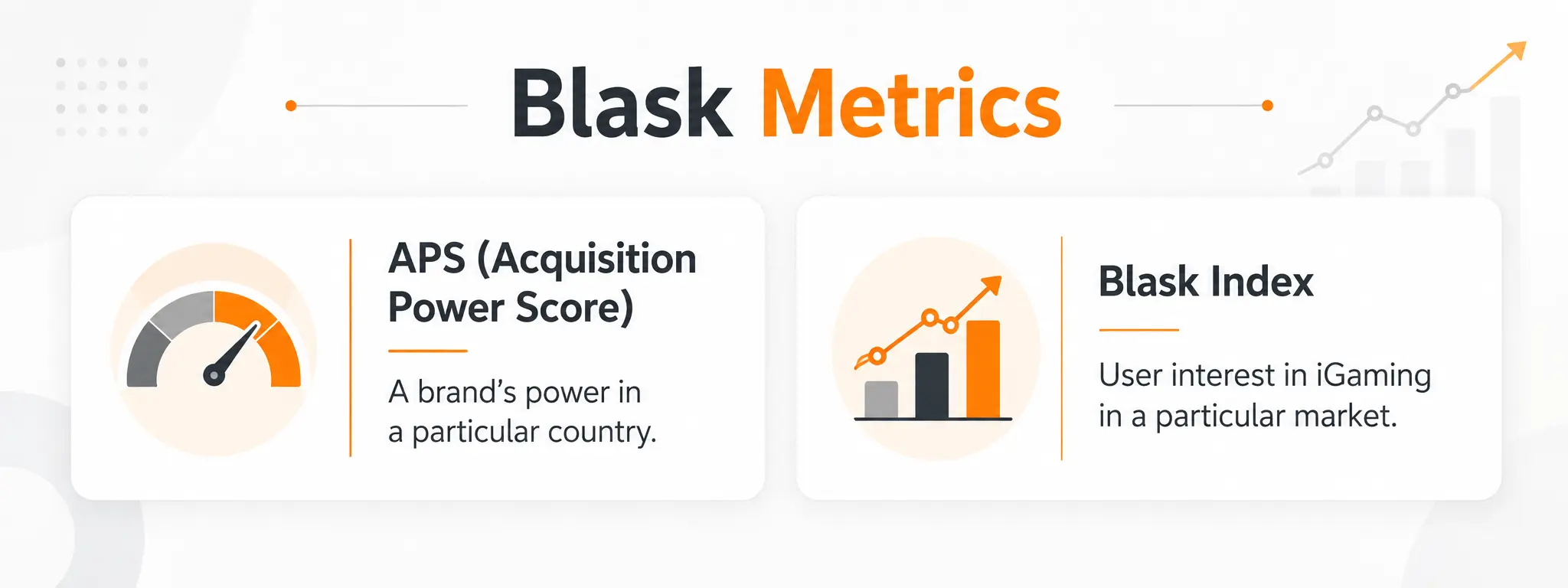
Blask Metrics used to measure LATAM iGaming market demand.

World Cup Cycles Raise the LATAM iGaming Market Floor

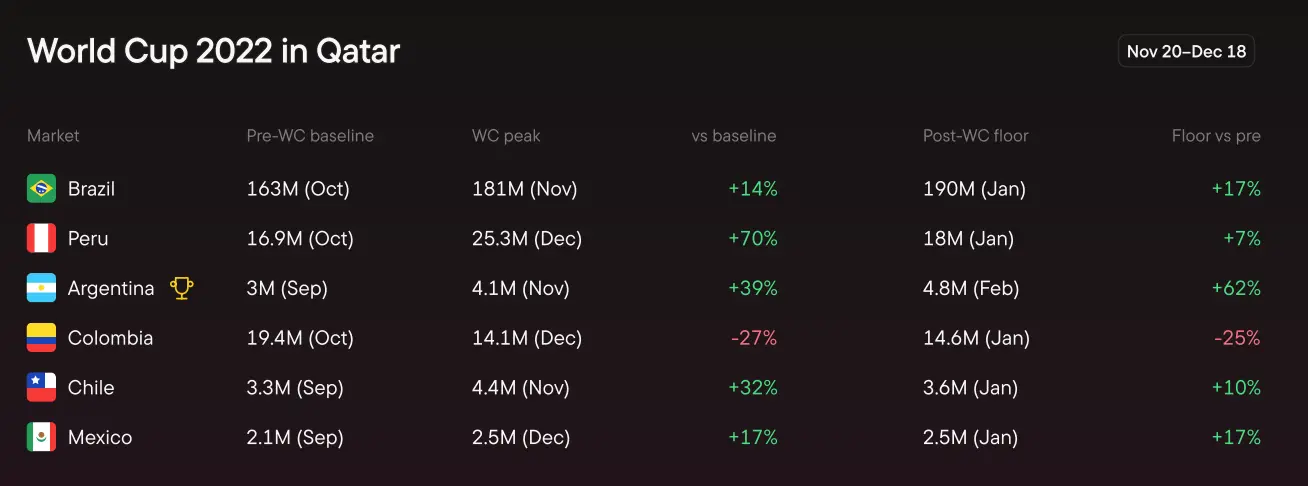
World Cup demand often starts with new bettors. Football gives casual fans a reason to register, deposit and place a first bet. Some leave after the tournament. Others stay, creating a higher floor for regular iGaming activity across Latin America.

That pattern appears throughout Blask’s ten-year dataset. Across the LATAM markets analysed, no country returned to its previous demand level after a World Cup cycle.

World Cup 2022 LATAM iGaming demand table showing market peaks and post-WC floors.

For operators, the tournament window tells only part of the story. The real test comes 30, 60 and 90 days later, when acquisition volume turns into retained depositors, second deposits, casino activation, live betting adoption and net revenue—the same operator KPIs used to measure whether short-term demand became lasting value.

World Cup Demand in LATAM Depends on Betting Culture, Not Just Qualification

A common assumption around World Cup betting is simple: when a national team qualifies, acquisition rises. When it doesn’t, demand weakens.

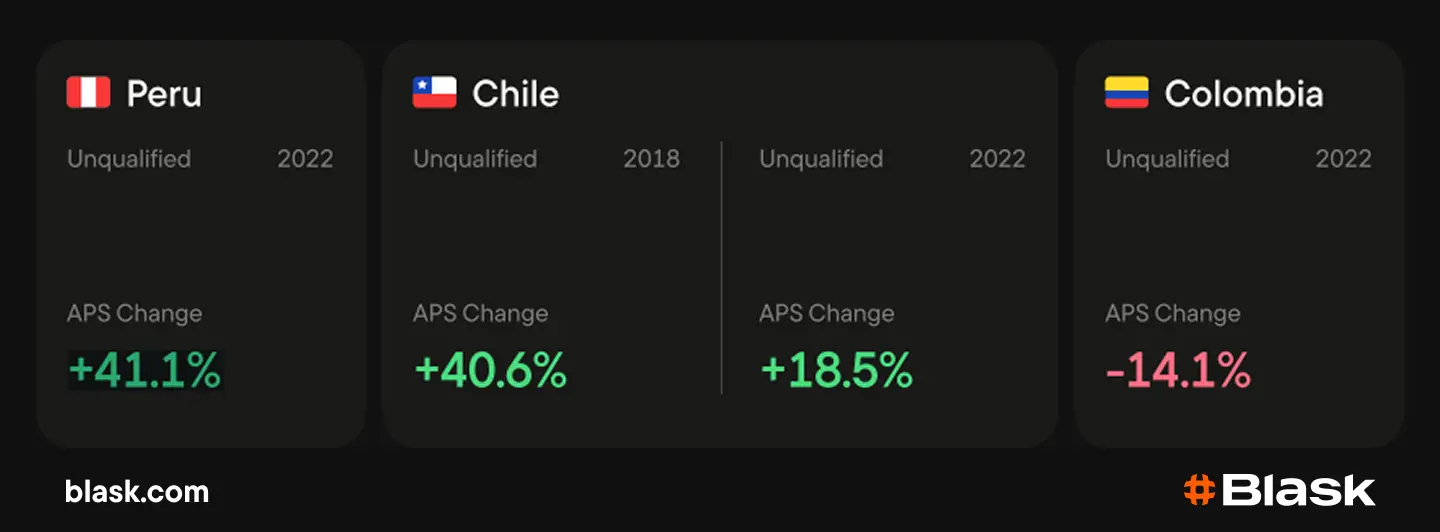
Blask’s data shows a more uneven pattern across the LATAM iGaming market. Peru and Chile both recorded strong World Cup demand without national team participation, while Colombia moved in the opposite direction.

LATAM World Cup APS change graphic showing Peru, Chile and Colombia demand shifts.

Peru Shows Demand Without Qualification

Peru did not qualify for the 2022 World Cup after losing to Australia in the playoff. Even so, APS jumped by +41.1%. That was the strongest World Cup response in six years of LATAM data, and higher than Peru’s +38.5% increase in 2018, when the national team did qualify. The data points to a mature betting culture. In Peru, the World Cup worked as a wider football event, rather than a market moment tied only to national team participation.

Chile Shows Long-Term LATAM iGaming Market Growth

Chile recorded 143x growth over ten years, despite missing both the 2018 and 2022 World Cups. The market also operated without iGaming regulation across the full decade of available data. By conventional measures, Chile should have shown a limited World Cup betting effect. Instead, APS rose by +40.6% in 2018 and +18.5% in 2022. That makes Chile one of the clearer examples of demand growing through football culture, brand activity and user behaviour rather than qualification alone.

Colombia Shows a More Team-Dependent Pattern

Colombia gives the counterexample. In 2018, when the national team qualified, APS increased by +35.1%. In 2022, when Colombia missed the tournament, APS fell by −14.1%. It was the only negative World Cup movement in the dataset. The structure of the market helps explain the difference. BetPlay holds 56% of market APS and sponsors domestic professional football. That ties Colombian betting identity closely to local football. Without the national team at the tournament, domestic football carried more weight and the World Cup added less demand.

Across these examples, qualification matters less than market structure. A single LATAM campaign built around national team excitement may work in some countries, but it won’t fit every market in the region.

Brazil Changes the LATAM iGaming Market Equation for 2026

Brazil enters the 2026 World Cup under different conditions from previous tournament cycles. In 2022, the market had 240 brands, 5.6M APS and no licensing framework. By 2026, operators will face a regulated market for the first time. That shift also sits within a wider regional discussion about World Cup 2026 regulation, as Mexico faces pressure to update gambling laws before the tournament.

That changes the competitive context in two ways.

Regulation changes the brand race

Licensed operators will need to compete on visibility, trust and regulatory discipline, while offshore brands continue to operate in the same media environment. For the LATAM iGaming market, Brazil becomes the clearest test of how World Cup demand behaves once formal licensing enters the equation.

Pix shortens the path to deposit

By 2026, 48% of Brazilian players prefer Pix for deposits. That matters during live football moments. Discovery, registration, deposit and first bet can all happen close to the same emotional trigger: a goal, a penalty, a red card or a late winner.

Betano Holds a Pan-LATAM Lead Ahead of the 2026 World Cup

Betano enters the 2026 World Cup with the broadest cross-market position in Blask’s LATAM dataset. The brand ranks first in Brazil, with +21% YoY growth and 16.3M APS, and first in Chile, where it recorded +29% YoY growth.

It also ranks second in Peru, with +63% YoY growth, and second in Argentina. No other international brand in the dataset holds a top-two position across more than one major LATAM market at the same time.
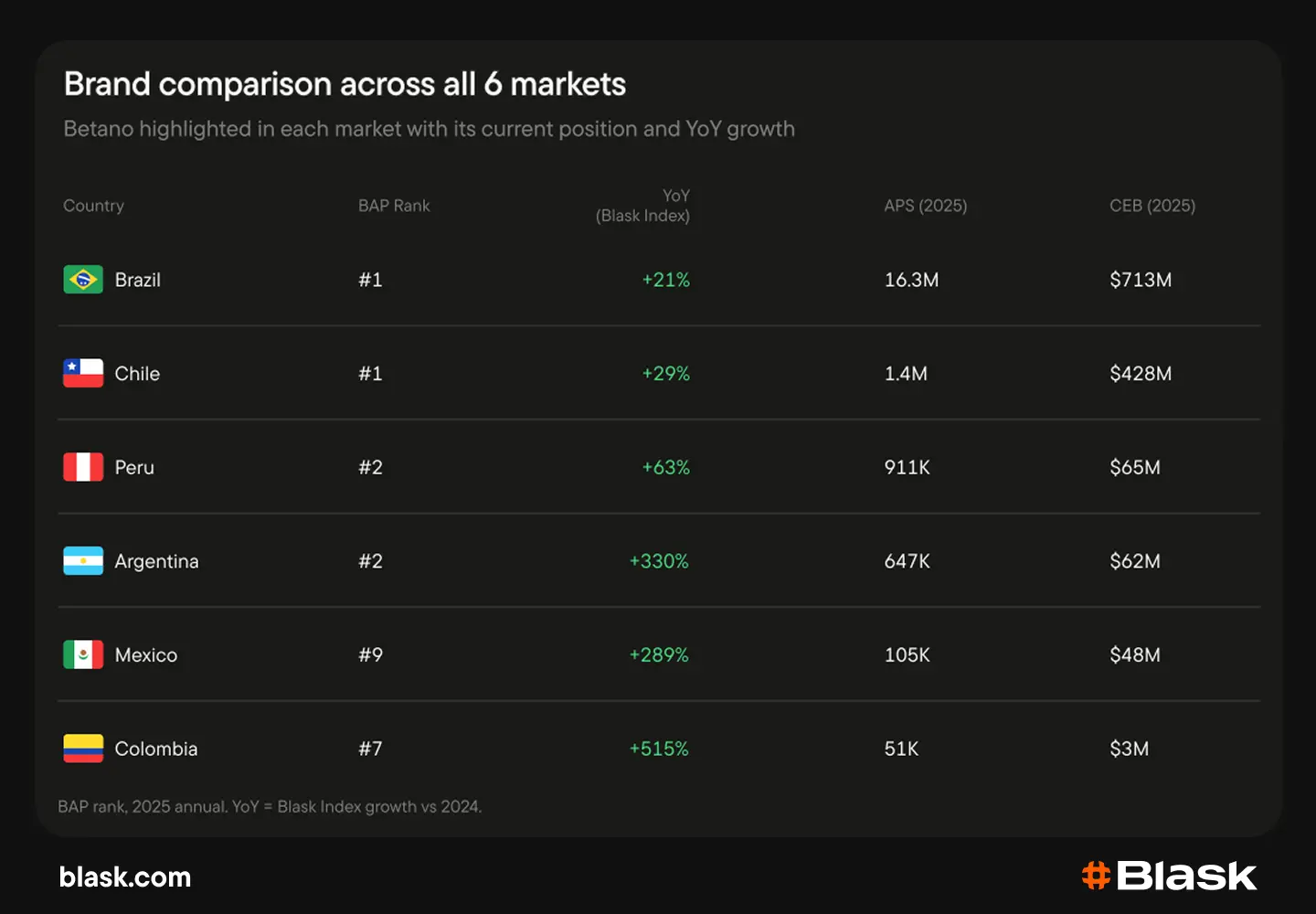
Betano LATAM brand comparison table showing APS, BAP rank and YoY growth.

Betano’s position in Colombia looks different. The brand ranks seventh by BAP, but it recorded the highest YoY growth in the market at +515%.

The 2026 question is whether Betano’s regional lead comes from lasting brand strength or tournament-level spend. Caliente holds 26% of Mexican APS. BetPlay holds 56% of Colombian APS. Apuesta Total grew +172% YoY in Peru.

That answer won’t come during the tournament itself. It will show three months later, when budgets normalise and retention data shows which operators kept the players they acquired.

What World Cup Data Shows About LATAM iGaming Demand

Blask’s ten-year LATAM dataset points to one clear pattern: the World Cup resets the demand floor. It brings in first-time bettors, lifts post-tournament activity and rewards operators that plan beyond the opening acquisition spike.

The markets don’t move in the same way. Culture shapes where World Cup demand appears. Infrastructure decides how much of that demand operators can convert and retain. Compared with the Blask x Ace Alliance report on World Cup 2026 iGaming demand in Europe, the LATAM data shows how regional betting behaviour can follow different patterns even around the same global football event.

That makes the 2026 cycle different. Brazil enters the tournament with regulation in place for the first time, Pix has shortened the path from football moment to deposit, and Betano holds a wider regional position than any other international brand in the dataset. The real result won’t appear at kick-off. It will show after the tournament, when retained depositors reveal which operators built demand that lasted.