Ace Alliance Riga
Ace Alliance Riga
Don’t miss the Early Bird Offer! | August 6-7, 2026
Get Your Pass!
Table Of Content :

How to Find Competitors’ Affiliates: 9 Steps to Build a Better Partner List

trust
Ace Alliance: Delivering Trust Through Expertise
From exclusive events and interviews to real-time market trends, Ace Alliance brings you unbiased, well-informed, and data-driven content. Our editorial team adheres to strict editorial standards, ensuring that the information you receive is not only relevant but also trustworthy.

Built by market experts hosting events since 2023, with our first event in Riga, Latvia gathering over 300 top level iGaming industry executives, Ace Alliance is able to provide you with reliable information from direct interaction with experts and leaders in the sector.
Yagmur Canel
Content Manager
Darko Ilievski
Lead Editor
Updated:
Reading Time: 6 minutes
Banner for finding competitors’ affiliates, showing a 9-step affiliate research process.

Examining competitors’ affiliate programs that offer similar products to your company can help you and your affiliate grow exponentially. This approach can also lead to a better audience understanding and discovering finer offers. Want to learn how to find competitors’ affiliate publishers? Using our thorough guide will help you do that in 9 simple steps before you continue building a better partner program.

Guide

Why Finding Competitors’ Affiliates Is Worth It

We can name several reasons why finding affiliates that operate in your field and analysing them is worth it. First of all, they already understand your market field and know how to engage with their target audience. Secondly, their customers are very familiar with their products/services and how they work.

Another good reason concerns the competitor’s posted content, as it provides proof of performance that you can thoroughly analyse. The final reason has to do with the quicker recruitment, as you get to avoid starting from scratch and not knowing who to hire.

Define Which Competitors Matter

When conducting competitor analysis, you must carefully select the businesses and affiliates that you want to examine. There are 3 types of competitors that you need to know before deciding which one to look for.

Direct Competitors

These are businesses that promote products and services that are similar to the ones you’re offering. They also tend to feature a similar audience, business model, pricing, and positioning.

Content Competitors

Such affiliate pages compete for the best SEO ranking, most traffic and attention, and audience engagement. They often target similar keywords and topics while looking for the same users.

Commission Competitors

These are affiliate marketing programs that usually don’t sell the same content or service as you. But they do compete for affiliate attention with various deals and revenue-sharing agreements.

9 Ways to Find Your Competitors’ Affiliates

We at Ace Alliance will help you learn how to find competitors’ affiliates by introducing an ultimate guide that features 9 simple steps. Here’s what you must do to identify affiliates with ease:

1. Use Google Search Operators

Start off by using search engines like Google for competitor reviews, promo codes, disclosures, and referral parameters. This way, you get to locate top-performing affiliates that offer the exact or similar content to the one you’re searching for.

2. Search for Affiliate Disclosures

This allows you to learn the affiliate relationship with its partners and how it earns from promoting their brands or services. The affiliate may generate an income in the form of commission, referral fees, revenue shares, or compensation.

3. Analyse Competitor Backlinks

Find review sites as well as comparison articles on popular SEO platforms like Ahrefs, Semrush, or Ubersuggest. You can also use their tools to locate coupon pages, bonus sites, and referral links.

4. Check YouTube Reviews and Descriptions

Stay ahead by watching review videos, tutorials, and comparisons on YouTube or other social platforms. Don’t forget to look for valuable competitor insights in the pinned comments and tracking links.

5. Search Reddit, Quora, and Niche Communities

You can use Reddit, Quora, and similar communities to search for smaller affiliate partners. These forum-based platforms can also help you locate creator-led recommendations in terms of affiliate strategy, conversion performance, commission structure, and more.

6. Review Coupon and Cashback Sites

Tracking promo and coupon codes can lead you to competitors with an aggressive marketing strategy. Looking for top bonus deal sites and discount code aggregators can also help you locate a competitive affiliate channel.

7. Investigate Affiliate Networks and Marketplaces

We also recommend searching for affiliate programs on Impact, Awin, CJ Affiliate, ShareASale, PartnerStack, or similar sites. They can assist you in learning about competitor commission structure, GEO targeting, recruitment strategy, and more.

8. Look At Competitor Affiliate Landing Pages

Access the competitor affiliate landing pages and examine their commission terms, positioning, cookie duration, and approved traffic sources. You’ll also learn about their conversion strategy, bonus structure, priority, and tracking systems.

9. Track Social Mentions and Branded Hashtags

Examine brand hashtags, affiliate mentions, and engaging social media profiles to locate creators who promote competitors. You can use native search engines or tools like Brand24 and Mention to find these individuals and break down their influencer marketing strategy.

How to Qualify the Affiliates You Find

While you look for your top competitors, you may come across a large number of affiliate programs. This can cause issues, as you might not know which of them are best for benchmarking your affiliate. That’s why we recommend setting up an easy-to-use scoring system.

Use a Simple Scoring System

If you don’t know how to create your own scoring system, we’ll gladly point out a couple of useful tips. We evaluated numerous parameters and picked the main ones that you need to grade from 1 to 5. Here are the key attributes that you need to score:
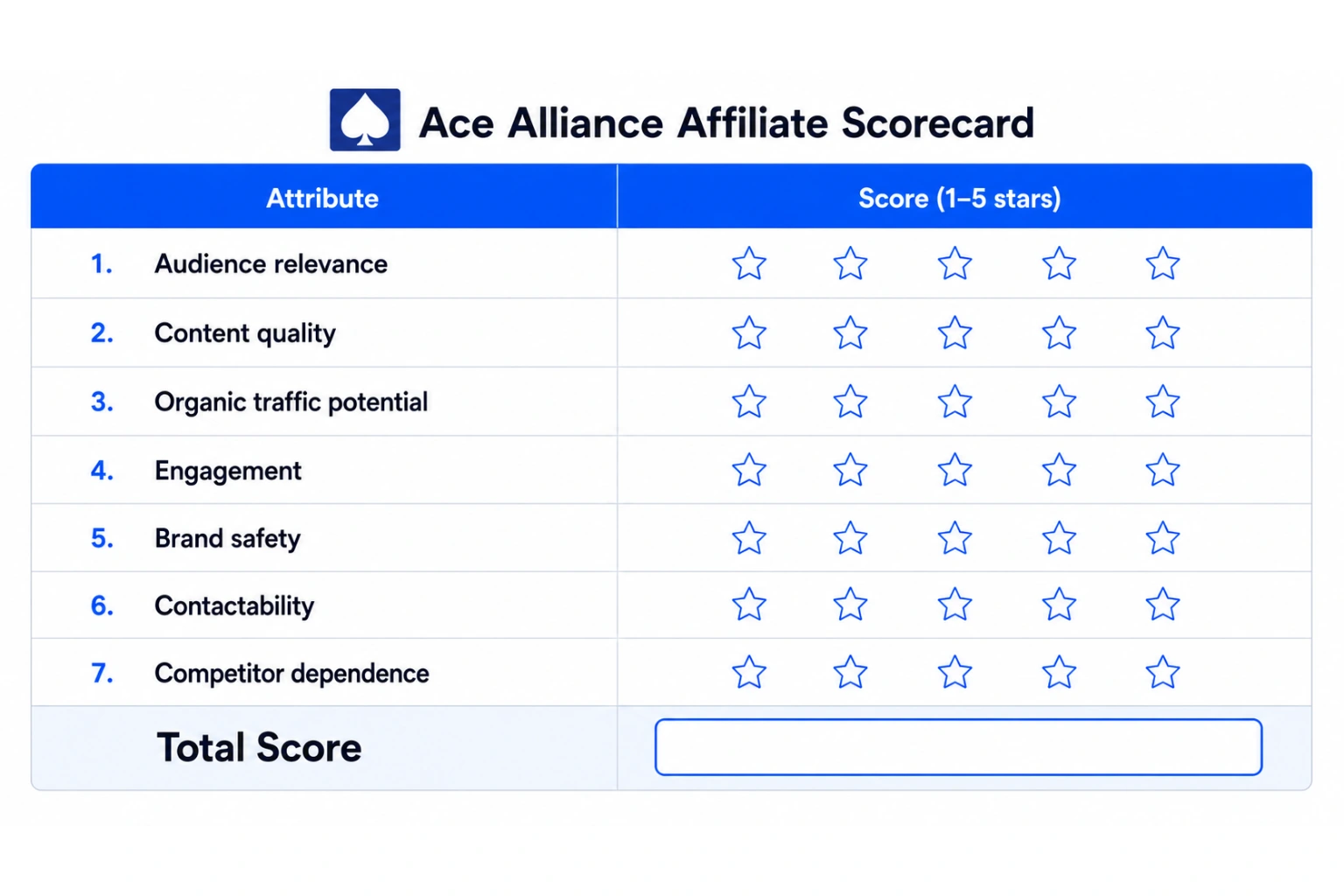
Affiliate scorecard with seven attributes rated from 1 to 5 stars

Use this scoring scheme to grade your competitors and identify areas of interest. When you finish scoring all affiliates, rank them from top to bottom based on their total score. You can then choose to analyse the finest affiliates. Don’t put your entire focus on raw traffic, as relevance is key for locating the best affiliates.

What to Track in Your Competitor Affiliate Spreadsheet

Using a competitor affiliate spreadsheet helps you understand how other businesses grow through affiliate partnerships and marketing. Your objective should be finding out where they get their traffic from, how they promote products and brands, what incentives they offer, and what strategies they use. But before you do this, you must first track several important details, such as:

Make sure to use official websites and affiliate links when setting up your competitor affiliate spreadsheet. Some competitors might hide certain information from the public, which may cause difficulties during your tracking.

How to Recruit Competitors’ Affiliates Without Sounding Desperate

Recruiting potential affiliate partners from your competitors can be a difficult task to accomplish. But there are a few tricks that you can use to gain a competitive advantage and sign deals with new affiliates. Check them out below and choose the approach that you think works best for your new potential partners.

Personalise the First Message

Conduct your competitive analysis to get familiar with the affiliate’s actual content. Then, you should reference their work when you initiate the first message. This shows that you’re actually interested in what they do, not just in their revenue.

Offer a Better Reason to Work With You

Try discovering as much information about the competitor’s affiliate program as possible, including the commission, marketing tools, and strategic approach. Use the findings to offer better payment terms, stronger creative assets, a higher conversion rate, and others.

Make Onboarding Easy

Make your new publishers’ transfer as easy as possible by providing links, tracking tools, assets, quicker support, and product angles. Be available for them around the clock as they try to settle into the new affiliate program.

Not every recruitment opportunity starts with an email. Affiliate events, dinners and private meet-ups can help you build trust with high-value publishers, understand what they need and give them a reason to consider your programme when the timing is right.

As our Head of Partnerships, Hordij Shkuropat explains:

Never underestimate the value of affiliate events. Building relationships with an organiser of gatherings frequented by desired affiliate partners can do wonders for advertisers. Sponsorship of, or attendance at, networking parties, dinners and retreats can build real trust and open many doors at once, as it is no secret that, in the age of AI and digital fatigue, meeting face to face makes even more of a difference.

Mistakes to Avoid When Finding Competitors’ Affiliates

Here are a couple of common mistakes that you need to avoid when looking at and analysing affiliate programs:

  • Copying competitors blindly – top affiliates may provide some ideas, but fully copying their approach can cause various issues.

  • Contacting every affiliate without qualification – not every affiliate that operates in the same industry is worth partnering with.

  • Leading only with higher commission – there are numerous other tools that you can use to attract businesses for a potential partnership.

  • Ignoring compliance and disclosure rules – this approach can create legal issues and risks, payment processing problems, and reputation damage.

  • Forgetting to monitor new affiliates over time – the new partners’ performance may change over time, which might include a decline in quality and traffic.

Final Thoughts on Finding Competitors’ Affiliates

Learning how to find competitors’ affiliates is not about copying everything that you understand about them. It’s all about identifying proven partners, assessing them in the right way, and offering them a better deal. We at Ace Alliance recommend starting with 3 competitors, finding 20 affiliates, scoring them, and contacting the top 5.

Finding Competitors’ Affiliates FAQs

Is it legal to contact competitors’ affiliates?

Yes, it’s legal to contact competitors’ affiliates, as long as they operate as independent publishers and you ethically use public information.

Can I find competitors’ affiliates without paid SEO tools?

Yes, you’re free to find competitors’ affiliate programs on your own. We suggest using competitor pages and disclosures, as well as popular platforms like Google, YouTube, and Reddit.

How often should I research competitors’ affiliates?

It depends on your goals and growth plans. Active affiliate programmes should repeat this research monthly, while smaller or stable programmes can do it quarterly.