Ace Alliance Riga
Ace Alliance Riga
Don’t miss the Early Bird Offer! | August 6-7, 2026
Get Your Pass!
Table Of Content :

Blask x Ace Alliance Report: Canada’s iGaming Market Remains Offshore-Led in H1 2026

trust
Ace Alliance: Delivering Trust Through Expertise
From exclusive events and interviews to real-time market trends, Ace Alliance brings you unbiased, well-informed, and data-driven content. Our editorial team adheres to strict editorial standards, ensuring that the information you receive is not only relevant but also trustworthy.

Built by market experts hosting events since 2023, with our first event in Riga, Latvia gathering over 300 top level iGaming industry executives, Ace Alliance is able to provide you with reliable information from direct interaction with experts and leaders in the sector.
Darko Ilievski
Lead Editor
Updated:
Reading Time: 5 minutes
Blask and Ace Alliance report graphic featuring a glowing map of Canada, a maple leaf casino chip and iGaming data dashboards, with the headline “Canada’s iGaming Market Remains Offshore-Led in H1 2026.”

Canada ranked as the world’s fourth-largest iGaming market by projected revenue in the first half of 2026, according to the latest Blask x Ace Alliance analysis. Blask recorded a Competitive Earning Baseline (CEB) of $4.97 billion across 292 brands, placing Canada behind Turkey and narrowly ahead of Russia.

However, most of that projected revenue remained outside locally regulated channels. Offshore brands accounted for 59.4% of Canada’s CEB, compared with 40.6% for onshore brands. Ontario was the clear exception, while the remaining provinces recorded substantially lower levels of channelisation.

Report

Key Takeaways From the Canada iGaming Market Report

The report shows that Canada’s position as a top-four global market has not translated into consistent channelisation across the country. Ontario directs most projected revenue towards locally licensed operators, but offshore brands continue to lead nationally and account for the majority of activity in every other province covered by the data.

This provides a useful comparison with the earlier Blask x Ace Alliance US iGaming market report, where offshore operators also captured most projected revenue despite the size and maturity of the wider market.

  • Canada ranked fourth among the 135 countries tracked by Blask, with an H1 2026 CEB of $4.97 billion.

  • Blask tracked 292 brands operating across the Canadian market.

  • Offshore brands accounted for 59.4% of projected revenue, compared with 40.6% for onshore brands.

  • Ontario generated roughly one-third of Canada’s CEB and recorded an onshore share of 80.7%.

  • British Columbia’s onshore share stood at 35%, while Quebec recorded 16.3%.

  • Stake was the largest Canadian brand by CEB, recording more than three times the projected revenue of the next-ranked brand.

  • Alberta’s regulated market launched after the H1 reporting period, creating a new channelisation test for the second half of 2026.

Methodology note: Competitive Earning Baseline is Blask’s projected revenue metric. It should not be treated as regulator-reported gross gaming revenue or confirmed operator revenue. Onshore and offshore classifications reflect whether a brand held the required local licence during the reporting period.

Canada Is the World’s Fourth-Largest iGaming Market by Projected Revenue

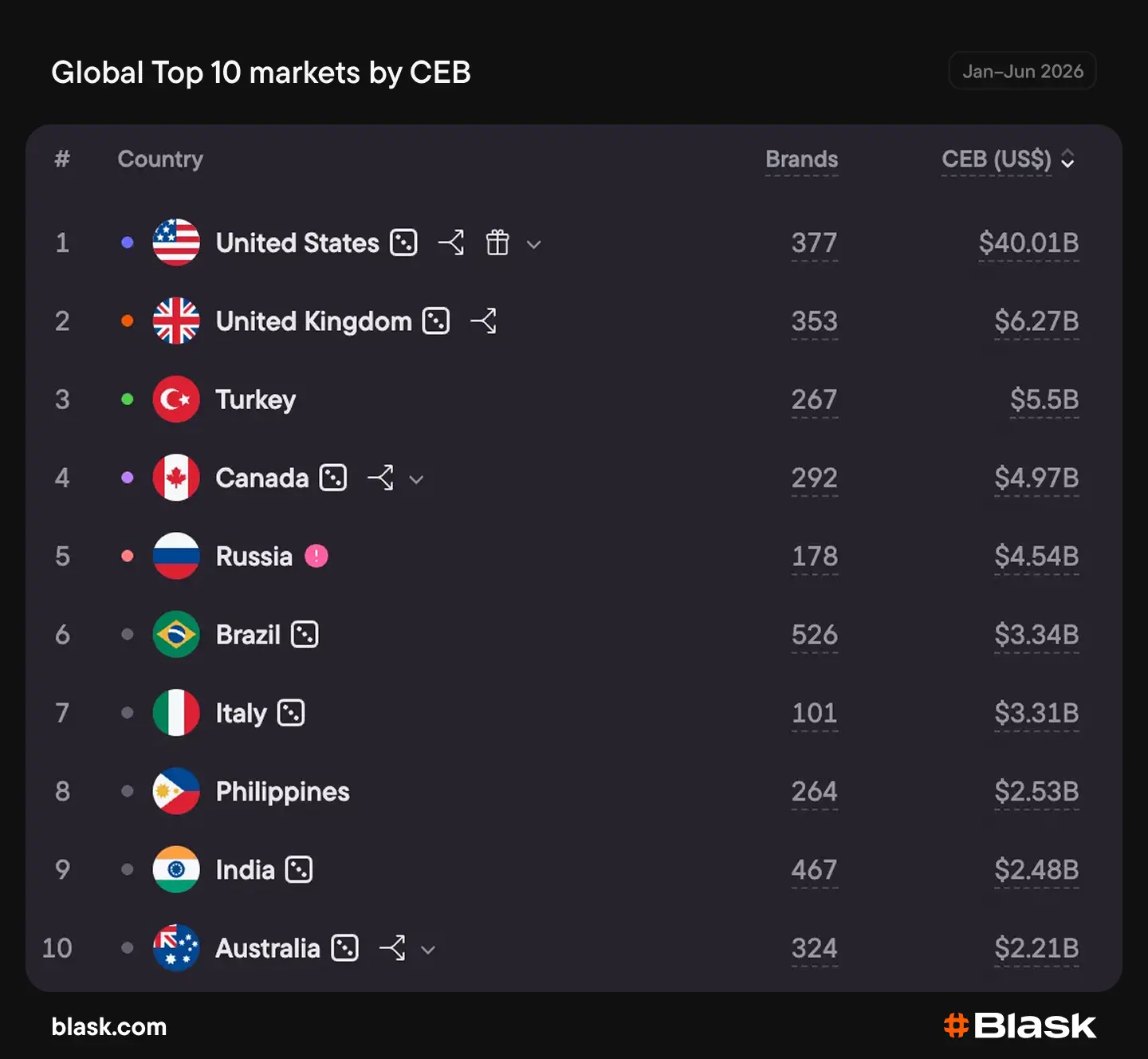
Canada ranked fourth among the 135 countries tracked by Blask during the first half of 2026. Its CEB of $4.97 billion placed it behind Turkey and just ahead of Russia, forming a relatively close group of markets below the much larger US total.

Blask ranking of the top 10 global iGaming markets by CEB in H1 2026, with Canada fourth at $4.97 billion across 292 brands.

The narrow difference between Canada and the markets immediately above and below it means its fourth-place position should be viewed in context. Canada is a major global iGaming market, but it does not hold the same distance over its closest competitors that the US does at the top of the ranking.

Blask tracked 292 brands in Canada during the reporting period. However, projected revenue was not distributed evenly across the country or among those brands. A small group of provinces and leading operators accounted for a large share of the overall market.

Ontario Accounts for Roughly One-Third of Canada’s CEB

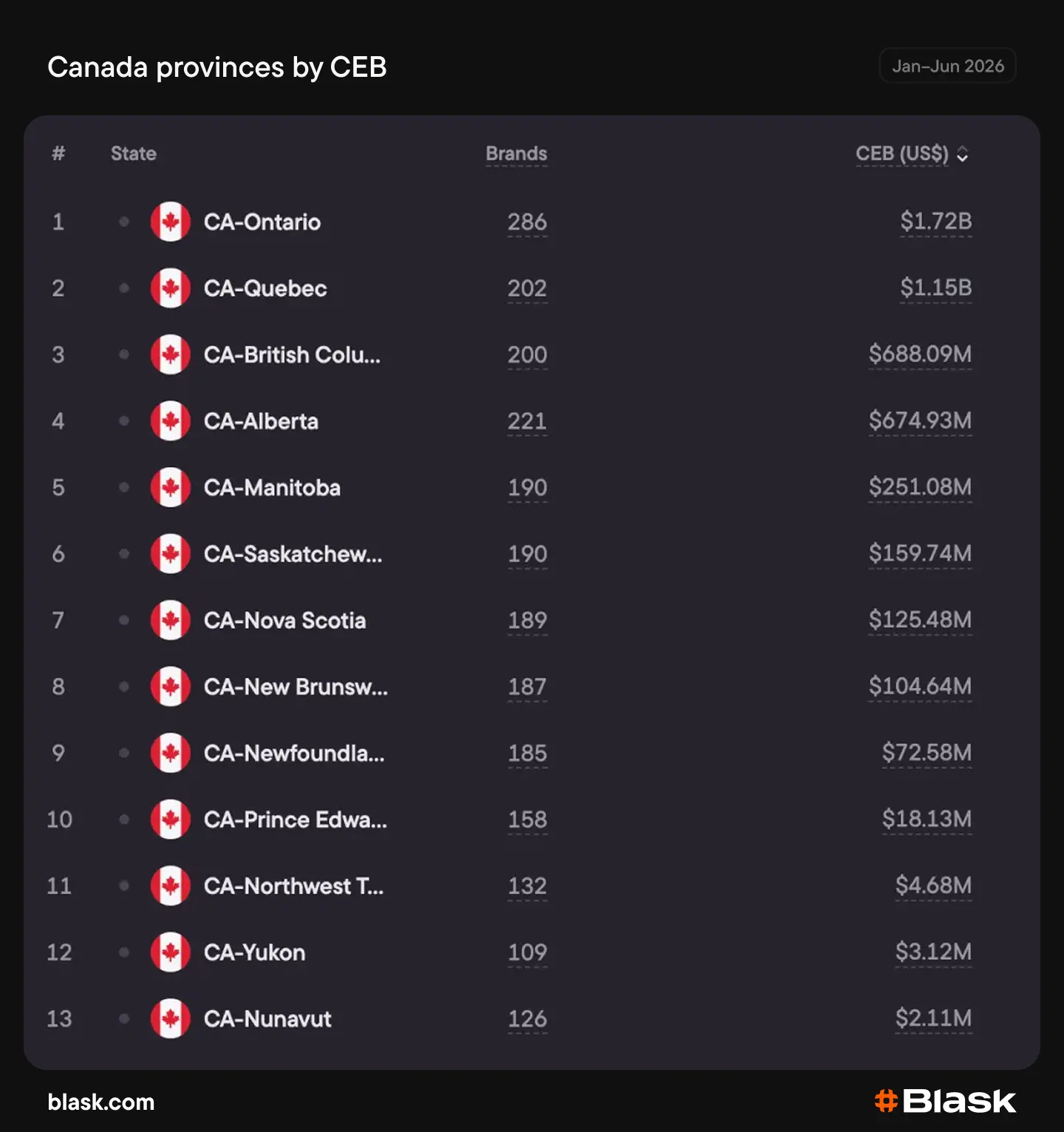
Ontario was the largest provincial market by a clear margin, accounting for approximately one-third of Canada’s total projected revenue. Quebec, British Columbia and Alberta formed a second tier below it, followed by a steep decline across the remaining provinces.

Blask ranking of Canadian provinces and territories by CEB in H1 2026, led by Ontario at $1.72 billion, followed by Quebec at $1.15 billion.

Projected revenue then tapered through Manitoba and Saskatchewan before reaching the smaller Atlantic markets. The Northwest Territories, Yukon and Nunavut recorded the lowest CEB totals in the country.

This concentration means national figures can disguise substantial differences between provincial markets. Ontario combines the country’s highest projected revenue with its strongest onshore share, while several smaller provinces remain predominantly offshore.

Offshore Brands Account for 59.4% of Canada’s Projected Revenue

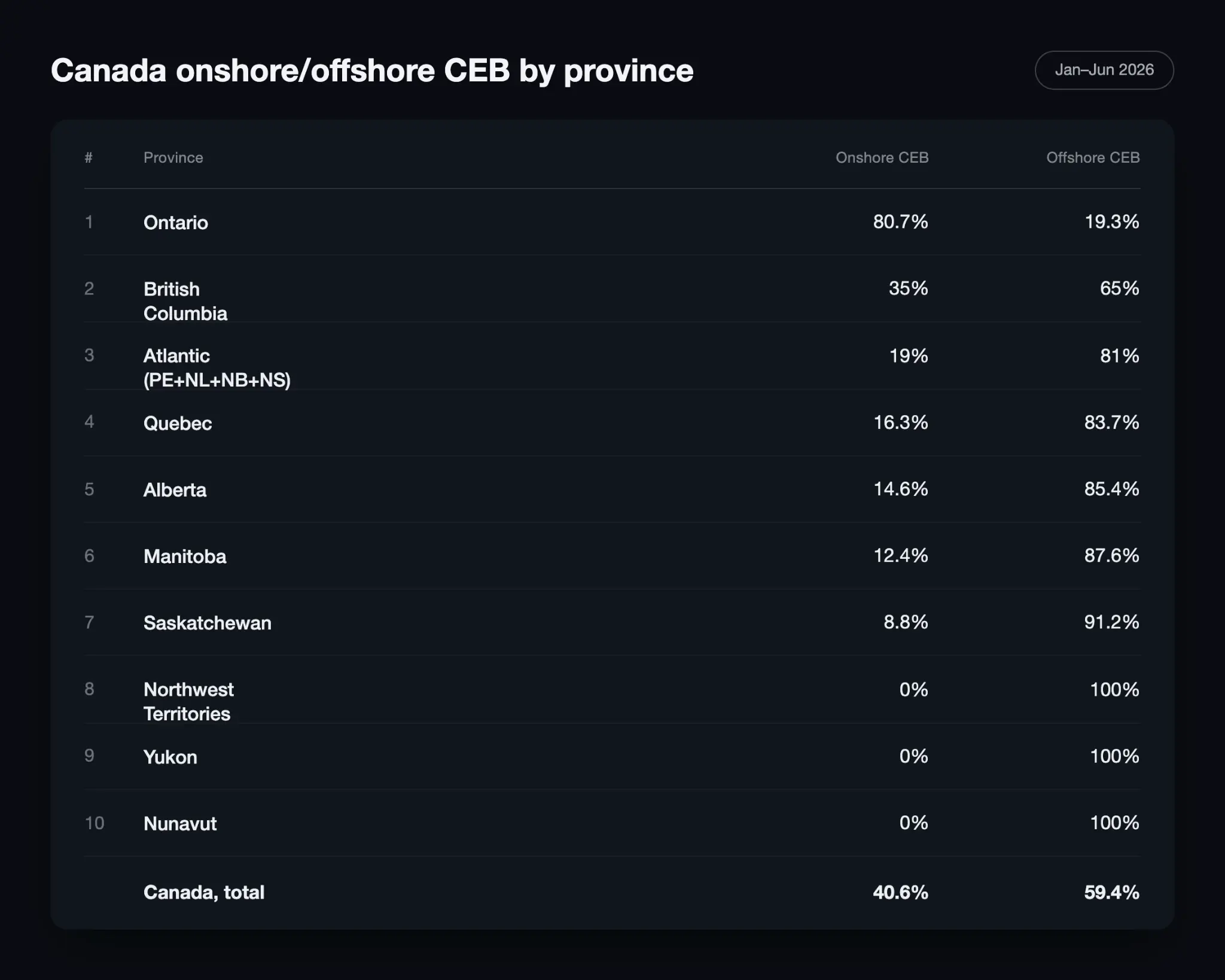
Onshore brands accounted for 40.6% of Canada’s CEB during the first half of 2026. The remaining 59.4% was attributed to brands that did not hold the required local licence in the province where the activity was recorded.

Blask comparison of onshore and offshore CEB by Canadian province in H1 2026, with offshore brands accounting for 59.4% of Canada’s total.

The balance varied significantly by province. Ontario was the only market where locally licensed brands held a dominant position, accounting for 80.7% of CEB. British Columbia recorded an onshore share of 35%, while Quebec’s locally licensed share stood at 16.3%.

Market Onshore CEB share Offshore CEB share
Canada 40.6% 59.4%
Ontario 80.7% 19.3%
British Columbia 35.0% 65.0%
Quebec 16.3% 83.7%

Alberta, Manitoba, Saskatchewan and the Atlantic provinces also directed most of their projected revenue towards offshore brands. Blask classified the CEB associated with the Northwest Territories, Yukon and Nunavut as offshore because no locally licensed competitive iGaming framework was available in those territories during H1 2026.

The figures make Ontario an important internal comparison. Its 80.7% onshore share shows how strongly the national balance can change when a competitive regulated market captures activity that would otherwise remain offshore.

Alberta’s Market Launch Creates a Second-Half Channelisation Test

Alberta’s regulated iGaming market officially launched on 13 July 2026, after the H1 reporting period ended on 30 June. The effects of the new framework are therefore not reflected in the figures covered by this report. During H1, PlayAlberta operated as the province’s only locally licensed product. Alberta nevertheless recorded one of the country’s lowest onshore shares, with most projected revenue attributed to offshore operators.

The H1 results now provide a pre-launch baseline against which the province’s second-half performance can be measured. The main question is not simply how projected revenue is redistributed among newly licensed operators, but whether Alberta’s overall onshore share increases as the regulated market develops. Ontario demonstrates that a competitive framework can coincide with substantially stronger channelisation. However, Alberta’s results will depend on how quickly registered brands establish themselves and how much existing offshore activity moves into the provincial system.

Stake Leads Canada’s iGaming Market by a Wide Margin

Stake was the largest brand in Canada by CEB during the first half of 2026. Blask classified the operator as offshore within Canada, and its projected revenue was more than three times higher than that of the next-ranked brand. 

Behind Stake, the market was divided between locally licensed products and offshore or mixed-licensure brands. PlayNow and Bet365 led the onshore group, with PlayNow operated by the British Columbia Lottery Corporation. Six of the ten largest brands were classified as onshore products. These included the provincial platforms PlayNow in British Columbia and Loto-Québec in Quebec, alongside privately operated brands holding local licences. Four of the top ten were classified as offshore.
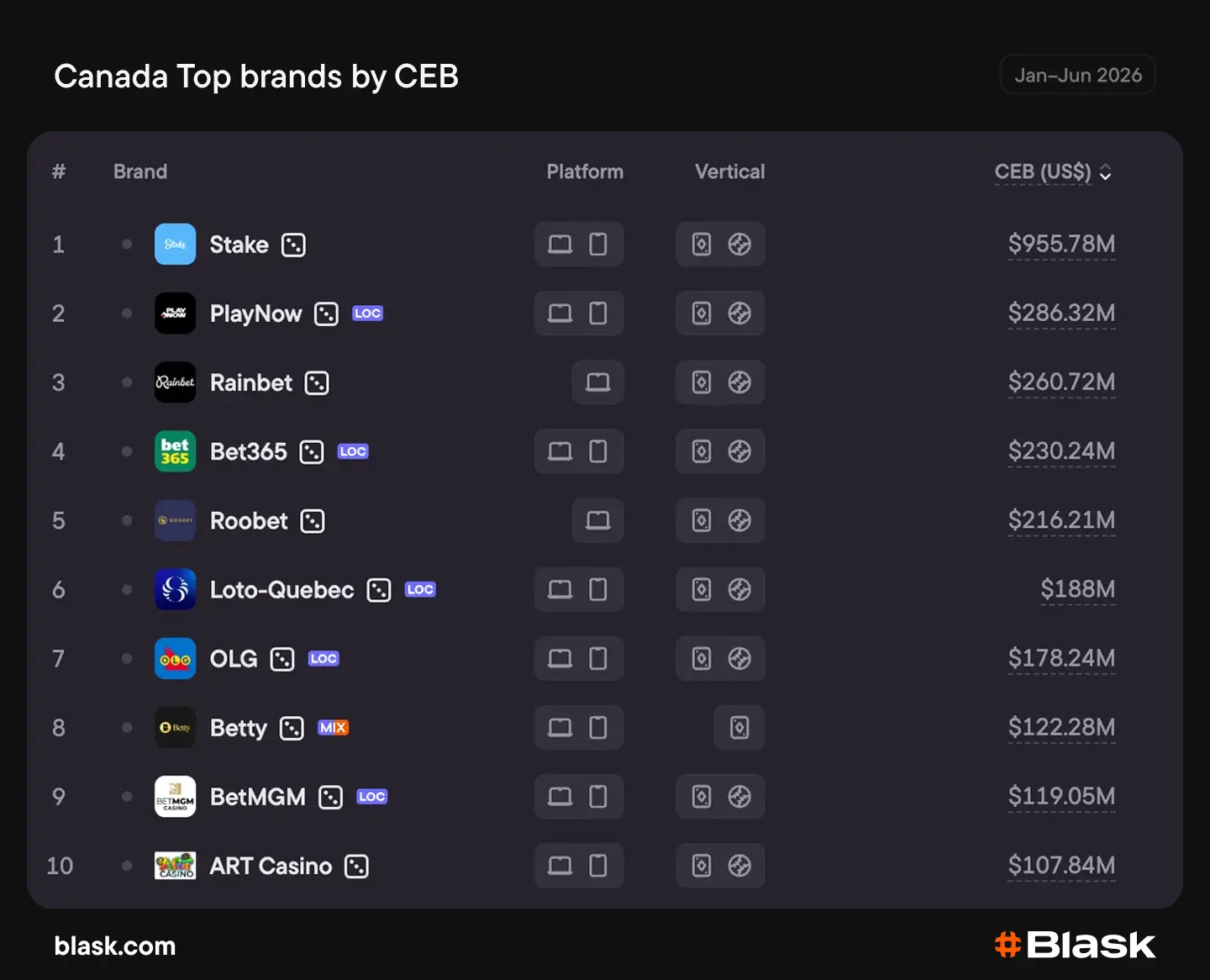
Blask ranking of Canada’s top 10 iGaming brands by CEB in H1 2026, led by Stake at $955.78 million, followed by PlayNow and Rainbet.

Despite onshore products holding more positions in the top ten, Stake’s substantial lead helped keep the national offshore share above 59%. The results show that the number of licensed brands near the top of the ranking matters less than the amount of projected revenue concentrated in the largest individual operators. PlayAlberta did not appear among the ten leading Canadian brands during H1, despite being Alberta’s only locally licensed option at the time. Its relative position may change as new competitors enter the regulated market, but the more important measure will be whether those entrants expand Alberta’s total onshore share rather than only redistributing existing licensed activity.

What Blask Data Shows About the Canada iGaming Market

Canada is one of the world’s largest iGaming markets, yet offshore brands still captured 59.4% of Blask’s projected revenue in H1 2026. Ontario stood apart, with locally licensed operators accounting for 80.7% of CEB, while British Columbia, Quebec and most other provinces remained more offshore-led. Alberta now provides the clearest test of whether an open competitive market can improve channelisation and shift more activity towards locally licensed brands in the second half of the year.

Viewed alongside earlier Blask x Ace Alliance reports on the US iGaming market, as well as World Cup iGaming demand in Europe and LATAM, Canada adds a different regulatory perspective to the series. The findings suggest that market size alone does not determine where projected revenue is captured. Regulation, market structure and demand concentration remain central to the balance between locally licensed and offshore operators.