Ace Alliance Riga
Ace Alliance Riga
Last Chance to Get Your VIP Pass! | August 6-7, 2026
Get Your Pass!
Table Of Content :

Blask x Ace Alliance Report: Where iGaming Demand Grew Most During World Cup 2026

trust
Ace Alliance: Delivering Trust Through Expertise
From exclusive events and interviews to real-time market trends, Ace Alliance brings you unbiased, well-informed, and data-driven content. Our editorial team adheres to strict editorial standards, ensuring that the information you receive is not only relevant but also trustworthy.

Built by market experts hosting events since 2023, with our first event in Riga, Latvia gathering over 300 top level iGaming industry executives, Ace Alliance is able to provide you with reliable information from direct interaction with experts and leaders in the sector.
Darko Ilievski
Lead Editor
Updated:
Reading Time: 5 minutes
Global iGaming demand growth during World Cup 2026, shown with a globe and data charts.

Eight of the ten countries recording the fastest Blask Index growth during the 2026 FIFA World Cup did not have a team in the tournament.

At the global level, demand increased by only 1.8% across comparable country geographies. The findings suggest that the tournament redistributed iGaming search demand between markets more than it expanded demand worldwide.

This Blask x Ace Alliance analysis examines which countries gained, which declined, and whether a national team’s participation or progress influenced the results.

Report

Key Takeaways From the World Cup 2026 Blask Index Analysis

  • The strongest percentage growth was concentrated outside the tournament field, with Iceland, Costa Rica, and Jamaica leading the ranking.

  • Peru stood out across both measures. It was the only large market among the five strongest percentage gainers and recorded the largest absolute Blask Index increase.

  • National-team performance did not consistently determine demand. Several countries eliminated during the group stage or first knockout round grew faster than teams reaching the later stages.

  • The three co-hosts also followed different patterns. Canada, Mexico and the United States reached the Round of 16, but their demand trends diverged after elimination.

How the Blask Index Comparison Was Calculated

Blask compared the full 39-day World Cup period, from 11 June to 19 July 2026, with the preceding 39 days, from 3 May to 10 June.

Blask Index measures aggregated and de-noised online search demand for iGaming brands in individual markets. The metric removes irrelevant and negative-intent searches before normalising the remaining data.

The participant comparison covers the national-team geographies available through Blask rather than all 48 teams. Iran, Uzbekistan, Iraq, Cape Verde, and Curaçao were not available, while England and Scotland were represented through the combined United Kingdom geography.

This analysis builds on the previous Blask x Ace Alliance World Cup iGaming Index report, which found that national-team performance and iGaming demand did not consistently move together during the 2018 and 2022 tournaments.

Non-Qualifiers Lead the Percentage-Growth Ranking

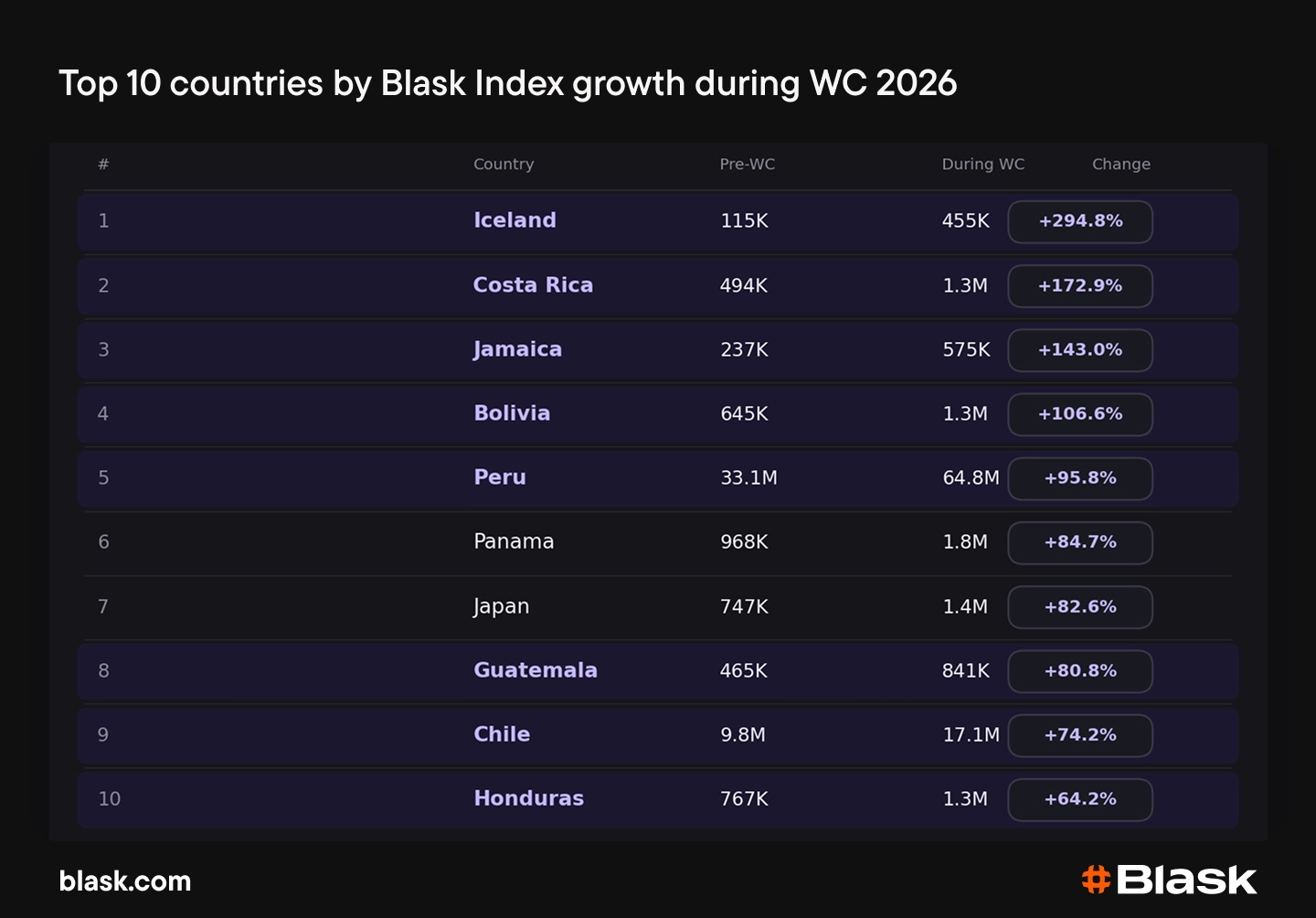
The three largest percentage increases came from countries outside the 48-team tournament: Iceland, Costa Rica, and Jamaica.

Peru was the main outlier at scale. Alongside ranking among the strongest percentage growers, it generated the largest absolute increase in the dataset. Chile followed the wider Latin American pattern further down the ranking.

Top 10 countries by Blask Index growth during WC2026.

Eight of the ten countries in the percentage-growth table did not qualify for the World Cup. The concentration of gains across Central and South America suggests that regional interest extended beyond countries represented on the pitch. The pattern also reflects the earlier Blask x Ace Alliance LATAM iGaming market report, which found that Peru and Chile could record substantial World Cup demand without national-team participation.

Panama and Japan were the only tournament participants to enter the top ten.

Panama was eliminated during the group stage, while Japan reached the Round of 32 before losing 2–1 to Brazil in Houston on 29 June. Their positions show that tournament progress alone did not determine how strongly search demand increased.

Large Markets Lead the Absolute-Gain Ranking

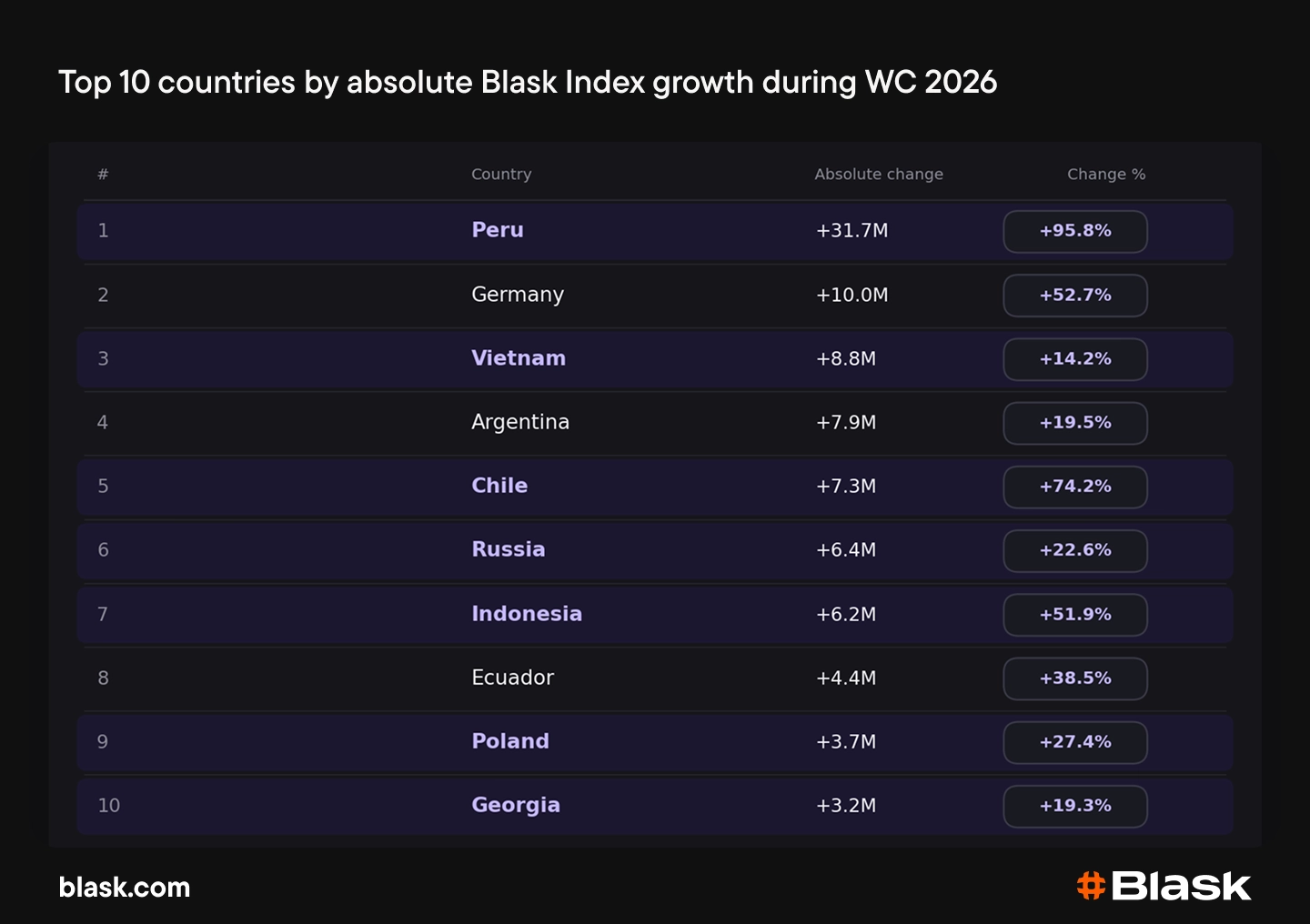
The ranking changes when markets are measured by the number of Blask Index points added rather than percentage growth.

Peru remained first, followed by Germany, which became the highest-ranked World Cup participant by absolute increase.

Vietnam, Argentina, Chile, Russia, and Indonesia accounted for much of the remaining top ten. Seven of the ten countries did not qualify for the tournament, with Germany, Argentina, and Ecuador the only participants in the ranking.

Top 10 countries by absolute Blask Index growth during WC2026.

Iceland and Costa Rica dropped out of the table once market size became a larger factor. Their percentage changes were substantial, but their starting demand volumes were lower than those recorded in Peru, Germany, and other larger markets.

The two rankings therefore measure different effects. Percentage growth identifies where demand changed most sharply relative to the previous period, while absolute growth shows where the largest volume of additional demand appeared.

Tournament Progress Did Not Determine Participant Growth

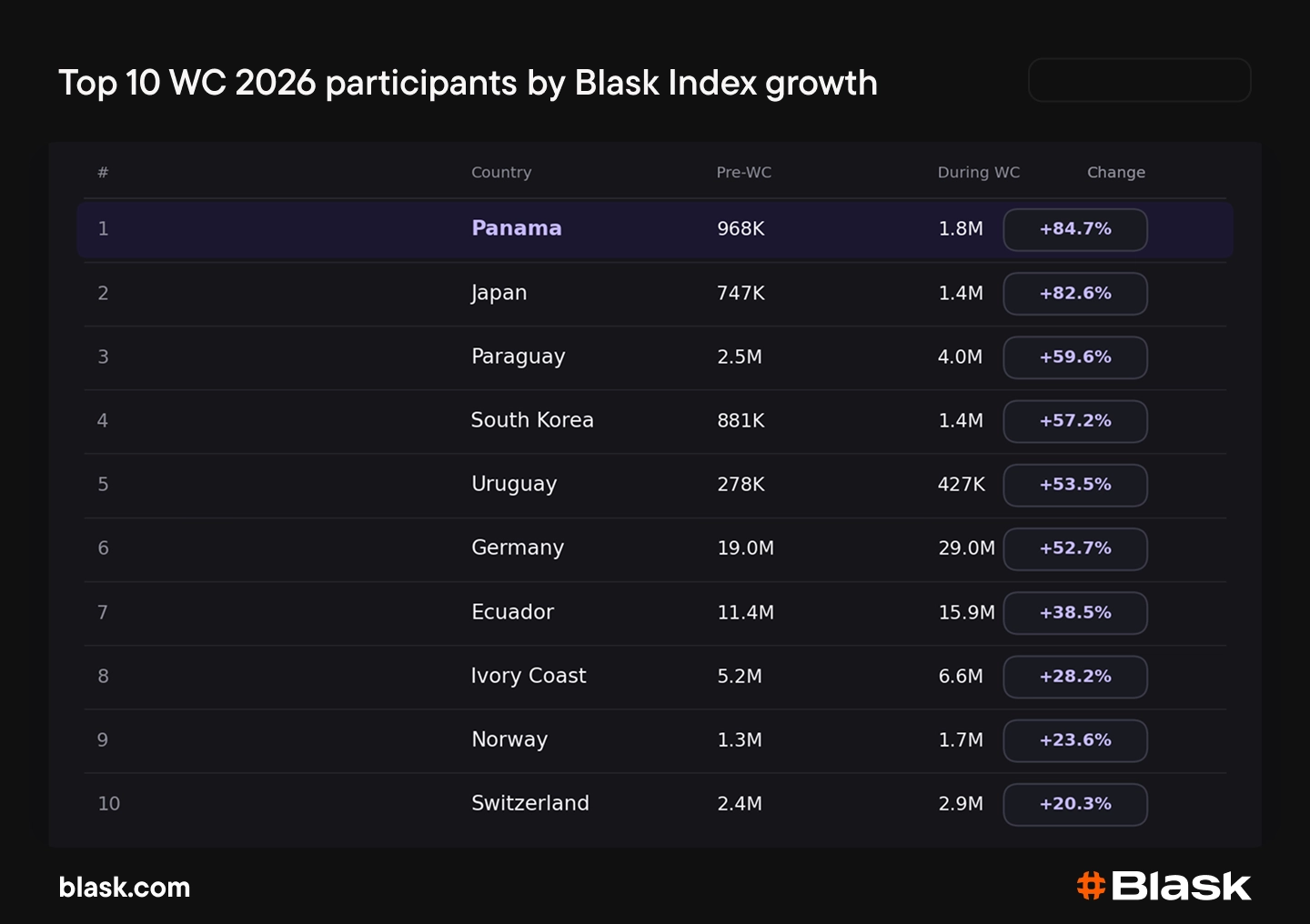
When the comparison is limited to participating countries covered by Blask, mid-sized markets with sharp percentage increases move to the top.
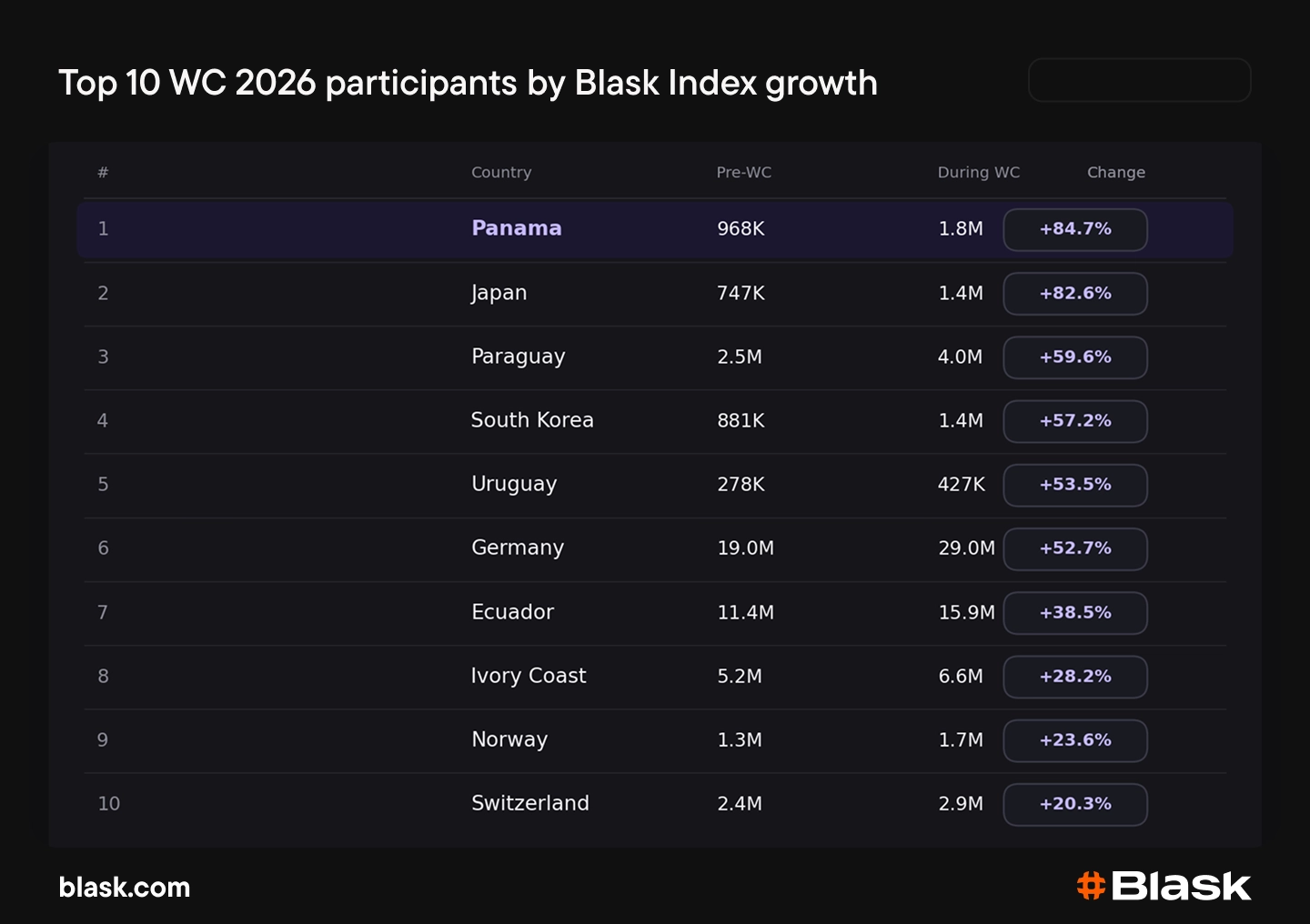
Top 10 WC 2026 participants by Blask Index growth.

Paraguay combined a strong demand increase with a run to the Round of 16. It eliminated Germany on penalties in the Round of 32 before losing 1–0 to France.

Germany nevertheless recorded the largest absolute increase among the participants appearing in the ranking, despite its early knockout-stage elimination.

Group-stage exits did not prevent demand growth either. South Korea and Uruguay were eliminated before the knockout rounds but still ranked among the five strongest participant markets by percentage increase.

Norway and Switzerland both reached the quarter-finals. Norway also defeated Brazil 2–1 in the Round of 16, but both countries ranked below several teams eliminated earlier in the tournament.

Winner Spain recorded Blask Index growth of 14.3%, while runner-up Argentina increased by 18.6%. Brazil, the largest market among the tournament participants tracked by Blask, was broadly unchanged, declining by 0.5%.

These results indicate that sporting performance was one influence on demand, but it was not sufficient to explain the overall ranking.

Hosts Canada, Mexico, and the US Diverged After Elimination

Canada, Mexico, and the United States all reached the Round of 16 and were eliminated within three days of one another. Canada lost to Morocco on 4 July, Mexico was eliminated by England on 5 July, and the United States exited against Belgium on 6 July.

WC 2026 hosts Blask Index.

Across the full tournament window, the three co-hosts recorded relatively similar cumulative demand totals. Their daily trajectories became more distinct after their national teams left the competition.

The three co-hosts also entered the tournament from different market positions. Earlier Blask x Ace Alliance reports identified declining US iGaming demand during H1 2026 and an offshore-led Canadian market, providing additional context for their contrasting tournament trends:

The equal-period comparison reflects the same split. Canada and Mexico grew from the May–June baseline into the World Cup period, while the United States declined.

Hosting the same tournament therefore produced three different market reactions once the local teams were no longer involved.

What the World Cup 2026 Data Shows

The largest World Cup-related percentage gains appeared in countries that did not qualify for the tournament.

Among participating markets, Panama and Japan led the percentage ranking despite exiting during the group stage and Round of 32, respectively. Germany recorded the largest absolute participant increase despite being eliminated by Paraguay in its first knockout match.

The co-host markets also diverged after their teams left. US demand cooled, Mexico retained more of its audience, and Canada continued rising following elimination.

The next question is how much of the growth recorded in non-participating and post-elimination markets will remain once the international fixture calendar returns to normal.

About Blask

Blask is an AI-powered platform for iGaming and gambling market analytics. The company turns fragmented open-source signals into real-time insight on brand visibility, player demand, and baseline revenue metrics, helping teams move first, spend smarter, and reduce risk across global markets.