Ace Alliance Horizon & Speed Rome
Early Bird Passes Available! | November 2, 2026
Get Your Pass!
Table Of Content :

Ace Alliance x SlotCatalog Report: The Mechanic Wars

trust
Ace Alliance: Delivering Trust Through Expertise
From exclusive events and interviews to real-time market trends, Ace Alliance brings you unbiased, well-informed, and data-driven content. Our editorial team adheres to strict editorial standards, ensuring that the information you receive is not only relevant but also trustworthy.

Built by market experts hosting events since 2023, with our first event in Riga, Latvia gathering over 300 top level iGaming industry executives, Ace Alliance is able to provide you with reliable information from direct interaction with experts and leaders in the sector.
Darko Ilievski
Lead Editor
Updated:
Reading Time: 11 minutes
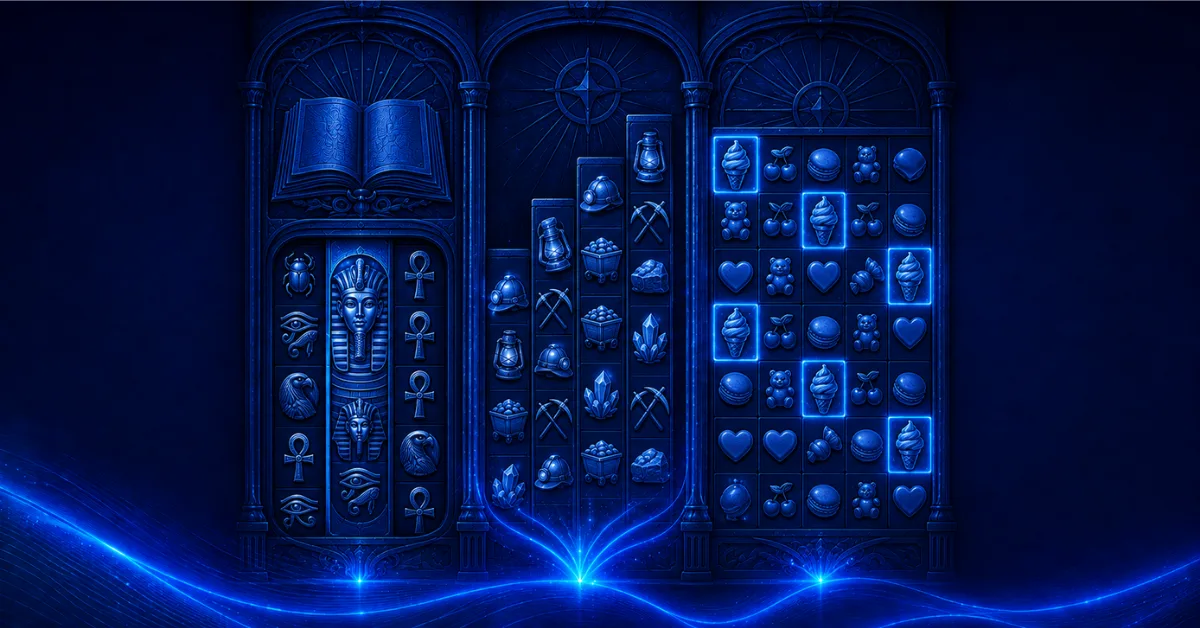
Blue panels comparing Book Of, Megaways and Pay Anywhere through Egyptian symbols, variable reels and scattered candy wins.

Pay Anywhere has overtaken Book Of and Megaways in SlotCatalog’s recorded title totals. This Ace Alliance x SlotCatalog report compares the three slot mechanics through August 2026, examining release trends, provider adoption, and licensing models to explore how their development differs and what those differences mean for operators and providers.

Report

Early Advantages and the Shift in Slot Production

Book Of had the longest history, but Megaways brought a different kind of advantage: proprietary technology that other studios could license. Big Time Gaming’s licensing agreement with Blueprint Gaming shows how its patented and trademarked mechanic became a product other providers could build around.

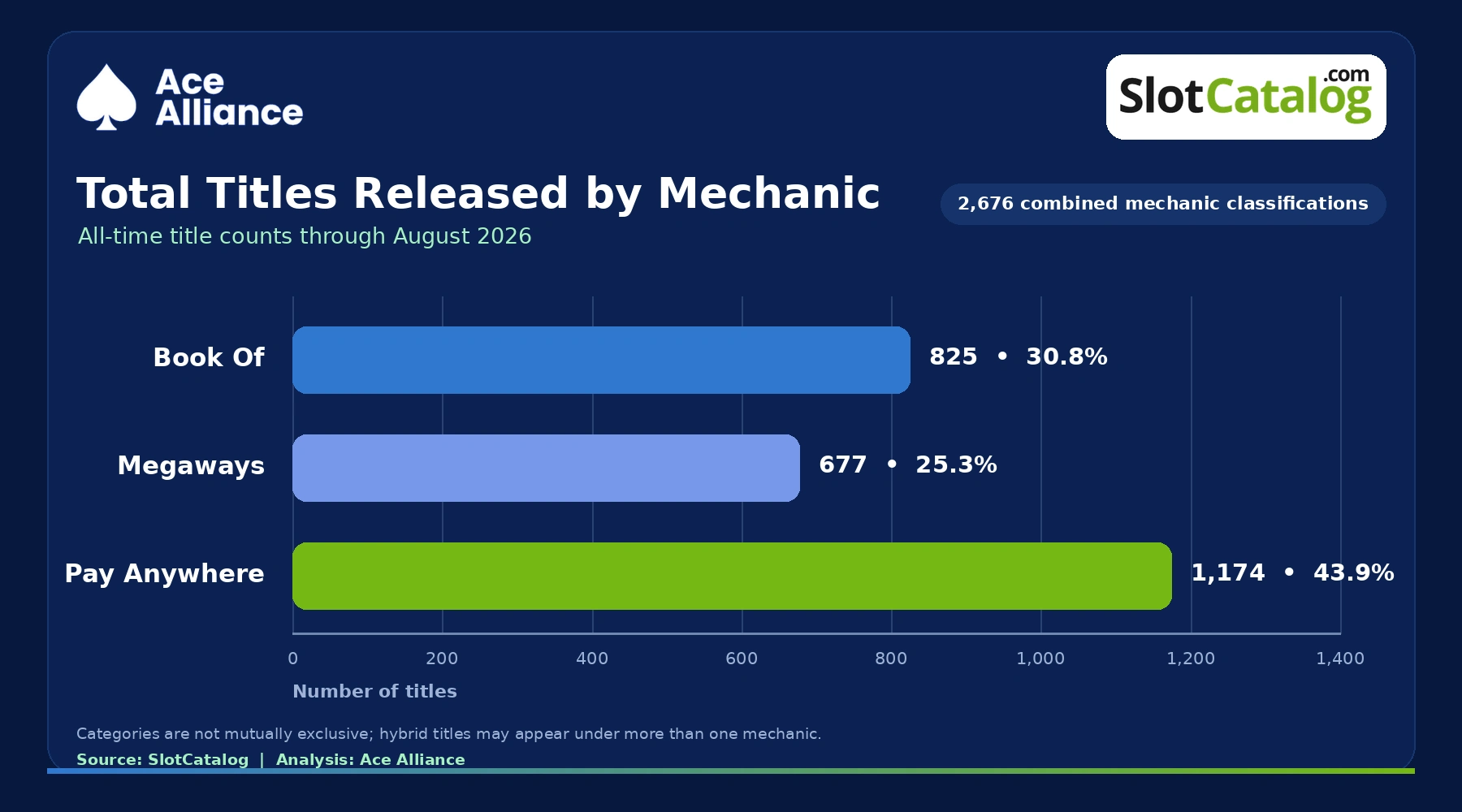
Neither advantage guaranteed the largest catalogue. By August 2026, Pay Anywhere had reached 1,174 titles, roughly 44% of the combined title counts across the three mechanics, ahead of Book Of’s 825 and Megaways’ 677. The format that spent years trailing its rivals now leads this comparison.

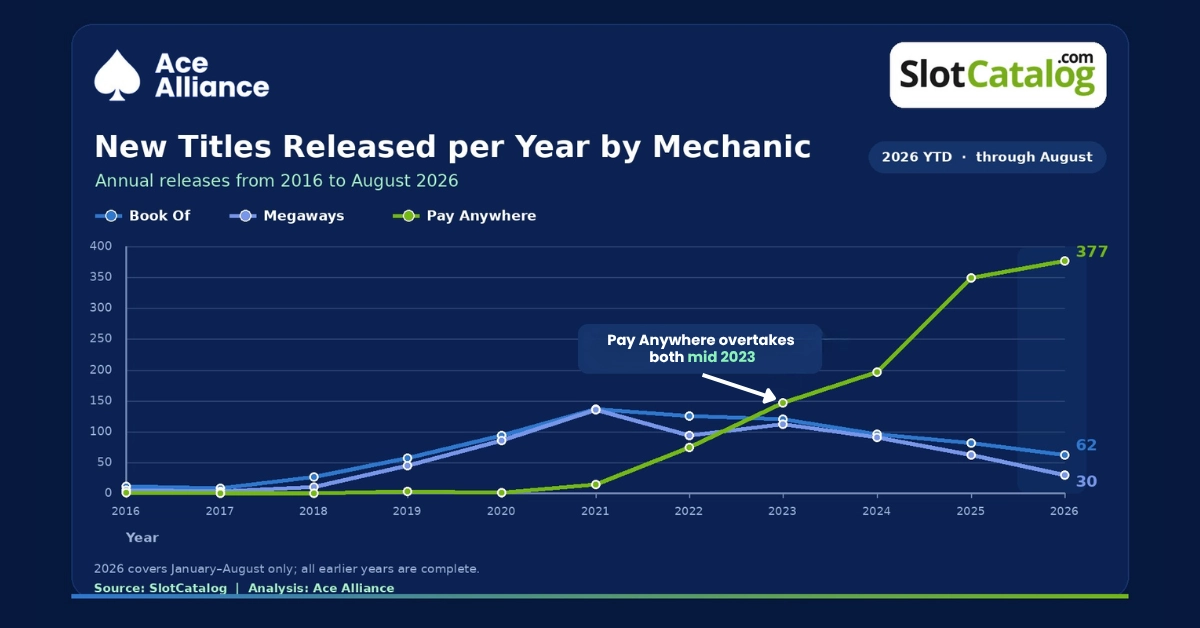
As recently as 2021, the picture looked very different. Book Of and Megaways were almost level at 136 and 135 releases that year, while Pay Anywhere recorded just 14. By 2023, Pay Anywhere had overtaken both in annual releases. It went on to reach 377 releases in the first eight months of 2026 alone, more than its two rivals produced together over the same period.

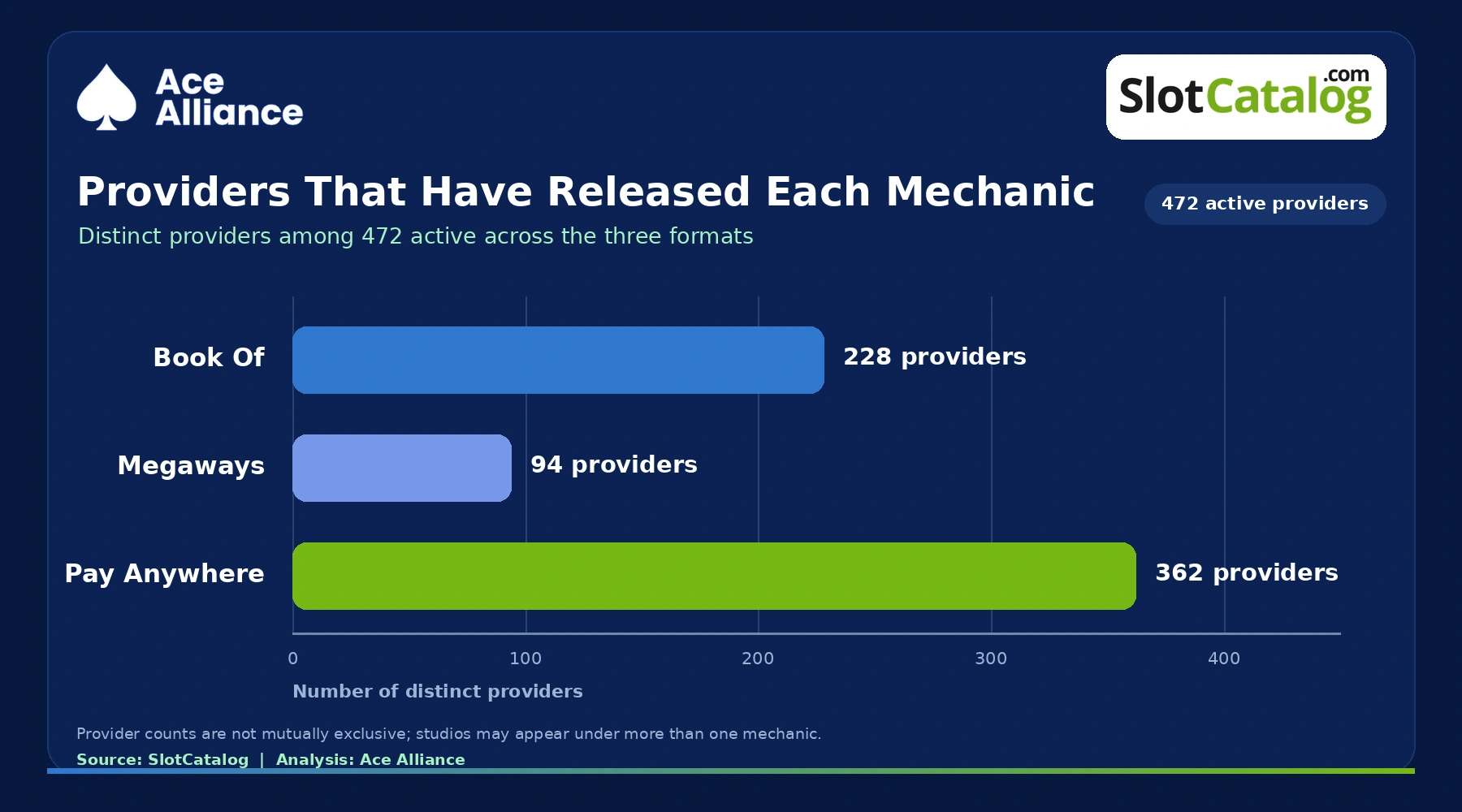
Provider adoption shows another contrast. Of the 472 studios active across these three mechanics, 94 had released a Megaways title, compared with 362 for Pay Anywhere. Licensing introduces an additional commercial requirement for studios developing Megaways games, making it relevant to that comparison. However, the counts alone cannot establish how much of the gap reflects licensing, development priorities or player demand.

The central shift is clear: Pay Anywhere now leads this comparison in both catalogue size and provider adoption, despite its much slower start.

Three Mechanics, Three Very Different Starts

Book Of
Megaways
Pay Anywhere

Expanding Bonus Symbols

  • How It Works: A special symbol is randomly selected when the bonus round begins. When the qualifying conditions are met, it expands to fill entire reels, creating payouts beyond the usual symbol positions.
  • Origins: Book of Ra (Novomatic/Greentube, 2005) introduced the format. Book of Dead (Play’n GO, 2016) later became one of its most recognisable titles.

A Different Reel Layout Every Spin

  • How It Works: The number of symbols on each reel changes with every spin, producing a variable number of ways to win. Some implementations offer more than 100,000 possible winning combinations.
  • Origins: Dragon Born, not Bonanza, was Big Time Gaming’s first Megaways title. Bonanza, released in 2016, subsequently helped popularise the mechanic.
  • Licensing Model: Big Time Gaming licenses its patented and trademarked mechanic to other providers, allowing them to develop their own Megaways games under an agreement.

Wins Without Paylines

  • How It Works: Matching symbols pay according to how many appear anywhere on the grid. They do not need to follow a payline or occupy adjacent positions.
  • Earliest Tracked Example: Money Rain (Incredible Technologies, 2014) is the earliest surviving example identified for this report. The format remained relatively small for years before its release volume accelerated.

Comparison Period: This report tracks release trends from January 2016 to August 2026. All-time totals (825 Book Of, 677 Megaways and 1,174 Pay Anywhere titles) also include a small number of Book Of and Pay Anywhere games released before 2016. These fall outside the trend window and are addressed in the methodology notes.

The Reel Wars: Where the Three Stand Today

Pay Anywhere leads this comparison in both catalogue size and provider adoption. Looking at these measures together shows how much content each mechanic has generated and how widely studios have adopted it.

Metric Book Of Megaways Pay Anywhere
Total titles, all-time to August 2026 825 677 1,174
Share of combined mechanic counts 30.8% 25.3% 43.9%
Early reference title Book of Ra Dragon Born Money Rain
Providers that have released a title 228 of 472 94 of 472 362 of 472
Highest yearly release count recorded 2021: 136 2021: 135 2026 YTD: 377
Releases in January–August 2026 62 30 377
Access model Open design pattern Licensed by Big Time Gaming Open design pattern

Title counts include releases before 2016. Games combining mechanics can appear in more than one category, so the combined counts should not be read as a total of distinct games. Figures for 2026 cover January–August only.

Pay Anywhere Leads in Title Count

Figure 1. All-time title counts by mechanic through August 2026: Pay Anywhere, 1,174; Book Of, 825; Megaways, 677.

Pay Anywhere accounts for approximately 44% of the combined title counts across the three mechanics. Its lead also extends to recent production: in the first eight months of 2026, providers released more Pay Anywhere titles than Book Of and Megaways titles combined.

Catalogue size, however, does not show whether production is concentrated among a few studios or spread across a wider field. Provider adoption adds that perspective.

Provider Adoption Shows a Wider Gap

Figure 2. Providers that have released each mechanic: Pay Anywhere, 362; Book Of, 228; Megaways, 94, from 472 studios active across the three formats.

Pay Anywhere has been adopted by more than three-quarters of the studios in this comparison. Looking at providers that concentrate on just one of these mechanics reveals a further distinction:

These counts refer only to the three mechanics examined here, not to each studio’s full portfolio. They show that Pay Anywhere’s broader adoption includes a substantial group of providers with no releases in either competing format.

Licensing Adds a Commercial Consideration

Big Time Gaming’s Megaways licensing agreements allow other providers to develop games using its patented and trademarked mechanic. Developing a Megaways title therefore involves a commercial agreement as well as the game’s production requirements.

That distinction makes licensing relevant to the adoption comparison. However, the figures do not establish why individual studios chose one mechanic over another, or how much of the gap reflects licensing costs, development priorities or player demand.

Release Trajectory: The Crossover

The annual release data shows a clear change in production leadership. Book Of and Megaways both peaked in 2021, while Pay Anywhere moved ahead in 2023 and continued expanding. The 2026 figures cover January–August only, so they should be read separately from completed calendar years.

Figure 3. Annual releases for Book Of, Megaways and Pay Anywhere slots from 2016 to August 2026, with 2026 showing eight months of data.

The three mechanics followed increasingly different paths:

Book Of
Releases peaked at 136 in 2021, followed by declining annual output through 2025. The format recorded 62 releases in January–August 2026, with four months still outstanding.
Megaways
Output fell from 135 in 2021 to 94 in 2022, recovered to 112 in 2023, then declined to 91 in 2024 and 62 in 2025. A further 30 titles were released in the first eight months of 2026.
Pay Anywhere
Releases rose from just 14 in 2021 to 74 in 2022, 147 in 2023, 196 in 2024 and 349 in 2025. Its 377 releases through August 2026 had already exceeded the previous full-year record.

Growth Within an Expanding Slot Market

These changes took place against a substantial increase in overall production. Average monthly releases tracked by SlotCatalog rose from approximately 170 in 2016 to 740 in January–August 2026, more than fourfold.

July 2026 provides a snapshot of Pay Anywhere’s position within that larger market. The mechanic recorded 60 releases, its highest monthly total in the dataset, out of 759 slots tracked that month—approximately 7.9%.

Pay Anywhere also represented four out of every five releases counted across the three mechanics that July. Its lead therefore extends beyond the accumulated catalogue to the composition of current slot production.

Who's Building What

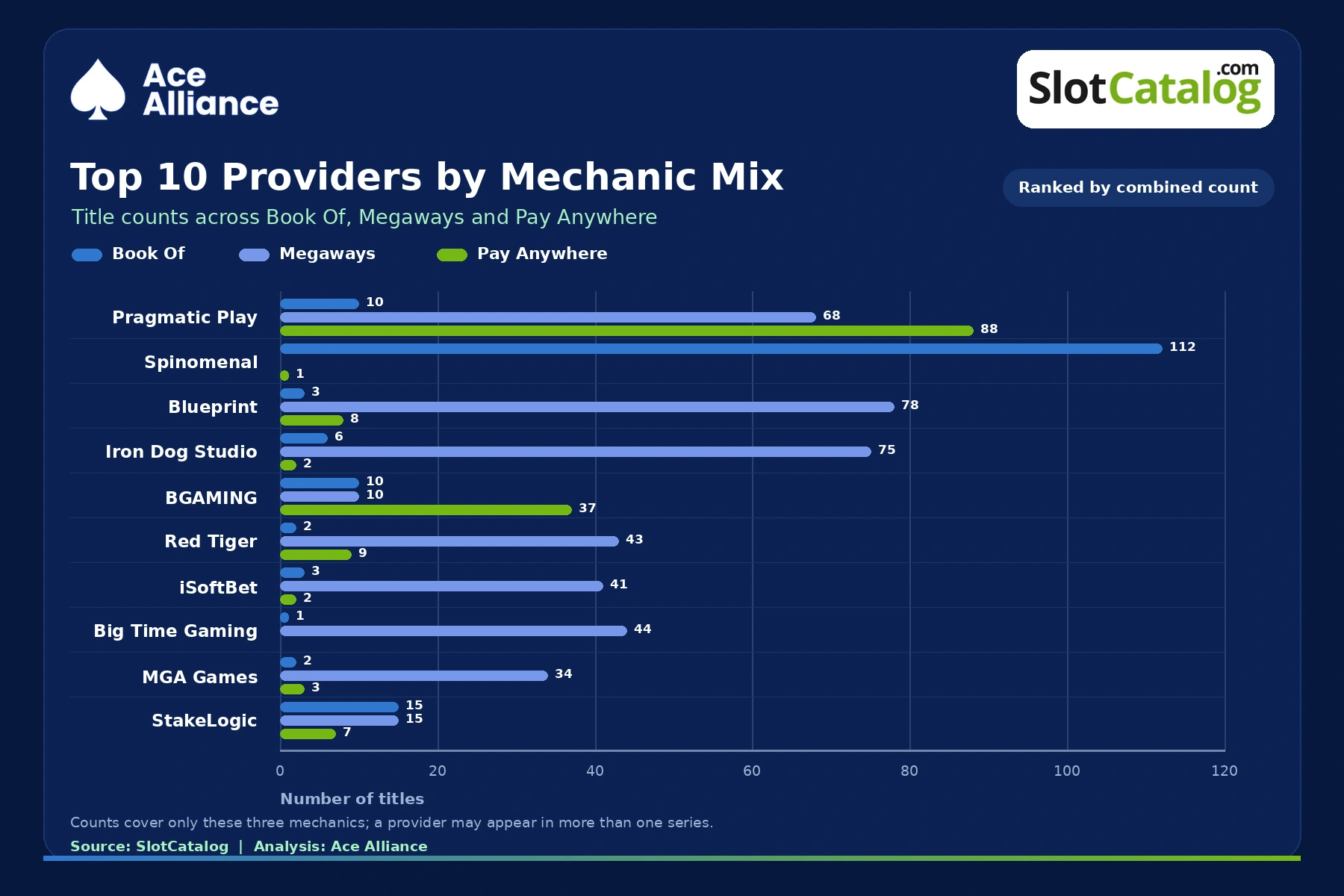
Three archetypes emerge once you split the ten biggest producers by mechanic mix.

Figure 4. The ten biggest producers across all three mechanics, split by title count.

The Book Of Loyalists

Spinomenal (112 Book Of, 0 Megaways, 1 Pay Anywhere), Gamomat (32/0/0), Swintt (24/0/3), Play’n GO (22/0/4) and Greentube (21/0/4) picked a lane years ago and never left it. For these studios, Book Of is the entire mechanic identity, not a side option.

The Megaways Licensees

Blueprint (78 Megaways), Iron Dog Studio (75), Big Time Gaming itself (44, the mechanic’s IP owner), Red Tiger (43), iSoftBet (41) and MGA Games (34) make up the licensed club. Blueprint and Iron Dog Studio especially lean almost entirely into Megaways and barely touch the other two mechanics at all, treating the license less as a side format and more as their core product line.

The Pay Anywhere Generalists

Pragmatic Play is the outlier worth naming directly: 10 Book Of, 68 Megaways (licensed from Big Time Gaming) and 88 Pay Anywhere. It’s the only top-tier studio building meaningfully across all three mechanics rather than picking one. Octoplay (35, effectively pure Pay Anywhere) and SabaPlay (22, pure) represent the newer-guard studios for whom Pay Anywhere is simply the default starting mechanic: no license fee, no paylines to design, no explaining required for the player.

The Games Players Actually Pick

Zoom in from provider strategy to individual titles, using SlotCatalog’s Norway popularity ranking (SlotRank) as of August 2026, and a few names at the top of each list are genuinely surprising.

Book Of: Book of the Fallen Outranks Book of Dead

The most popular Book Of game right now isn’t the one most people would guess. Book of the Fallen (SlotRank #6) currently outranks both Book of Dead (#9) and Book of Ra Deluxe (#13), the two titles players would usually name first. Cash Connection – Golden Book of Ra (#72), the original Book of Ra (#104), Oasis of Dead (#116), Book of Hidden Tombs (#140) and Book of Immortal Warlords (#288) round out the top tier.

Megaways: Bonanza Trails the Leading Titles

None of the mechanic’s top performers is the game that made it famous. Gears of Eternity Megaways Dream Drop (#63) currently leads, ahead of Temple Tumble Megaways (#111), Buffalo King Megaways (#135), Great Rhino Megaways (#154) and Gonzo’s Quest Megaways (#162). Bonanza Megaways, the title credited with putting the whole mechanic on the map, sits at #252, just behind Big Bad Wolf Megaways (#247) and just ahead of Release the Kraken Megaways (#257). Being first, or most famous, hasn’t kept it on top.

Pay Anywhere: Viking Runecraft 1000 Outranks Gates of Olympus

The single most popular Pay Anywhere game is Viking Runecraft 1000 (#10), ahead of the entire Gates of Olympus family. Gates of Olympus Super Scatter (#34), Gates of Olympus 1000 (#58), Sweet Bonanza (#118), the original Gates of Olympus (#130), Ronaldinho’s Streetball Bonanza (#174), Fury of Anubis (#193) and Gobstopper Grind (#287) fill out the rest of the top tier, a list leaning heavily on Pragmatic Play, the same studio already shown above building across all three mechanics at once.

Mechanic Mix: Hybrids Are Rare, And They Rarely Win

Across 2,676 titles in this dataset, only 10 games combine two of these three mechanics in the same title, and every single one pairs Megaways with something else. Not one game in the dataset combines Book Of with Pay Anywhere.

Game Vendor Mechanics combined SlotRank (Aug 2026)
Book of Tut Megaways Pragmatic Play Megaways + Book Of 1,151
Sugarlicious EveryWay Red Tiger Megaways + Pay Anywhere 3,891
Book of Cats Megaways BGAMING Megaways + Book Of 4,949
Book of Panda Megaways BGAMING Megaways + Book Of 5,207
Ali Baba's Luck Megaways Max Win Gaming Megaways + Book Of 7,796
Medal Winner Megaways KA Gaming Megaways + Book Of 11,199
Book of Gems Megaways Skywind Group Megaways + Book Of 14,532
Stadium Megaways Atlantic Digital Megaways + Pay Anywhere 15,240
Chicken Burst Megaways Wizard Games Megaways + Pay Anywhere 27,384
777 Calda Megaways MGA Games Megaways + Pay Anywhere 30,000

Every one of these ranks well outside the top 1,000. The best-placed hybrid sits at 1,151, the weakest at 30,000. Compare that with the pure-mechanic flagships from the section above: Book of the Fallen, Book of Dead and Book of Ra Deluxe all sit inside the top 15 most popular slots tracked on SlotCatalog. Blending two mechanics hasn’t produced a single breakout hit in this dataset. The market keeps rewarding a clean, recognisable implementation of one mechanic over a combination of two, and no designer here has yet found a way to make Book Of’s positional expanding symbol play nicely with Pay Anywhere’s positionless win logic.

Book Of: A Familiar Name, Not Always the Same Mechanic

“Book Of” is both a recognised mechanic label and a widely used naming pattern. The two do not always describe the same thing, which matters when classifying games or organising casino lobbies.

There really is a Book of Books

The title appears in Yggdrasil’s game catalogue, combining expanding symbols with a collection feature that enhances the free-spins round. Its name takes the familiar “Book Of” naming pattern literally.

A "Book Of" Title Does not Guarantee Traditional Mechanics

Book of Blarney Gigablox, for example, uses oversized Gigablox symbols and several bonus features rather than the conventional randomly selected expanding-symbol bonus. The familiar name therefore sits alongside a different game structure.

The book motif in Egyptian slots can act as shorthand for familiar bonus features, rather than simply suggesting a cultural setting. That makes naming and imagery useful cues, but a game’s rules should still determine its mechanic classification.

Max Win and the Multiplier Arms Race

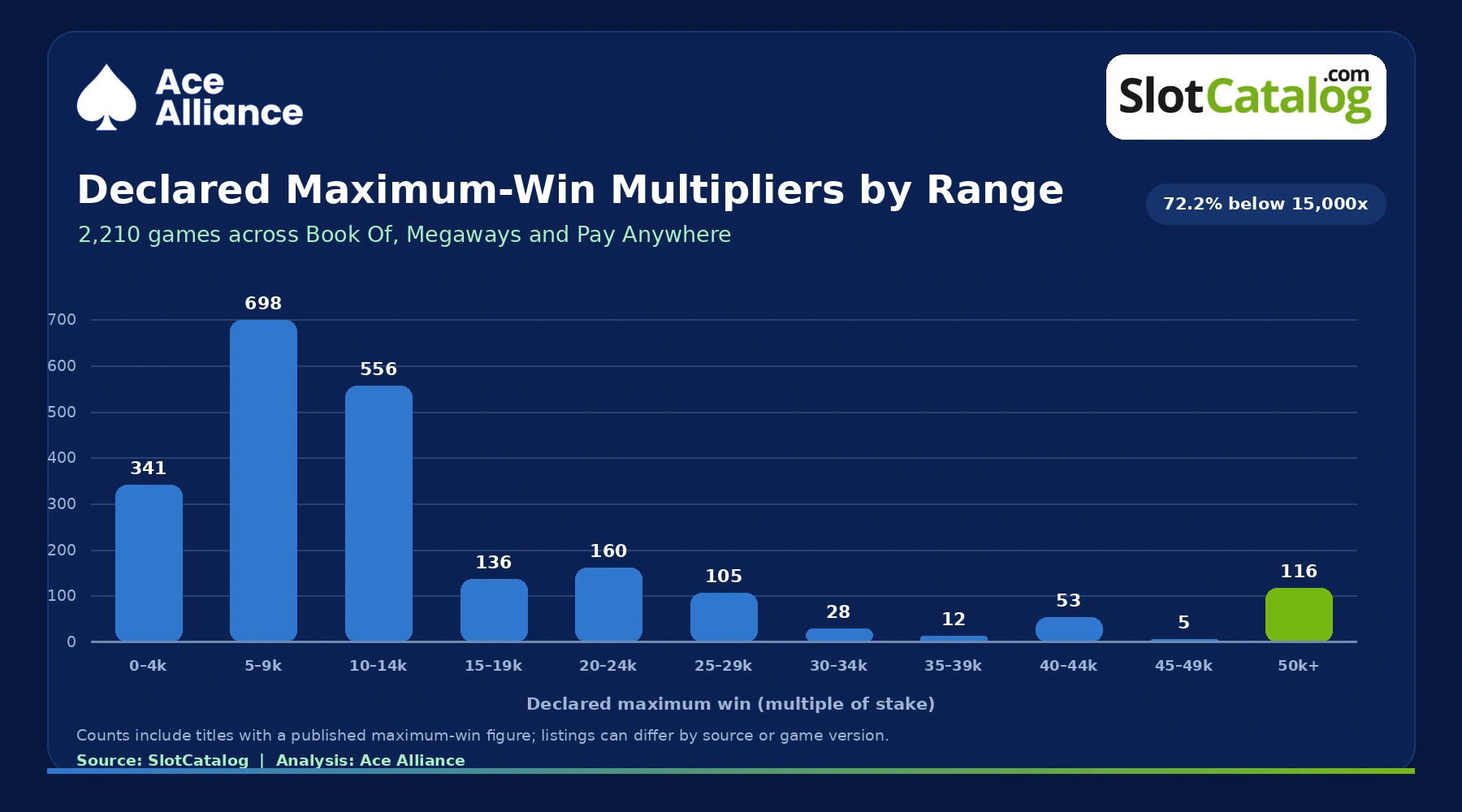
Maximum-win figures provide another point of comparison between the three mechanics. Most titles sit below the highest advertised ceilings, while a smaller group pushes into much larger multipliers.

Figure 5. Distribution of declared maximum-win multipliers across Book Of, Megaways and Pay Anywhere slots.

Approximately 72% of games with a declared maximum win fall below 15,000x, while 116 titles list potential payouts of 50,000x or more. These larger figures represent the upper end of the dataset, rather than the typical title.

Comparing published listings reveals another issue: the same game can carry different maximum-win figures on its provider’s website and its distributor’s catalogue. Selected Big Time Gaming titles illustrate the discrepancy.

Game Provider Declared Max Win:
BTG
Declared Max Win:
Light & Wonder
Fireworks Megaways Big Time Gaming 150,335x 75,830x
Golden Goose Megaways Big Time Gaming 29,030x 150,335x
Max Megaways 2 Big Time Gaming 147,620x 147,620x
Max Megaways Big Time Gaming 139,200x 139,200x

Figures are expressed as multiples of the stake. The comparison records published listings, not independently verified maximum payouts for matching game versions.

The Max Megaways titles agree across the two sources. Fireworks Megaways and Golden Goose Megaways do not. Both figures are retained to make those differences visible, without assuming which listing is correct.

The discrepancy concerns published information, not proof that a game’s underlying maths has changed. Different versions, configurations, or outdated listings could explain the differences, but provider clarification is needed to establish the cause.

For operators, the practical step is to check the documentation for the specific game version before using a maximum-win figure in promotional materials. That figure describes an upper payout limit, not its probability or an expected outcome. It should also be distinguished from RTP and house edge, which describe theoretical long-term returns rather than the largest possible payout.

What This Means For Operators And Providers

The findings point to practical choices in lobby curation and game development. Operators can use them to assess catalogue balance and discoverability, while providers can weigh licensing requirements, competition and opportunities to give their next release a distinct identity.

For Operators

  • Book Of = the deep-catalogue play. 825 titles and 228 producers deep, with decades of recognisable flagships (Book of Dead, Book of Ra) for reliable lobby rotation. A new entrant here has to fight for discoverability in a genuinely crowded field.
  • Megaways = the scarcity play. Licensing keeps the field to 94 studios, so a Megaways badge still signals a bigger production budget even as raw output shrinks. It remains a useful lobby filter and marketing tag precisely because not everyone can use it.
  • Pay Anywhere = the volume-and-growth play. Fastest-growing by far, easiest for casual and mobile-first players to understand (no paylines to explain), and the mechanic almost every new studio reaches for first. It’s also the most crowded lane right now, with a new record month arriving almost every quarter.

For Providers

  • Book Of needs a clear differentiation hook in an 825-title catalogue. That could mean exploring underused mythological characters, developing a different maths model or adopting a more distinctive art style.
  • Megaways stays gated behind Big Time Gaming’s license. That cost of entry, not player fatigue, is the single biggest reason its output is shrinking (135 → 30 releases since 2021) while the number of studios that can legally compete stays capped at 94.
  • Pay Anywhere is the cheapest mechanic to ship (no license fee, no paylines to design or explain), and 204 studios now build nothing else. That also makes it the fastest lane to get crowded: the trajectory it’s on looks a lot like Book Of’s own curve in 2018–2021, right before that market got saturated enough that only the sharpest ideas broke through.

Editor’s Tip: Prioritise Differentiation in Pay Anywhere Slots

Pay Anywhere now leads this comparison in catalogue size and provider adoption. Its continued expansion puts greater emphasis on what each new release adds to an increasingly crowded field.

Editor’s Tip: Prioritise Differentiation in Pay Anywhere Slots

Editor’s Tip: Add a Difference, Not Just Another Title

I’d test every new Pay Anywhere concept against the existing catalogue. Does it change the maths model, introduce a distinctive theme or offer a meaningful feature? If it only adds to the release count, I’d rethink the concept before committing to production.

Darko Ilievski
Darko Ilievski
Editor on Ace Alliance

Want a personalised version of this report? Reach out to Misha Kachanov, CBO at SlotCatalog, to find out more.

Methodology & Data Notes