Ace Alliance Horizon & Speed Rome
Early Bird Passes Available! | November 2, 2026
Get Your Pass!
Table Of Content :

Blask x Ace Alliance Report: UK iGaming Demand After Remote Gaming Duty Rose to 40%

trust
Ace Alliance: Delivering Trust Through Expertise
From exclusive events and interviews to real-time market trends, Ace Alliance brings you unbiased, well-informed, and data-driven content. Our editorial team adheres to strict editorial standards, ensuring that the information you receive is not only relevant but also trustworthy.

Built by market experts hosting events since 2023, with our first event in Riga, Latvia gathering over 300 top level iGaming industry executives, Ace Alliance is able to provide you with reliable information from direct interaction with experts and leaders in the sector.
Darko Ilievski
Lead Editor
Updated:
Reading Time: 6 minutes
UK highlighted on a glowing digital globe, surrounded by iGaming market charts, casino chips and balancing scales.

Four months after the UK raised Remote Gaming Duty from 21% to 40%, Blask data shows no mass migration to offshore operators. Between April and July 2026, overall demand remained close to 2025 levels, while leading licensed brands retained most of their market share. Offshore demand stayed limited despite concerns about reduced bonuses and adjusted RTP rates. The sharper shift came in projected revenue, with offshore brands’ share of CEB reaching 13% in July.

Report

What Blask Data Shows About UK iGaming Demand After the Tax Rise

Blask compared UK market demand, brand share, and projected revenue across April–July 2026 with the same period in 2025. The analysis points to four early patterns:

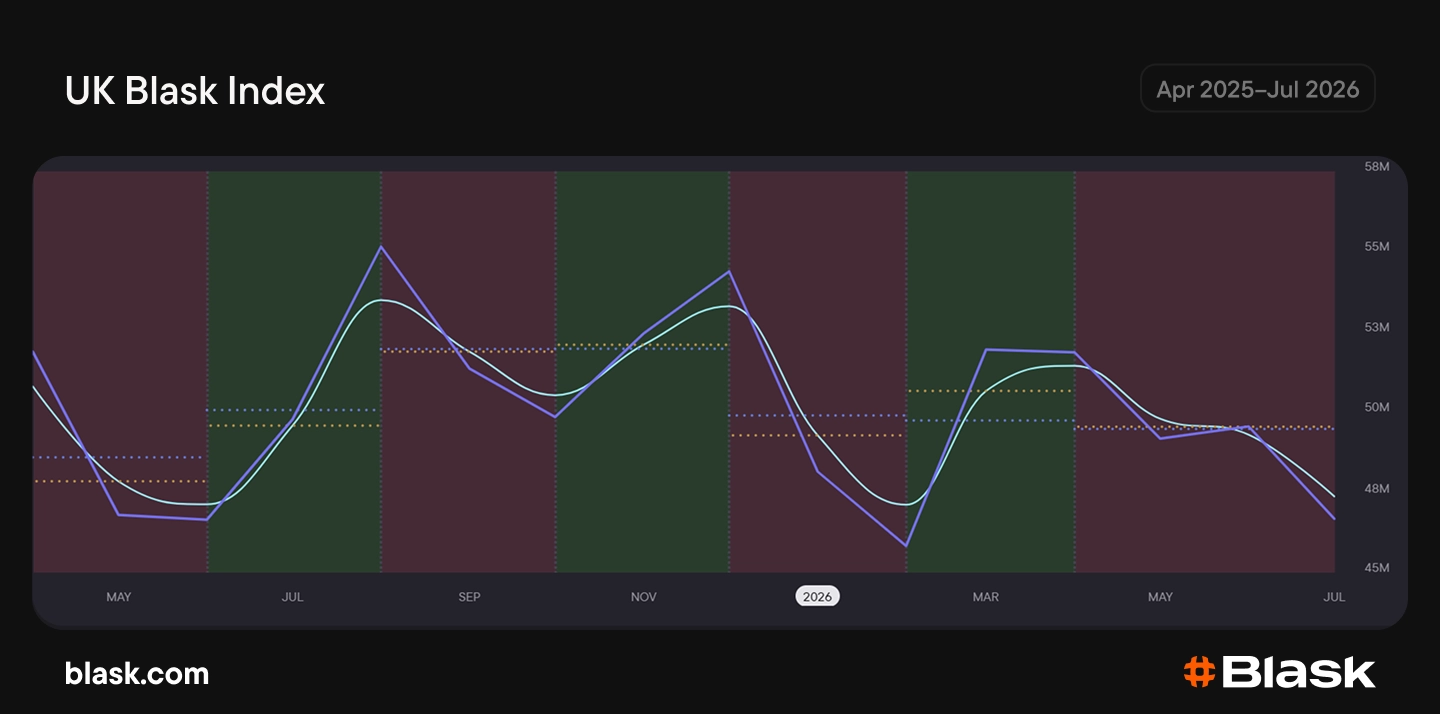
  • Total demand remained stable: the combined UK Blask Index for April–July 2026 was 1.1% higher than in the same four months of 2025.

  • The leading brands kept control: the top 10 accounted for 64% of market demand in July 2026, down only 1.4 percentage points year on year.

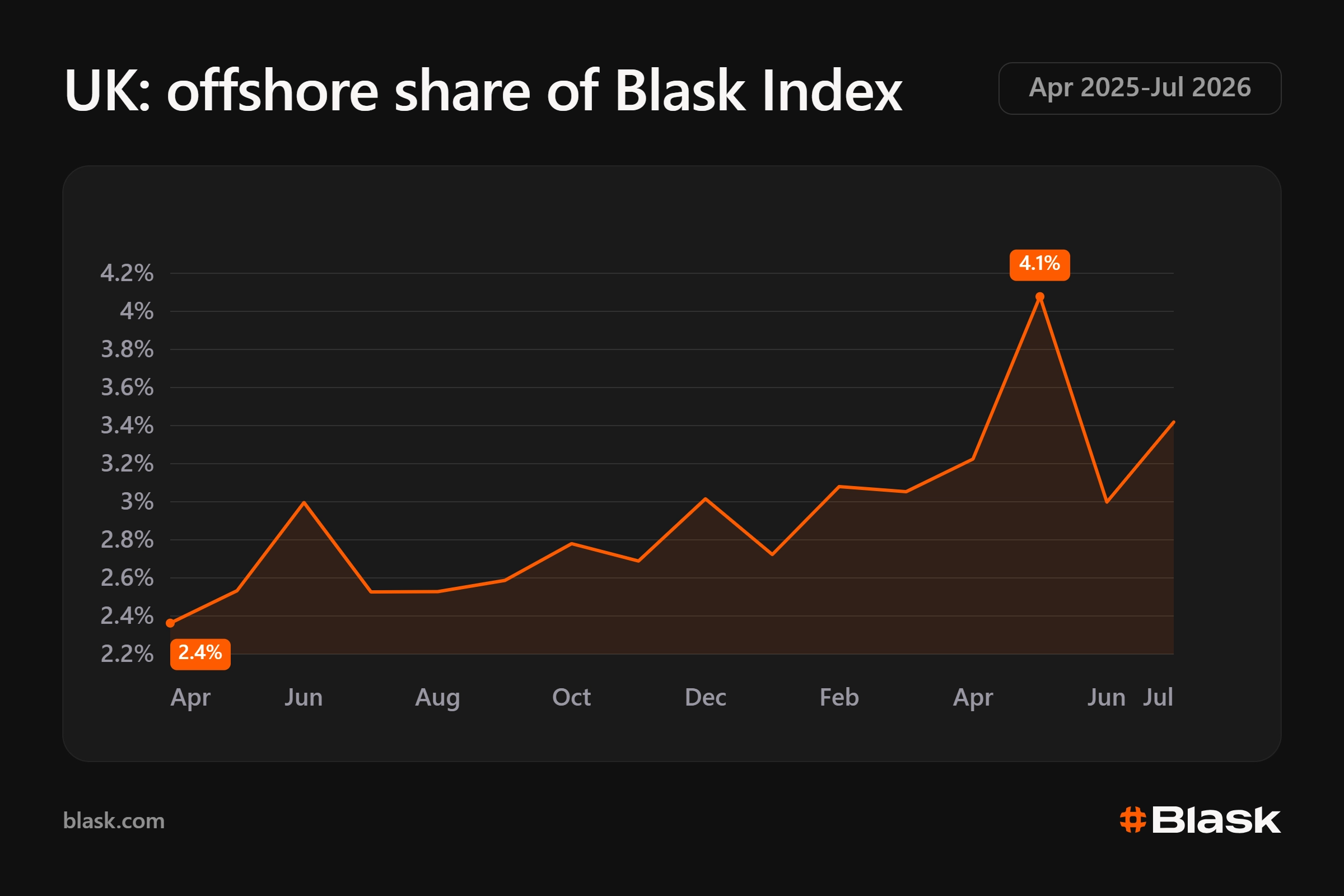
  • Offshore demand grew, but remained limited: offshore operators’ share of the Blask Index rose by 0.8 percentage points to 3.4% across the four-month period.

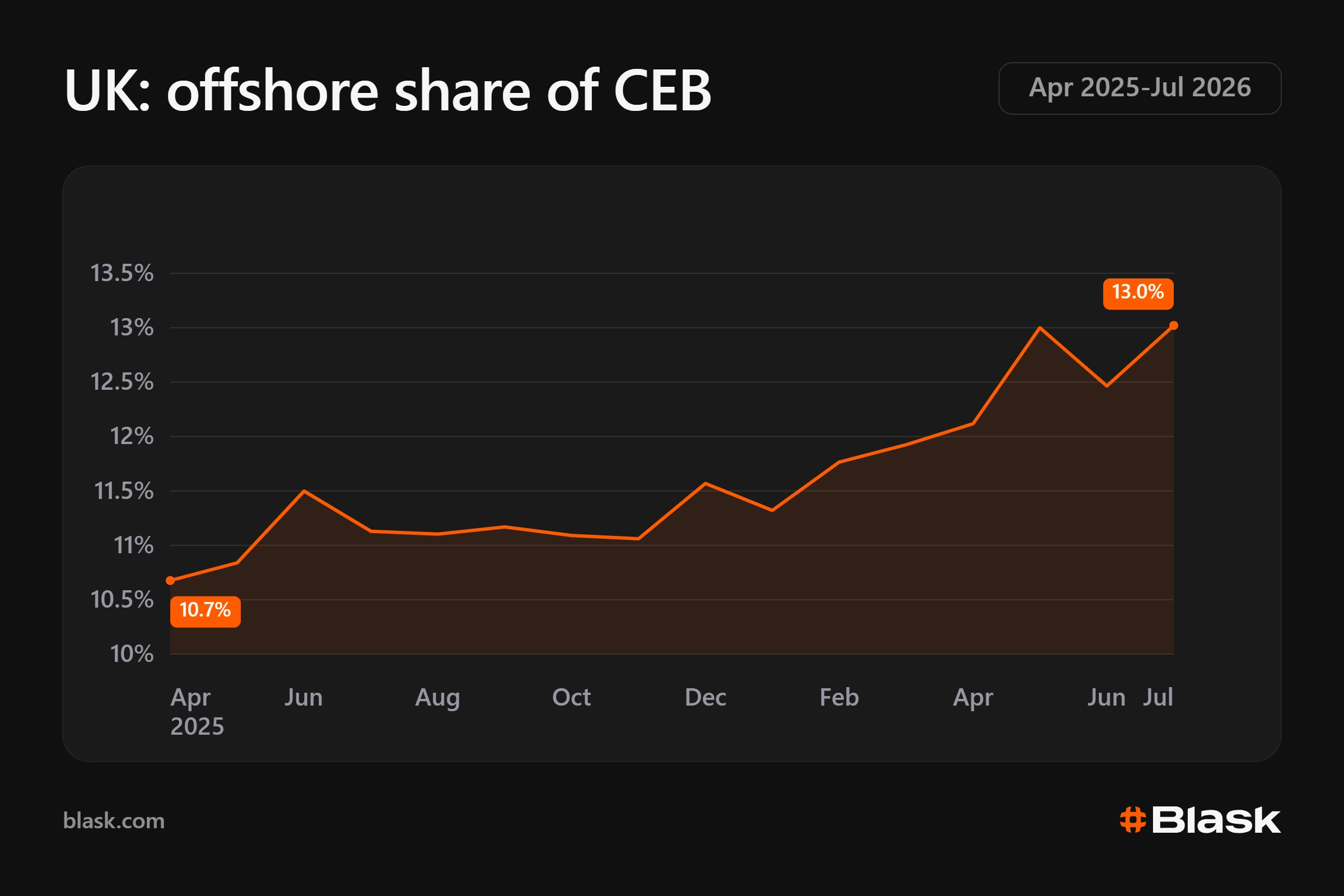
  • Projected revenue shifted more sharply: offshore brands’ share of CEB rose to 13% in July, its highest point in the period analysed.

These figures describe an early market response, not a final verdict on the tax change. They show where brand demand and projected revenue moved after April 2026 but do not prove that taxation alone caused every change.

What the Blask Metrics Measure

The analysis uses three Blask metrics:

  1. Blask Index — a real-time measure of demand for iGaming brands in a country, based on normalised search data.
  2. BAP (Brand’s Accumulated Power) — a brand’s percentage share of total market demand in a specific country and period.
  3. CEB (Competitive Earning Baseline) — Blask’s modelled estimate of the revenue a brand could capture based on its market presence, expressed as a minimum, average, and maximum range in US dollars.

Together, the metrics separate three questions: how much demand exists, which brands hold it, and how that market presence could translate into revenue. This reflects the wider role of data transparency in iGaming: no single metric explains the entire market, but the combination can reveal changes that topline demand alone may hide.

There is also an important limitation. The Blask Index measures demand for iGaming brands, including multi-product operators; it does not isolate casino demand from sportsbook demand in every brand search. The data should therefore be read as a directional view of the UK iGaming market after the RGD increase, rather than a direct causal measurement of tax behaviour.

UK iGaming Demand Held Its Shape

The combined UK Blask Index for April–July 2026 was 1.1% above the equivalent period in 2025. At market level, the tax increase did not coincide with a broad contraction in branded iGaming demand.

The monthly comparison was uneven:

Month Change in Blask Index vs 2025
April Broadly unchanged
May +5.1%
June +6.2%
July −6.2%

May and June were stronger than the same months in 2025, while July reversed that growth. Blask’s broader country-by-country analysis of iGaming demand during World Cup 2026 found that the tournament redistributed demand between markets more than it expanded demand uniformly worldwide.

The World Cup is therefore an important part of the context. As the earlier Blask x Ace Alliance World Cup 2026 demand report showed, major football tournaments can move demand without producing the same effect in every market or throughout the full competition window.

That makes the four-month total more useful than any single month. The aggregate result suggests that UK demand remained resilient, but the July decline shows that the market did not establish a consistently higher post-tax baseline.

UK Blask Index, April–July 2025 vs April–July 2026

The Top 10 UK iGaming Brands Remained Largely Unchanged

The UK’s leading brands also held their positions. Nine of the top 10 brands by Blask Index share in July 2025 remained in the top 10 in July 2026. The only change was at the bottom of the ranking: Betway moved into 10th place, while Betfair slipped to 11th.

There was more movement within the ranking than the top-line list suggests. Bet365 and William Hill recorded the largest declines in BAP among the leading brands, while Paddy Power and Ladbrokes made the largest gains.

Collectively, the top 10 accounted for 64% of UK Blask Index demand in July 2026. That was 1.4 percentage points lower than a year earlier. The decline indicates mild fragmentation, but not a breakdown in the market position of established operators.
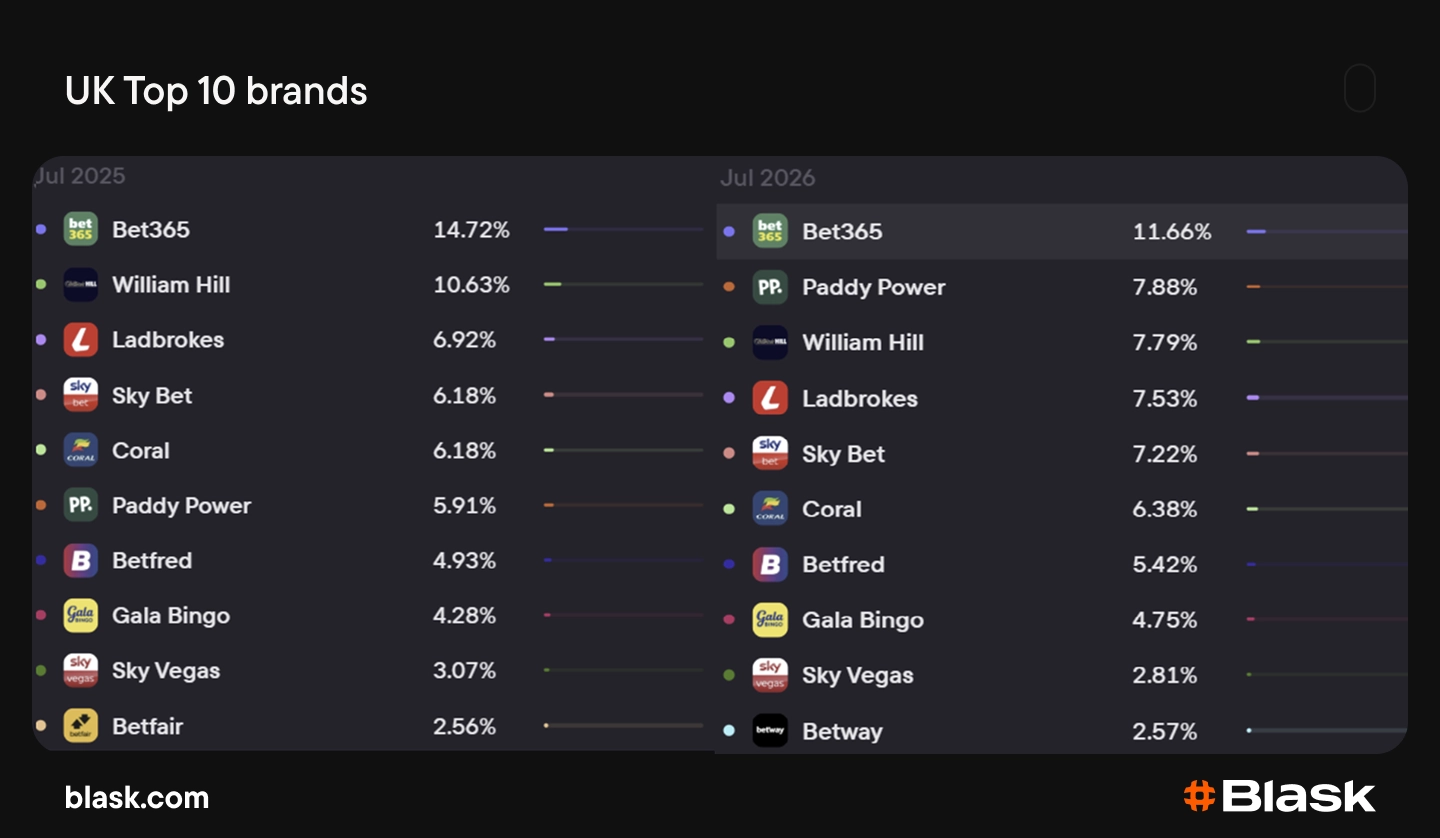
Top 10 UK iGaming brands, July 2025 vs July 2026

Every brand in the July 2026 top 10 was locally licensed. Offshore representation remained limited even deeper in the ranking: only four offshore brands—ART Casino, Goldenbet, Jojobet and Mystake—appeared among the top 50 by demand.

Offshore Demand Rose, but Only at the Margin

The clearest test of the industry’s pre-April warning is whether players shifted their attention towards unregulated operators. Blask data shows some movement, but not a large-scale switch. Across April–July 2026, offshore operators represented 3.4% of the UK Blask Index. That was 0.8 percentage points higher than during the same period in 2025.

May deserves attention. Offshore brands reached 4.1% of the monthly Blask Index, their highest share since autumn 2019. Even at that peak, however, licensed operators continued to account for more than 95% of branded demand. The early evidence, therefore, supports a measured conclusion: offshore demand increased but remained peripheral to the overall UK market.

UK offshore share of Blask Index

Projected Revenue Shifted Faster Than UK iGaming Demand

Demand share tells only part of the story. Offshore operators represented a small part of the Blask Index, but a much larger share of CEB. Their share of projected revenue increased throughout the period and reached 13% in July 2026—the highest level recorded in the analysis. That creates a clear gap between offshore demand share and offshore revenue potential.

The UK nevertheless remains considerably more heavily channelised than the markets examined in Blask’s recent US iGaming analysis and Canada iGaming report, where offshore brands accounted for most projected revenue in H1 2026. This does not mean offshore brands captured 13% of actual UK operator revenue. CEB is a modelled baseline, not reported financial performance. It does suggest, however, that the commercial weight associated with offshore brands was growing faster than their share of search demand.

That distinction matters in a higher-tax environment. Licensed operators may retain broad visibility while facing greater pressure on the value generated from that demand. Taxes, bonuses, acquisition costs, and player payouts all affect what an operator ultimately keeps, which is why market demand should be considered alongside measures of net gaming revenue.

the-larger-shift-appeared-in-projected-revenue

What the First Four Months Mean for UK iGaming Operators

Four months is too short a window for a definitive assessment, but the data gives licensed operators three signals to monitor.

Brand Strength Still Provides Protection
The stability of the top 10 shows that established operators did not lose their market position immediately after the tax increase. Strong brand recognition and local licensing remain significant competitive advantages.
Small Demand Shifts Can Carry Greater Commercial Weight
The offshore Blask Index share remained low, but the CEB share rose much faster. Operators and regulators should therefore monitor the quality and projected value of offshore demand, not only its absolute volume.
April 2027 Creates the Next Test
The 40% rate currently applies to remote gaming. From 1 April 2027, the new 25% remote General Betting Duty rate will extend the cost pressure to most online sports betting. That could change pricing, promotional strategy, and market economics across multi-product brands.

The next phase of analysis should examine whether offshore demand remains near current levels, whether the July decline continues beyond the World Cup period, and whether the gap between offshore Blask Index share and CEB share widens.

UK iGaming Demand Held Firm, but the Economics Shifted

Four months into the UK’s 40% Remote Gaming Duty regime, Blask data shows resilience rather than rupture. Demand between April and July remained 1.1% above the same period in 2025, while licensed operators continued to dominate: the top 10 brands held 64% of the Blask Index in July, and offshore brands captured just 3.4% of demand across the four months.

Yet demand tells only part of the story. Offshore operators accounted for 13% of CEB in July, indicating that their relatively small audience may carry disproportionate revenue potential. Measuring that audience remains difficult: a recent UKGC update on illegal gambling trends found fluctuating rather than sustained growth through February 2026 and warned that increased VPN use makes absolute offshore activity harder to quantify.

The tax rise has not redrawn the UK iGaming market, but the distribution of its projected commercial value may be shifting. With the remote betting duty increase arriving in April 2027, the next question is not simply whether more demand moves offshore, but whether offshore brands continue to gain a disproportionate share of projected revenue.

About Blask

Blask is an AI-powered platform for iGaming and gambling market analytics. The company turns fragmented open-source signals into real-time insight on brand visibility, player demand, and baseline revenue metrics, helping teams move first, spend smarter, and reduce risk across global markets.