Ace Alliance Horizon & Speed Rome
Sold Out! | November 2, 2026
Event Details
Table Of Content :

Brazil’s iGaming Market After Lula’s Re-Election: What Comes Next?

trust
Ace Alliance: Delivering Trust Through Expertise
From exclusive events and interviews to real-time market trends, Ace Alliance brings you unbiased, well-informed, and data-driven content. Our editorial team adheres to strict editorial standards, ensuring that the information you receive is not only relevant but also trustworthy.

Built by market experts hosting events since 2023, with our first event in Riga, Latvia gathering over 300 top level iGaming industry executives, Ace Alliance is able to provide you with reliable information from direct interaction with experts and leaders in the sector.
Darko Ilievski
Lead Editor
Updated:
Reading Time: 10 minutes
Brazil’s iGaming outlook after Lula’s re-election, with Planalto Palace and a gold map of Brazil.

Brazil’s iGaming market faces a prolonged interruption after Lula’s re-election, with a swift licensed reopening looking unlikely. Decisions by Congress and the courts could still change that outlook.

Blask’s data and lessons from India and Albania help assess where player interest could move and what recovery might involve for operators, affiliates and suppliers.

Regulation & Compliance

What Lula Has Said About a Market Reopening

Lula’s latest comments provide little indication of a voluntary reversal by the executive. Lula has given little sign that he plans to reverse the ban. According to Estadão/Broadcast, he said during a livestream on 22 October:

Betting platforms will not return.

He framed the issue around household finances and the effects of betting on poorer families.

That statement supports an expectation of continued executive opposition to reopening. It cannot settle the outcome of court proceedings or congressional negotiations. For commercial planning, any return would need a clear legal basis and operating conditions that companies could assess before committing resources.

Where Brazil’s Market Stands Today

Blask’s figures show a steep fall in Brazil’s measured search interest following the shutdown. Offshore brands briefly gained attention after licensed sites closed, but ended 19–25 October below their pre-ban level.

How Brazil’s Betting Shutdown Unfolded

The prohibition covers fixed-odds sports betting and online casino games, including services targeting Brazilian players from abroad. The shutdown progressed through three main stages:

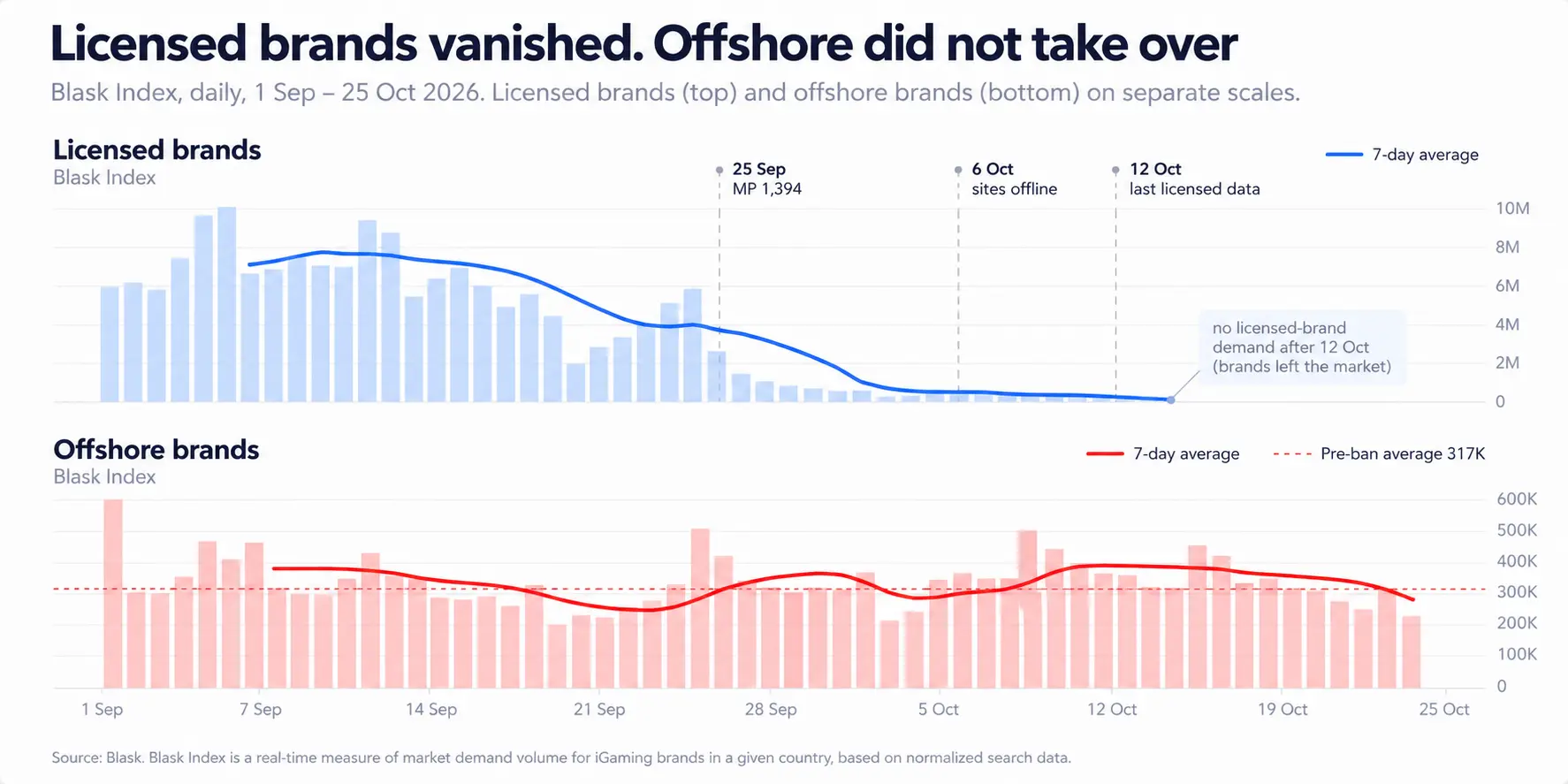
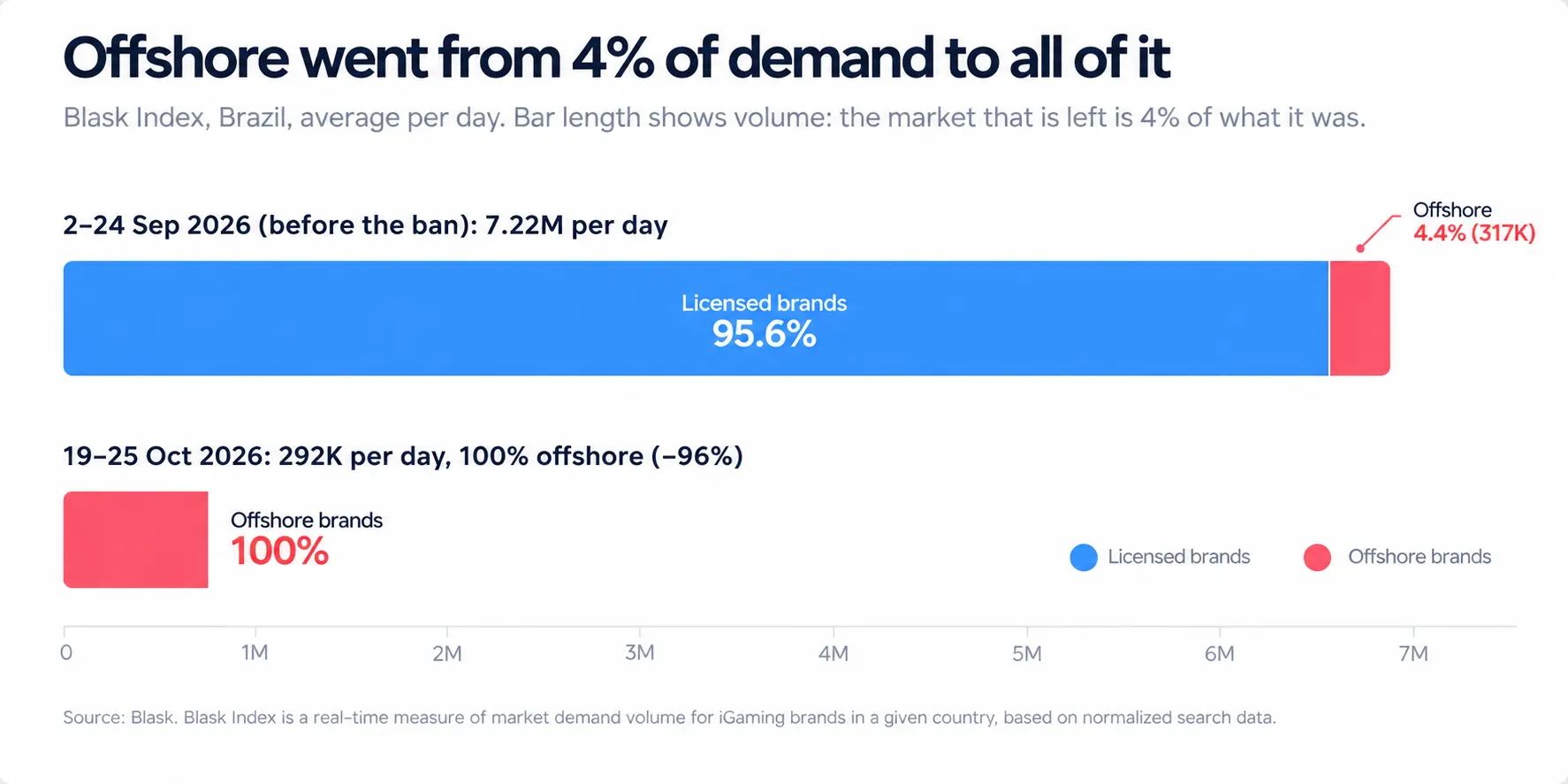
Before the ban, licensed brands accounted for 6.90 million of Brazil’s 7.22 million average daily Blask Index during 2–24 September.

Licensed-brand interest averaged 846,000 a day during 6–11 October, down 88% against that baseline. It fell to approximately 137,000 on 12 October. From 13 October, Blask’s supplied total consists of offshore-brand interest only.

Chart showing Daily Blask Index for licensed and offshore brands, 1 September–25 October 2026.

Offshore Search Interest Remains Below Pre-Ban Levels

Average daily interest in the tracked offshore brands rose 22% to 385,000 during 6–11 October, then declined. By 19–25 October, it averaged approximately 292,000, down 8% from the pre-ban baseline.

The comparison covers the same group of offshore-labelled brands throughout.

Offshore brands’ share of Brazil’s Blask Index rises from 4.4% to 100% as total interest falls 96%.

Offshore brands therefore accounted for 100% of the remaining measured interest, despite attracting less search interest than before the prohibition. Their larger share does not establish a corresponding transfer of customers or spending from licensed operators.

Search Interest Is Close to 2019 Levels

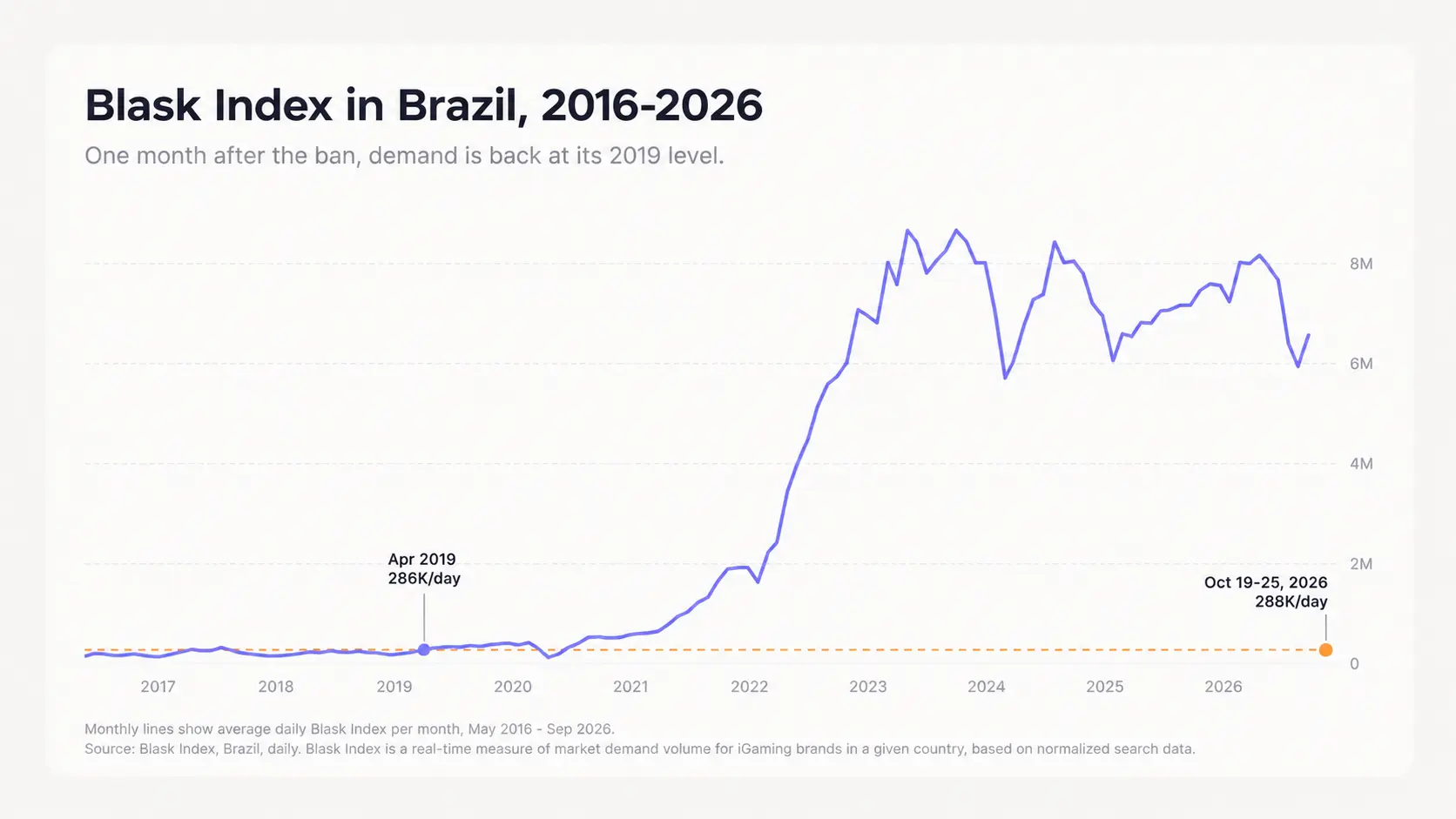
Blask’s reported total for 19–25 October was 96% below the pre-ban daily average. At approximately 292,000 a day, it was close to April 2019’s reading of 286,000.

For context, monthly daily averages between January 2025 and September 2026 never fell below 5.86 million, recorded in August 2026.

Chart showing  Monthly average daily Blask Index since January 2025, with April 2019 and 19–25 October 2026 comparisons.

These figures measure search interest in tracked brands. They do not establish equivalent changes in player numbers, deposits or revenue.

Jobs and Investment Face Continued Pressure

A prolonged shutdown could bring further job losses, reduced investment and more pressure on suppliers. With Lula maintaining his opposition to reopening, businesses face uncertainty over whether licensed operations will return.

Job Losses Extend Beyond Operators

Folha reported on 6 October that at least 36 of 188 formerly authorised brands had undertaken layoffs by 5 October, citing an AMIG survey. H2Bet reportedly dismissed 170 of its 270 employees, according to its chief operating officer.

These figures describe cuts at particular businesses, rather than a current industry-wide total. The survey excluded suppliers, although Folha also identified staffing reductions among marketing and events businesses.

Flutter Faces Different Pressures in Brazil and the UK

Flutter provides a direct example of financial exposure in Brazil. In its 28 September response to the ban, the group estimated that remaining unable to operate for the rest of 2026 would reduce revenue by approximately $70 million and adjusted EBITDA by $20 million.

The group’s UK and Ireland restructuring plans, announced on 20 October, could result in up to 1,400 redundancies, subject to consultation. Flutter attributed the plans to higher UK gambling taxes.

The pressures differ: Flutter’s UK business continues operating under higher taxation, while Brazil’s licensed sector faces restrictions on operating permission. Both cases illustrate how changes to operating conditions can affect staffing and investment.

The Costs of Continued Restrictions

Businesses are also reconsidering where they invest and what they retain in Brazil. In Blask’s report on the ban, Luiz Felipe Correia de Almeida, CEO of Smart Social, says client budgets are shifting mainly to other Latin American markets. He argues that preserving creator and partner relationships, networks and data could help brands return if the market reopens. Ricardo Bianco Rosada, founder of brmkt, makes a similar case for maintaining the underlying business: “Freeze, but do not dismantle.” In his view, rebuilding a Brazilian entity, team and payment infrastructure would cost more than keeping them in place during the shutdown.

Where Player Interest Could Go Next

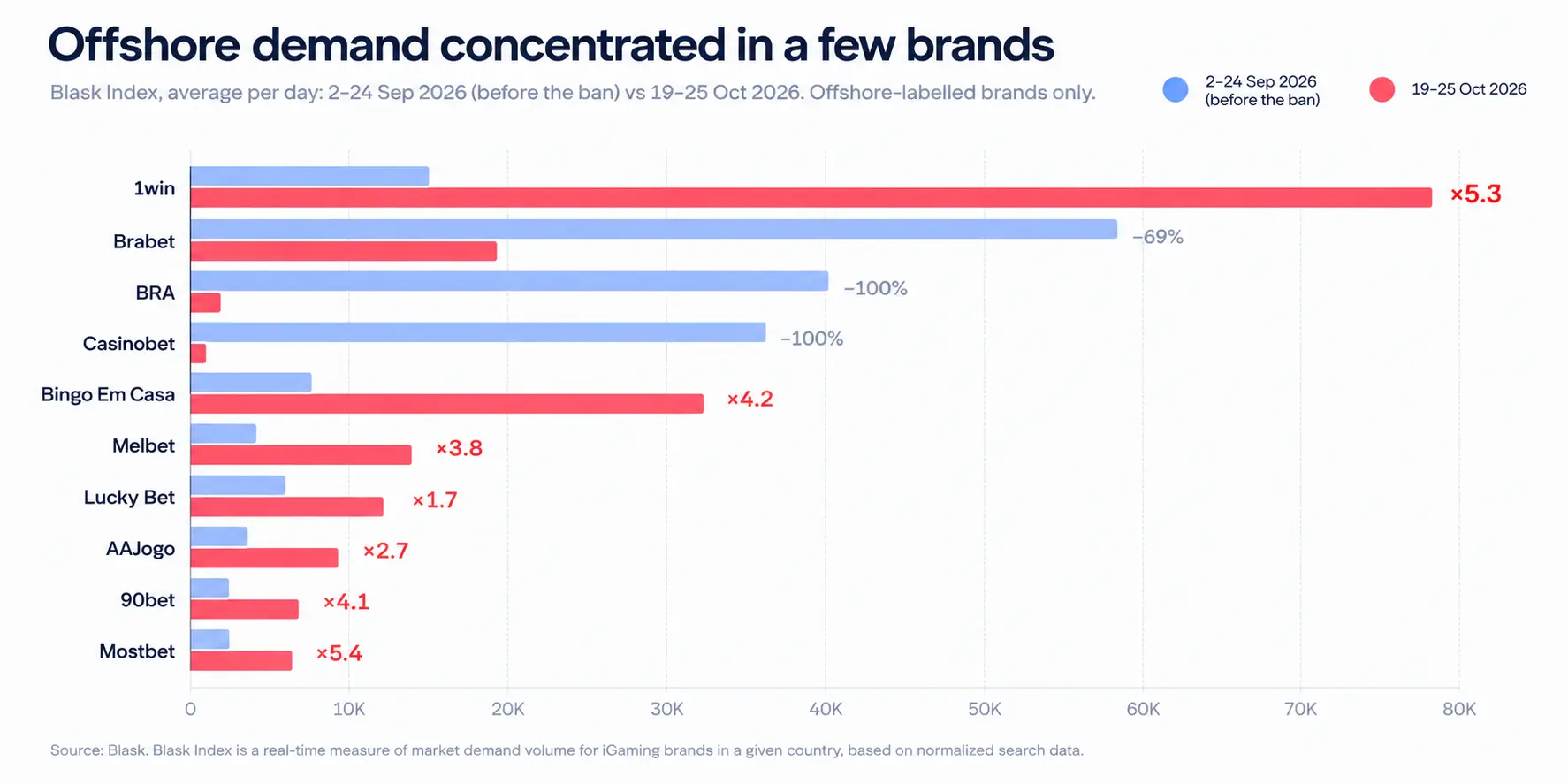
Within Brazil’s smaller offshore segment, search interest shifted sharply between brands. Some attracted substantially more attention than before the ban, while several former leaders lost visibility. Whether those gains persist will help establish where the remaining interest is settling.

1win Becomes the Leading Offshore Brand

1win averaged 84,856 a day during 19–25 October, reaching 5.3 times its pre-ban level. Its share of tracked offshore search interest increased from 5.0% to 29.0%.

Other brands also recorded gains:

Graph showing offshore demand concentrated in a few brands.

Brabet and Other Brands Lose Ground

Brabet, the largest offshore brand before the ban, experienced a 69% decline, from 62,055 to 18,951 average daily Index points. Its share of offshore interest fell from 19.6% to 6.5%.

Blask also reports no measurable interest in BRA, Casinobet and RealBet during 19–25 October. Together, those offshore-labelled brands had averaged approximately 98,000 a day before the prohibition.

What the Concentration Figures Show

The change in leadership made the largest brand more prominent, although concentration did not increase across every measure.

Measure 2–24 September 19–25 October
Leading brand’s share 19.6% — Brabet 29.0% — 1win
Top three brands’ combined share 42.8% 46.5%
Top five brands’ combined share 56.6% 54.7%

Source: Blask. Shares refer to tracked offshore-brand search interest.

The leading brand and top three gained share, while the top five’s combined share edged down. Blask’s HHI concentration measure also increased, from 825 to 1,097, indicating a more uneven distribution of interest across the segment overall.

For the market outlook, the next question is whether the gaining brands retain that interest across subsequent reporting periods.

What Previous Bans Can Tell Us

India illustrates how search interest and website use can move differently during a ban. Albania shows how legal reform can precede an operational licensed market. Both provide context for Brazil, although differences in products, enforcement and timing limit direct comparisons.

India: Offshore Website Use Continued After the Ban

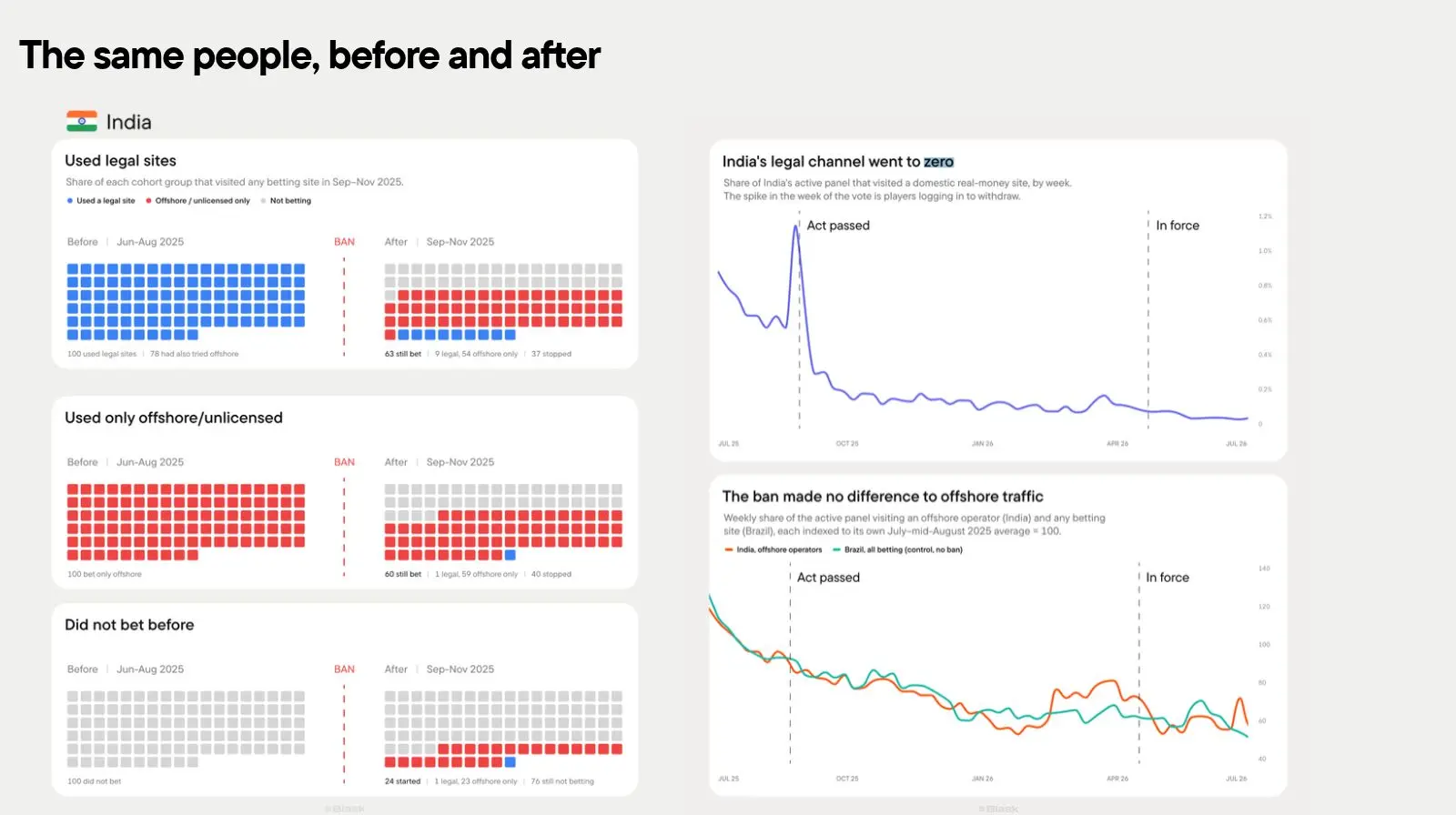
India passed its Promotion and Regulation of Online Gaming Act in August 2025, with implementing rules coming into force on 1 May 2026. Blask examined behaviour around both stages, using Brazil as a comparison market before its own shutdown.

Its browsing-panel research found:

Blask charts comparing betting-site use in India before and after the ban, with Brazil as a control.

Methodology: The fixed-cohort analysis covered 19,924 participants in India and 31,785 in Brazil. The wider opt-in browsing panel was approximately 90% desktop. Website visits do not establish whether users placed bets.

India: Search Interest Fell as Traffic Sources Changed

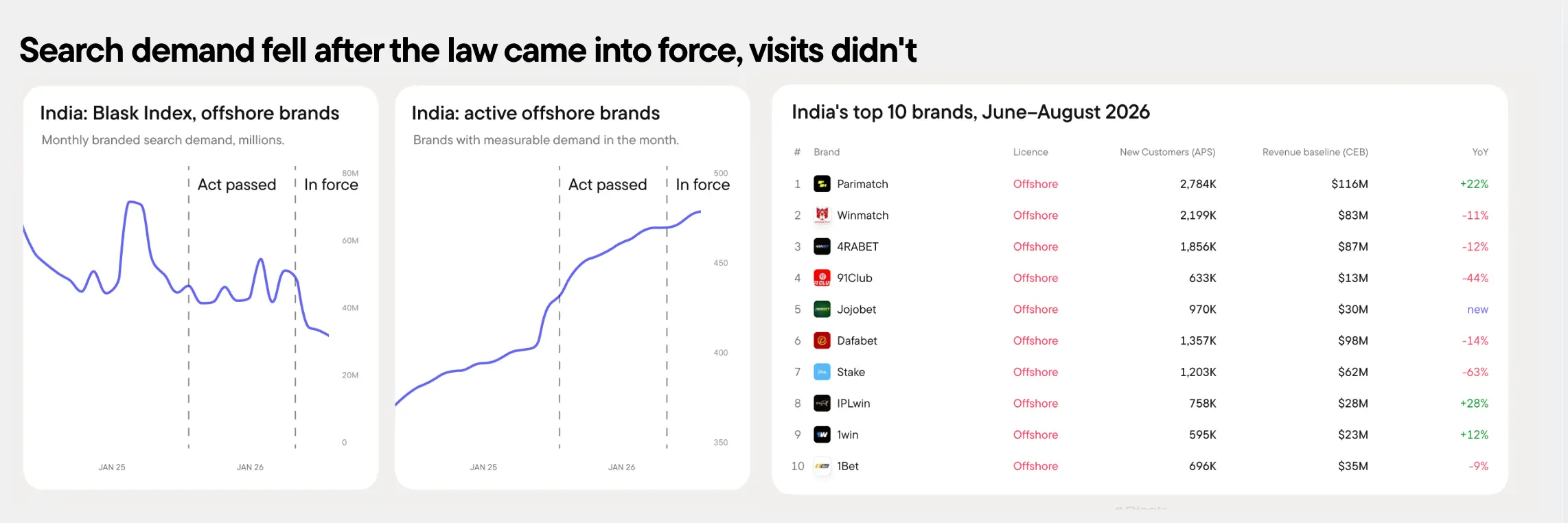
Search data showed a different pattern. Offshore-brand interest initially fell 11% in September 2025, then recovered. By August 2026, however, it was 33% below August 2025, while the number of brands with measurable interest increased from 431 to 478.

Blask’s traffic-source analysis also found a change in how visitors reached offshore sites:

Falling offshore search interest in India alongside more active brands and a top-ten operator table.

Together, these observations show why weaker branded search cannot establish an equivalent decline in website use. They also caution against interpreting search data alone as evidence that gambling activity has stopped.

Brazil’s own post-ban browsing observations cover only 25 September–1 October. By 1 October, licensed-site reach was 74% below normal. That short reporting window cannot yet support a comparison with India over matching periods after each ban.

Albania: Legal Reform Took Time to Implement

Albania’s betting ban took effect in 2019. Parliament approved a restricted return of online sports betting in 2024, under the same prime minister, Edi Rama, with a maximum of ten licences.

Further implementation steps followed:

The sequence illustrates the time that can separate legislative approval from licensed operations. Any future Brazilian reform would need to resolve its own permitted products, authorisations and operating rules.

Albania: Offshore Search Interest Continued

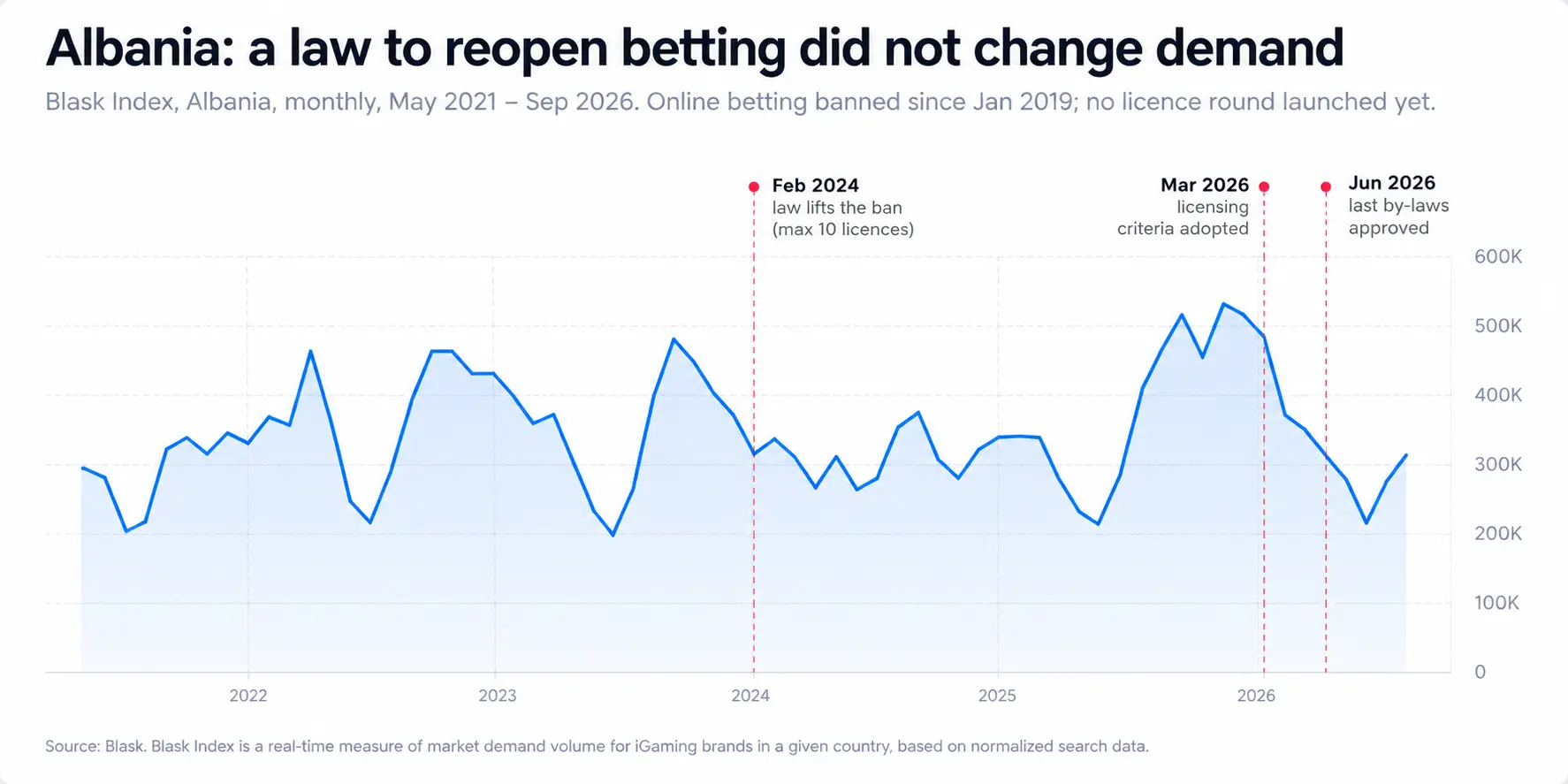
Blask recorded continuing interest in offshore brands throughout its available Albanian dataset. Between May 2021 and September 2026, the monthly Index ranged from approximately 209,000 to 515,000.

The averages show continuing activity around the 2024 reform, without a sustained increase immediately afterwards:

Period Average monthly Blask Index
February 2023–January 2024: before the vote 358,000
March 2024–February 2025: after the vote 324,000
March 2025–February 2026 383,000

Source: Blask.

Albania’s monthly Blask Index, 2021–2026, marking the 2024 betting reform and 2026 licensing rules.

Coverage: May 2021–September 2026, with 27–58 brands tracked. Earlier data cover a single brand, so the chart cannot show the initial effect of the 2019 ban. Changes in brand coverage also need to be considered when comparing periods.

Albania’s experience illustrates how offshore interest can persist while a licensed framework remains unfinished. It does not establish a timetable for Brazil or guarantee that its market would follow the same path.

Possible Paths for Brazil’s iGaming Market

The three scenarios below explore Brazil’s outlook, with continued disruption as our near-term base case. Congress or the courts could still change the prohibition.

During Lula’s first term, Provisional Measure 168 banned bingo and slot-machine operations in February 2004. The Senate rejected it that May by 32 votes to 31, but legal uncertainty persisted, with some venues operating under court injunctions.

Quoted in Blask’s report before the election, Ricardo Bianco Rosada, founder of brmkt, expected the current measure to change or lapse. He warned, however, that Brazil could again be left without a workable replacement framework.

For operators, the key question is whether any change provides a practical route back to licensed activity, with clear authorisations, permitted products and conditions for restarting operations.

Continued Restrictions

If the prohibition remains in force and no alternative permission to operate is established, licensed activity stays interrupted. This remains our near-term base case, given Lula’s stated opposition to reopening.

India’s experience shows that offshore website use can continue after domestic operators withdraw. Brazil’s response still needs to be assessed on its own evidence: offshore-brand search interest remained below its pre-ban level during 19–25 October. The indicators to watch are whether offshore reach expands, which brands retain attention and how enforcement affects access.

A Narrower Reopening

A legislative compromise or court decision could allow selected products or operators to return. The commercial effect would depend on permitted activities, licence eligibility and restrictions on advertising and acquisition.

Blask points to Brazil’s initial licensing transition as evidence that established brands can enter a regulated framework quickly. According to its analysis, brands representing 92% of tracked search interest obtained licences within a month during the January 2025 transition.

That history indicates interest in licensed access, but the terms of any future reopening would determine participation. Any change would also need to clarify whether previous authorisations could be restored or new approvals would be required. During the interruption, audiences may continue developing relationships with offshore alternatives.

Broader Restoration

A broader return of sports betting and online casino games would require decisions resolving both operating permission and the status of authorisations. Commercial recovery would then depend on which operators return, the products they offer and how quickly customers respond.

Blask highlights the practical consequences of winding down local operations. Operators that have reduced staffing, ended sponsorships or dismantled supplier arrangements could take longer to return. Rebuilding those relationships and capabilities could delay recovery even if broad operating permission is restored.

Dates to watch across all three scenarios:

Neither date guarantees a reopening or a final legal settlement.

What Would Indicate Recovery

Recovery would require both confirmed operating permission and sustained commercial activity. The main signals to watch are:

Evolution’s temporary closure of its Brazilian studio illustrates the operational capacity suppliers would need to reassess if licensed activity returns.

What Stake’s Brief Reopening Shows

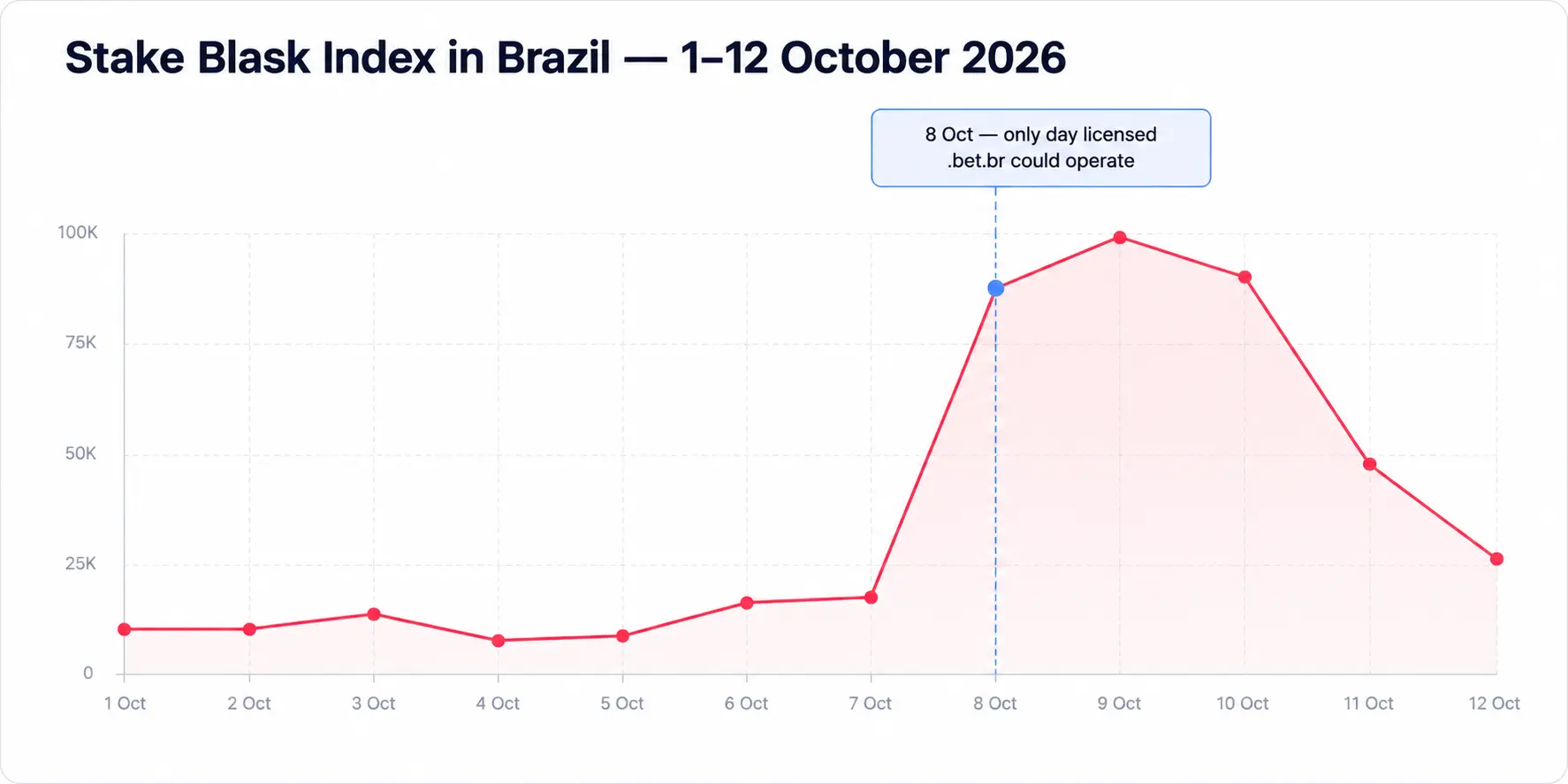
Stake’s temporary exemption illustrates why search interest needs to be assessed alongside operating status. A court order allowed it to operate on 8 October, before TRF-3 suspended that permission on 9 October.

Its Blask Index reached 87,600 on 8 October, peaked at 98,900 on 9 October and remained at 89,500 on 10 October, before falling to approximately 25,000 by 12 October.

Chart of Stake’s daily Blask Index in Brazil, 1–12 October 2026.

Interest remained elevated beyond the withdrawal of operating permission. The spike therefore shows attention to the brand, rather than confirming sustained betting activity or recovery.

Jeffrey Haas, Chairman of the Board of Advisors, Blask said:

Judge a ban by what people do afterwards, not by the number of blocked URLs or falling search volumes.

How Blask Will Monitor Changes

Blask plans dated updates against the 19–25 October baseline of approximately 292,000 a day, which covers offshore brands only. These will track:

Website reach will be reported separately using Blask’s behavioural panel.

The planned reporting windows cover 26 October–1 November, the period after the 3 November court hearing, and developments around the 23 November congressional deadline. These milestones provide opportunities to reassess conditions; neither guarantees a reopening.

Continued disruption remains our near-term assessment, subject to any confirmed change in operating rights.

Data and Methodology

The Blask Index measures search-based interest in tracked iGaming brands, rather than player numbers, deposits or revenue. Daily readings and period averages are identified in the accompanying charts.

Brazil’s brand groups follow Blask’s September 2026 licence labels: local or mixed licences for the licensed group, and international-only licences for the offshore group. These historical classifications do not establish current operating permission.

Blask revises recent figures as data settles. The pre-ban offshore baseline covers 2–24 September, excluding a one-day spike on 1 September.

Browsing findings for India and Brazil come from a separate opt-in panel, approximately 90% desktop, and are not part of the Blask Index.

References